What Is Batch Cooking and Why Is It Different from Meal Prep?
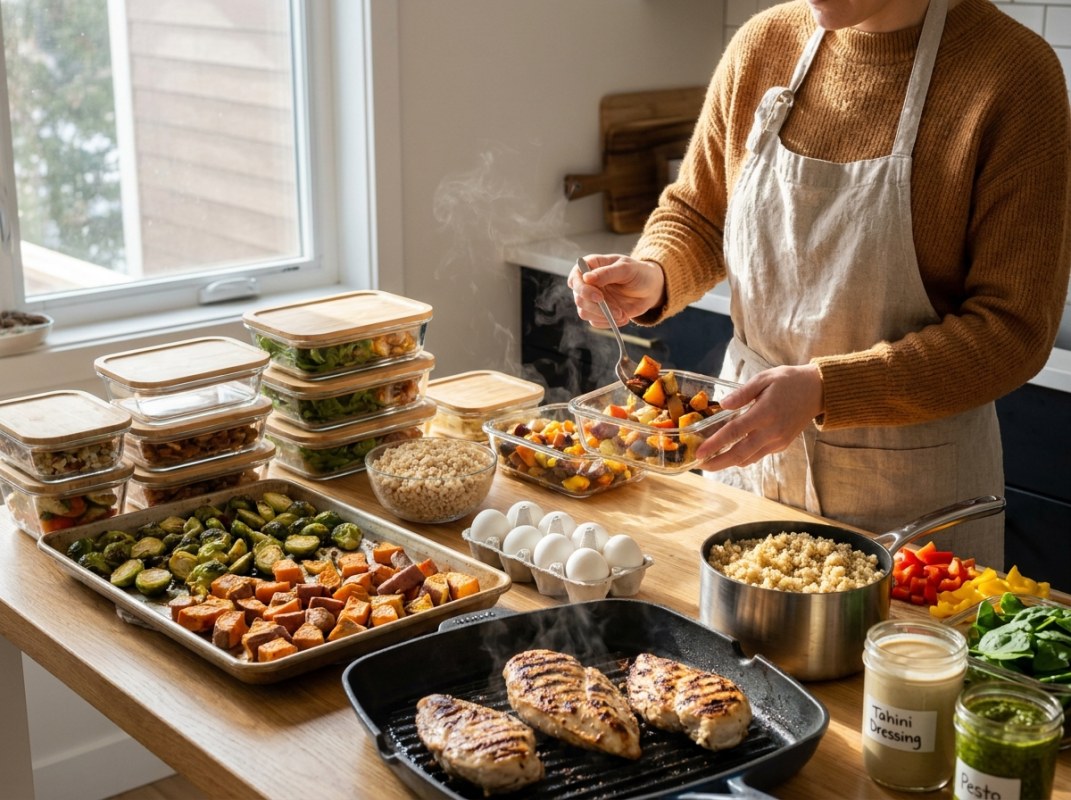
Batch cooking is the practice of cooking large quantities of individual food components — proteins, grains, roasted vegetables, sauces — in a single session, then combining them into different meals throughout the week. It differs from traditional meal prep in one important way: instead of assembling complete, identical meals in containers, you create flexible building blocks that can be mixed and matched.
Traditional meal prep: five identical chicken-and-rice bowls in five identical containers. Batch cooking: one big batch of cooked chicken, one big batch of rice, two trays of roasted vegetables, and a sauce — from which you make chicken fried rice on Monday, a rice bowl with roasted veg on Tuesday, a chicken wrap on Wednesday, a grain salad on Thursday, and a quick stir-fry on Friday.
The same ingredients, completely different meals, zero weekday cooking beyond reheating. This is why batch cooking is the system that most people actually stick to long-term — it solves the number one reason people abandon meal prep: eating the same food five days in a row gets boring fast.
Why Sunday Is the Best Day for Batch Cooking
Sunday works for batch cooking because it sits between the grocery shop and the workweek. Most people grocery shop on Saturday or Sunday morning, which means ingredients are fresh and quantities are correct. The afternoon is typically the most unstructured time of the week, with 2–3 hours available before Monday arrives.
The psychological benefit of Sunday batch cooking is also significant. Research consistently shows that people who begin their week with a structured evening Sunday routine report lower stress levels on Monday through Wednesday, because foundational decisions — what to eat, whether there is food — have already been resolved. That cognitive load is not trivial. Nutritional psychologists estimate that food-related decisions account for over 200 choices per day for the average person. Removing breakfast, lunch, and dinner from that pool for five days frees up measurable mental energy.
If Sunday genuinely does not work for your schedule, the system functions equally well on any other day. The critical factor is consistency — a fixed weekly batch cooking session that becomes a habit rather than a decision. Many people find that choosing a day and making it a ritual (with music, a coffee, a podcast) makes it sustainable in a way that sporadic meal prep sessions never were.
The Batch Cooking Foundation: 4 Food Categories to Always Prep
Every effective batch cooking session produces components across four categories. These are not specific recipes — they are categories. Within each category, what you cook varies week to week based on what is on sale, what is in season, and what you actually want to eat. Covering all four categories ensures that you can build complete, balanced meals throughout the week without gaps.
Category 1: Proteins — The most time-consuming component to cook from scratch, which is exactly why it belongs in the batch cooking session. Good batch proteins are ones that reheat well and can be used in multiple ways: chicken thighs (roasted, shredded for wraps, added to salads), ground turkey or beef (cooked with onion and garlic, becomes taco filling, pasta sauce, or bowl topping), hard-boiled eggs (breakfast, snack, or salad protein), baked salmon or cod, or a large batch of lentils or chickpeas for plant-based protein. Cook your protein until just done — slightly undercooking proteins that will be reheated prevents them from becoming dry and tough.
Category 2: Grains and Starches — These form the caloric base of most meals and take the longest to cook with the least active involvement. Brown rice (45 minutes, minimal effort), white rice (18 minutes), quinoa (15 minutes), farro, barley, or sweet potatoes. Cooked grains store excellently for 5 days in the refrigerator and can be frozen for up to 3 months. The trick with batch-cooked rice is to cool it completely before storing — hot rice in a sealed container continues to steam, leading to clumped, mushy results. Spread it on a baking sheet to cool for 15 minutes, then portion into containers.
Category 3: Roasted Vegetables — The most flexible category and the one that most dramatically improves weekday eating. A 425°F oven and two large sheet pans can roast 4–6 different vegetables simultaneously in 20–30 minutes. Broccoli, Brussels sprouts, cauliflower, zucchini, bell peppers, cherry tomatoes, red onion, asparagus — all roast beautifully and reheat in 60 seconds in a microwave or 5 minutes in a hot pan. Roasted vegetables store for 4–5 days and add fiber, micronutrients, and satiety to any meal.
Category 4: Sauces and Flavor Agents — This is what transforms identical components into different meals. A batch of tahini-lemon sauce makes a grain bowl feel like a different dinner than the same grain bowl with a teriyaki glaze. Batch cooking one or two sauces — pesto, tomato sauce, a soy-ginger marinade, a curry base — costs 10 extra minutes and completely changes how versatile your week can be. Sauces store well for 5–7 days and most freeze effectively.

The Exact Sunday Batch Cooking Timeline
The most common mistake in batch cooking is working sequentially — finishing one thing before starting the next. Effective batch cooking runs multiple processes simultaneously, using the oven, stovetop, and passive time (like waiting for rice to cook) in parallel. Here is a reliable 2.5-hour timeline:
Minute 0 — Start grains first. Grains take the longest and require minimal attention once started. Put rice or quinoa on the stove first. While water heats, move to the next task.
Minutes 5–20 — Prep and season proteins. While grains cook, season your protein. If roasting chicken thighs, season and get them into a 425°F oven. They need 35–40 minutes — completely unattended time you can use productively.
Minutes 20–35 — Prep and start vegetables. While protein is in the oven and grains are nearly done, wash and chop your vegetables. Season with olive oil and salt, add to sheet pans. Sheet pan vegetables go into the oven alongside the chicken if there is room, or after the chicken comes out. Most vegetables need 20–25 minutes at 425°F.
Minutes 35–50 — Make sauces. While everything else cooks, make any sauces. A basic tahini sauce takes 3 minutes. Pesto takes 5 minutes with a food processor. Tomato sauce for pasta takes 15–20 minutes of low simmering.
Minutes 50–80 — Cool everything properly. This is the step most people skip and then wonder why their containers sweat and their food goes bad faster. Spread cooked grains on a baking sheet. Remove chicken from oven to cool on a cutting board. Spread vegetables on cooling racks. Everything should reach room temperature before going into containers — roughly 30 minutes.
Minutes 80–120 — Portion and store. Divide proteins, grains, and vegetables into containers. Label each container with the date. Stack in the refrigerator. Clean up.
Total active cooking time: approximately 45–60 minutes. Total batch cooking session with cooling and packing: 2–2.5 hours.
What Batch Cooks Well and What Does Not
Not all foods are created equal for batch cooking. Understanding which foods degrade and which improve over days prevents the disappointment of opening your Tuesday container to find something inedible.
Excellent batch cooking foods — roasted root vegetables (sweet potato, carrot, beet), cooked lentils and legumes, cooked whole grains, braised meats, hard-boiled eggs, soups and stews (most improve by day 2 as flavors meld), marinated proteins, cooked pasta (store with a drizzle of olive oil to prevent clumping).
Foods that hold up reasonably well with care — baked chicken breast (refrigerate with any pan juices to retain moisture), cooked fish (best consumed within 3 days, reheat gently), cooked ground meat, roasted brassicas like broccoli and cauliflower (may develop a stronger smell when reheated — perfectly safe, just less appealing to some people).
Foods that do not batch cook well — leafy salad greens (wilt immediately once dressed), avocado (browns quickly), scrambled eggs (become rubbery when reheated), delicate fish like sole or tilapia (falls apart and becomes mushy), fresh herbs in hot dishes (add these fresh when serving), crispy textures like breaded items (lose their crunch within hours).
The Mix-and-Match Meal Formula
The reason batch cooking produces flexible meals rather than repetitive ones is the mix-and-match formula. This is the mental model that separates batch cooking from standard meal prep:
Base + Protein + Vegetables + Sauce = Meal
Using the same week's batch of rice, chicken, roasted broccoli and peppers, and two sauces (teriyaki and pesto), here is how five completely different lunches emerge:
- Monday: Rice + chicken + broccoli + teriyaki = teriyaki chicken rice bowl
- Tuesday: Rice + chicken + peppers (cold) + pesto = cold chicken pesto salad
- Wednesday: Wrap (add a tortilla) + chicken + broccoli + teriyaki = meal prep wrap
- Thursday: Rice + broccoli + peppers (scrambled in a pan with eggs) = vegetable fried rice
- Friday: Soup (add leftover rice, vegetables, broth) = quick meal prep soup
All five meals from one batch cooking session. The key is to think in components, not in dishes, when you are cooking on Sunday.
Storage Guide: How Long Everything Lasts
Knowing how long each component stays safe and good allows you to plan your week intelligently — eating the most perishable items early and the more shelf-stable items later.
5 days (refrigerator): Cooked grains, cooked legumes, roasted root vegetables, soups and stews, most sauces (check dairy-based sauces at day 4).
4 days: Roasted chicken (whole pieces, stored in juices), cooked ground meat, roasted brassicas, cooked pasta.
3 days: Cooked fish and seafood, hard-boiled eggs, fresh tomato-based sauces, dishes with cooked fresh herbs.
Up to 3 months (freezer): Cooked grains (portion into meal-sized bags), cooked legumes, soups, stews, cooked ground meat, tomato sauce, most casseroles and baked dishes. Do not freeze: cooked potatoes (become grainy), cooked eggs (become rubbery), creamy sauces (separate and become grainy), dressed salads.
The freezer is the batch cooker's secret weapon. Double a batch of soup or stew — eat half this week, freeze half for a week in the future when you have no time to prep. This creates a gradually growing emergency food supply that rescues you from takeout on the weeks when Sunday cooking genuinely does not happen.

Batch Cooking for Specific Goals
For weight loss: Prioritize lean proteins (chicken breast, turkey, white fish, legumes), high-volume low-calorie vegetables (broccoli, cauliflower, zucchini, spinach), and limit grain portions to half a cup per meal. Batch cook and pre-portion everything so that meals are grab-and-go without decision-making. The act of portioning during batch cooking is itself a weight loss tool — it prevents the casual over-eating that happens when food is served from a large communal pot.
For muscle building: Protein quantity is the priority. Batch cook at least 200g of protein per day across your meals — for five days, that means roughly 1kg of cooked protein from your Sunday session. Include both animal and plant proteins for amino acid variety. Ensure grains are present at every meal for carbohydrate-driven recovery and energy.
For a family of four: Double all quantities. A single batch cooking session for four people typically takes the same 2.5 hours but uses larger pots, more sheet pans, and produces about 20 meals rather than 5. The efficiency gain is even greater at scale — the time cost per person-meal drops significantly.
On a budget: Center your batch cooking around the cheapest proteins (eggs, lentils, canned beans, chicken thighs) and the most affordable in-season vegetables. A complete Sunday batch cooking session for one person — covering five days of lunches and dinners — typically costs $35–$55 in ingredients, roughly $3.50–$5.50 per meal. This is significantly less than the $12–$18 average cost of a restaurant or delivery meal.
How to Start Your First Batch Cooking Session
The biggest obstacle to starting batch cooking is the perceived complexity. People imagine they need special containers, a perfectly organized kitchen, and a detailed plan. None of this is true. Here is the minimum viable approach:
Week 1 — Batch just one thing. Cook a large pot of rice or quinoa. Nothing else. Put it in the fridge. Use it throughout the week as a base for meals. Notice how much easier dinners are when the grain component is already done. This is all batch cooking is, scaled up.
Week 2 — Add one protein. Roast a tray of chicken thighs alongside your grain. Season simply with olive oil, salt, pepper, garlic powder. You now have the two most time-consuming components of weekday meals already done.
Week 3 — Add vegetables. Add a sheet pan of roasted vegetables. You now have the complete trio: protein, grain, and vegetable. Weekday meals are assembly, not cooking.
Week 4 onward — Add sauces and complexity as desired. Once the habit is established, expand your repertoire. Try new flavor profiles, add a soup to the mix, experiment with different proteins and grains. The system scales naturally as your confidence grows.
Frequently Asked Questions About Batch Cooking
Q: Is batch cooking the same as meal prep?
Batch cooking is a style of meal prep that focuses on cooking components rather than assembling complete meals. Traditional meal prep often means identical portioned containers; batch cooking means flexible ingredients that produce different meals. Both are valid — most people find batch cooking more sustainable because it allows more variety.
Q: How many hours does batch cooking take per week?
A full batch cooking session for one person takes 2–2.5 hours including cooling and packing. For a family of four, add 30–45 minutes for the larger quantities. Most people find that this time investment pays back 4–6 hours of weekday cooking time across the week.
Q: Do I need special containers for batch cooking?
No. Any airtight containers work. Glass containers with locking lids are the most durable and do not absorb odors, but good-quality BPA-free plastic containers, mason jars, or zip-lock bags all work perfectly. The most important feature is that containers seal airtight — this prevents moisture loss and keeps food fresh for the full 5-day storage period.
Q: What if I do not have time to batch cook every Sunday?
This is where the freezer strategy matters. On the Sundays when you do batch cook, make larger quantities and freeze half. These frozen batches rescue you on the Sundays when life intervenes. A well-stocked freezer can cover 2–3 weeks of missed batch cooking sessions before you need to replenish.
Q: Can I batch cook the same ingredients for every meal?
Technically yes, but most people find this monotonous and unsustainable after 2–3 weeks. The mix-and-match formula exists precisely to prevent this. The goal is to prep the same components but consume them in different combinations, with different sauces, temperatures, and presentations. This variety is what makes the system sustainable long-term.