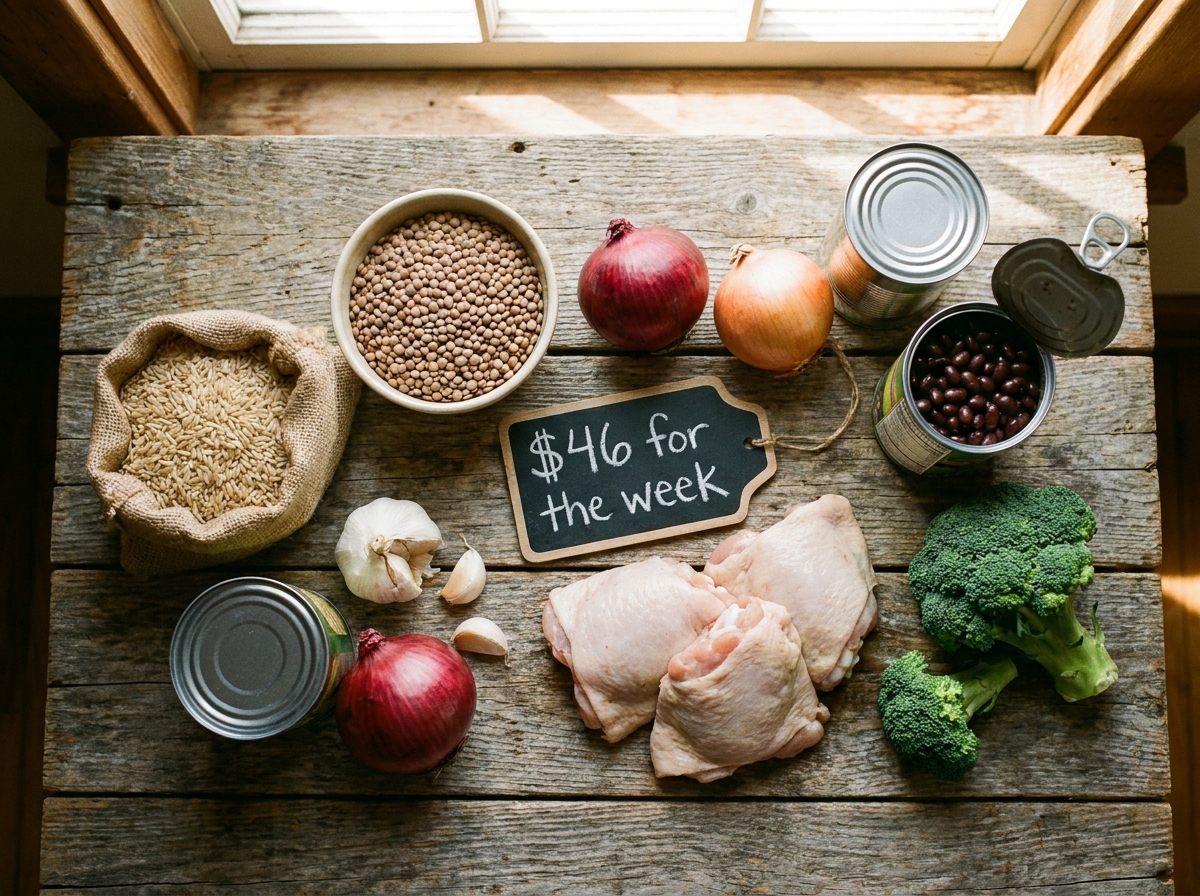
Your First Meal Prep Grocery List
One of the biggest friction points for beginners is not knowing what to buy. This list covers everything you need for a complete first week of meal prep, organized by category, with the cheapest option noted for each item.
Proteins
- Boneless skinless chicken thighs (2 lbs) — more flavorful than breast, stays moist when reheated, typically $4–6/lb. Budget swap: bone-in thighs at $2–3/lb (just remove the bone after cooking)
- Eggs (1 dozen) — for egg muffin cups or hard-boiled snacks. Budget swap: none needed, eggs are already cheap at $3–4/dozen
- Plain Greek yogurt (32oz tub) — breakfast base or high-protein snack. Budget swap: cottage cheese is slightly cheaper and has similar protein content
Grains
- Brown rice (2 cups from bulk bin or 1 lb bag) — your primary grain for the week
- Rolled oats (1 cup) — overnight oats for breakfast
Vegetables
- Broccoli (2 heads or 1 large frozen bag) — most versatile roasting vegetable for beginners
- Sweet potatoes (3 medium) — nutrient-dense, filling, great texture after roasting
- Baby spinach (5oz bag) — for salads or stirring into grain bowls
- Bell peppers (2–3) — slice raw for snacking or dicing into egg muffin cups
Pantry Items (if you don't have them)
- Olive oil
- Garlic powder
- Onion powder
- Smoked paprika
- Salt and black pepper
- Soy sauce or coconut aminos
- Lemon (1–2 fresh, or juice bottle)
Breakfast Additions
- Chia seeds (small bag — lasts months, adds fiber and thickness to oats)
- Frozen berries (1 bag — cheaper than fresh, goes into oat jars)
- Honey or maple syrup (for oat sweetening)
Snacks
- Almonds or mixed nuts (small bag)
- Hummus (container — pairs with raw vegetables)
Estimated Total: $45–60 for One Person, One Week
This total includes some pantry staples you'll use for multiple weeks. After the first week, your weekly grocery total drops to $25–35 as you stop buying pantry basics.
What to Skip in Week One
Don't buy: protein powder, specialty health foods, unusual grains, or exotic vegetables. Week one is about establishing the habit, not optimizing every nutritional variable. Keep the list simple, execute it successfully, then expand in week two and beyond.

Frequently Asked Questions
Can I substitute any of these ingredients?
Absolutely. Chicken thighs can be swapped for ground turkey, salmon, or chickpeas. Brown rice can be swapped for quinoa or farro. Broccoli can be swapped for any roast-friendly vegetable (cauliflower, Brussels sprouts, asparagus). The template matters more than the specific ingredients.
Should I buy organic produce for meal prep?
Only where it makes a meaningful difference to you. The Environmental Working Group's Dirty Dozen list identifies the highest-pesticide conventional produce if you want to prioritize selectively. For budget-conscious meal prep, conventional produce is a completely reasonable choice.
Is it cheaper to buy from a warehouse store like Costco?
For bulk staples (chicken, eggs, oats, olive oil, nuts), yes — often 30–50% cheaper. For produce, the quantity may exceed what you can use before spoilage. A Costco rotisserie chicken ($5–6 for a full chicken) is one of the best value proteins in meal prep.
How do I know how much to buy?
A simple rule: 1.5–2 lbs of protein per person per week, 1 cup dry grain per person per week, and 4–6 cups of raw vegetable per person per week. This covers 5 dinner-sized meals per person. Scale up linearly for multiple people.
What about sauces and condiments?
Buy one sauce per week that excites you. Teriyaki sauce, salsa, tahini, or a good hot sauce transforms identical base ingredients into completely different meals. The sauce investment is small; the flavor payoff is large.