I've cooked for families ranging from 3 to 8 people, and feeding a family of 4–6 through meal prep is a different problem than solo or couple prep — not just in quantities, but in the specific constraints that apply at scale. Picky eaters. Different portion sizes for adults and children. The parent who wants high protein and the child who will only eat plain rice. Budget pressure that feels much more acute when you're feeding six people versus one. I've worked with family meal prep systems long enough to know that the approaches that work for adults fail predictably when applied to families — and that the solutions are specific.
This guide covers the family meal prep approach that actually works at scale: the modular assembly method that accommodates different preferences without separate cooking, quantity calculations for 4–6 people, the best family-friendly batch recipes with real costs, the $100/week budget framework, and USDA food safety guidance scaled for large-batch family prep.
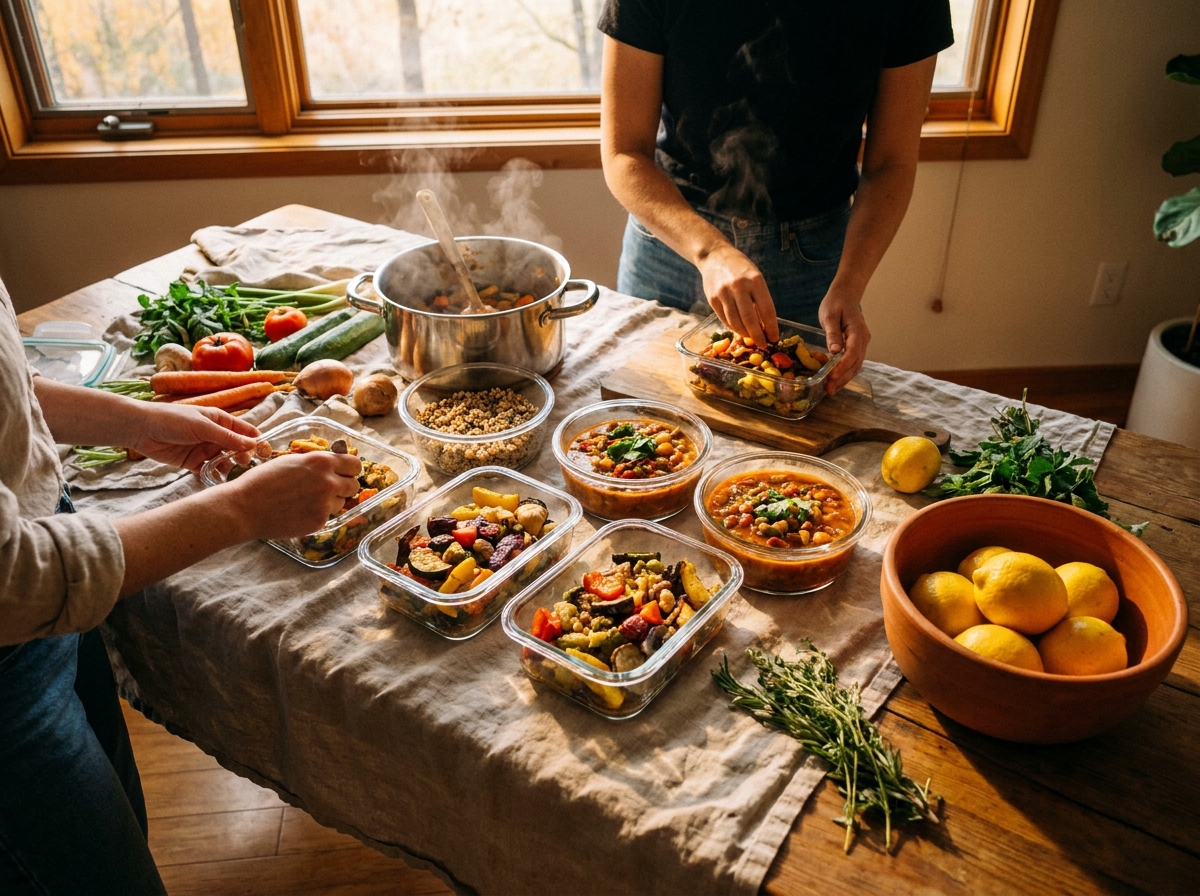
The single biggest mistake family meal preppers make is trying to make everyone eat the same complete dish. The modular approach serves components separately — protein on one plate, grain in one container, vegetable in another, sauce options available — and lets each family member assemble their own bowl. Adults load up on protein and vegetables; kids take plain rice with the one sauce they like. One cook, zero separate meals, zero mealtime conflict. This is how restaurant meal prep systems work, and it applies perfectly to family batch cooking.
How Is Meal Prep for a Family Different From Solo Prep?
The core differences aren't just quantity — they're structural. Family meal prep must accommodate: different appetites (a 10-year-old eats half the portion of an adult male), different preferences (almost every family has at least one restrictive eater), different schedules (school pickup, work hours, activities), and a budget that feels the pressure of 4–6 mouths rather than one or two.
The portion arithmetic alone changes the math significantly. A standard 4-portion recipe covers one adult's lunches for the week. For a family of four, that same recipe covers one family dinner — not a week. Family batch cooking requires thinking in terms of 4–6× scale while managing the oven capacity and cook time implications of larger batches.
Budget pressure is also different. A solo prepper can spend $35 per week and eat well. A family of four spending $35 per week is genuinely struggling. The realistic budget for a family of four eating well through meal prep is $75–$100 per week — the budget meal prep plan shows the exact $47 single-person framework you can scale from. — this guide's framework targets the upper end of that range to ensure adequate protein and variety while staying significantly below what the same family would spend eating without a plan ($175–$280/week is the average for a family of four in the US).
How Much Food Do You Need When Meal Prepping for a Family?
Quantities scale differently for adults and children, and different protein sources have different yields after cooking. Here's the reference table I use for family prep planning:
| Component | Per Adult Serving | Per Child Serving | Family of 4 (2A+2C) | Family of 6 (2A+4C) |
|---|---|---|---|---|
| Protein (cooked) | 5–6 oz | 2.5–3 oz | 1.5–1.75 lbs total | 2–2.25 lbs total |
| Grain (dry) | ¾ cup dry rice | ⅓ cup dry rice | 2 cups dry → ~6 cups cooked | 2.5 cups dry → ~7.5 cups cooked |
| Vegetables | 1.5 cups cooked | ¾ cup cooked | 4.5 cups cooked (8–10 cups raw) | 6 cups cooked (12 cups raw) |
The portion arithmetic alone changes the math significantly. For a full week of dinners (5 nights) for a family of four — see the batch cooking Sunday guide for the full parallel prep system — multiply the per-dinner quantities by five: approximately 8–9 lbs of protein across the week, 10 cups dry grain, and 20–25 lbs of raw vegetables. This sounds like a large quantity — but spread across Sunday prep plus a Wednesday top-up for fresh items, it's manageable in 2–2.5 hours total per week.
What Are the Best Family-Friendly Batch Recipes?
Family batch recipes need to pass three tests: they're broadly liked across different age groups, they hold up to 4 days refrigerated without quality loss, and they're economical at family scale. These are the core four I recommend to every family starting batch cooking (I've made all four of these repeatedly and they've never failed):
Sheet Pan Chicken Thighs and Roasted Vegetables ($2.20–$2.80/serving)
For family of 4: 3 lbs bone-in skin-on chicken thighs, seasoned with olive oil + garlic powder + smoked paprika + salt. Roast at 425°F for 35–38 minutes until 175°F internal. Simultaneously on a second sheet pan: 1.5 lbs broccoli florets + 2 medium sweet potatoes cubed, tossed in olive oil and salt, roasted at 425°F for 22 minutes. Total active prep: 15 minutes. This is the highest-reliability family meal prep recipe I know — nearly impossible to mess up, kids generally accept the seasoning, and the leftovers work equally well in school lunchboxes and adult office lunches.
Per USDA FoodKeeper guidelines, cooked chicken lasts 4 days refrigerated at 40°F or below — plan to eat within 4 days of prep day or freeze portions made for Thursday and Friday at prep time.
Slow Cooker Pulled Chicken ($1.65–$2.10/serving)
For family of 4: 2.5–3 lbs boneless chicken thighs + 1 can diced tomatoes + 1 cup chicken broth + 4 garlic cloves + 1.5 tsp cumin + 1 tsp chili powder + salt. Low for 6 hours or high for 3 hours. Shred directly in cooker. Makes 8–10 generous servings. The versatility here is exceptional for family feeding: adults can use it in bowls with toppings; children can eat it simply with rice and no sauce; it works in quesadillas for a quick school night variation.
Ground Turkey Taco Bowl Filling ($2.40–$3.00/serving)
For family of 4: 2 lbs 93% lean ground turkey, browned with 1 diced onion + 4 garlic cloves + 2 tsp cumin + 1.5 tsp chili powder + 1 tsp smoked paprika. Add 2 cans drained black beans, cook 2 minutes. This is the recipe most families find most universally accepted — the taco flavour profile crosses almost every age-group preference divide. Serve over rice; adults add salsa, chipotle sauce, and pickled jalapeños while children take it plain or with mild salsa. 8–10 servings from one cook.
Red Lentil Soup ($1.10–$1.40/serving)
For family of 6: 1.5 cups dried red lentils + 2 cans diced tomatoes + 1 diced onion + 5 garlic cloves + 1.5 tsp cumin + 1 tsp turmeric + 1 tsp smoked paprika + 7 cups vegetable broth. Sauté aromatics first, add lentils and liquids, simmer 25 minutes until lentils dissolve completely. Makes 8–10 servings. This is the highest-value family batch recipe on the list — the cheapest per serving, the most nutritionally dense (iron, folate, plant protein), and one that genuinely improves over 4–5 days as the spices deepen. Children who accept mild spicing tend to like it; for very spice-sensitive children, reduce cumin and omit paprika and serve with plain yogurt stirred in.
How Do You Meal Prep for a Family on a Budget of $100 a Week?
A $100 weekly budget for a family of four works out to $25 per person per week — approximately $3.57 per person per day covering all meals. This is achievable with the right approach. Here's how I structure it:
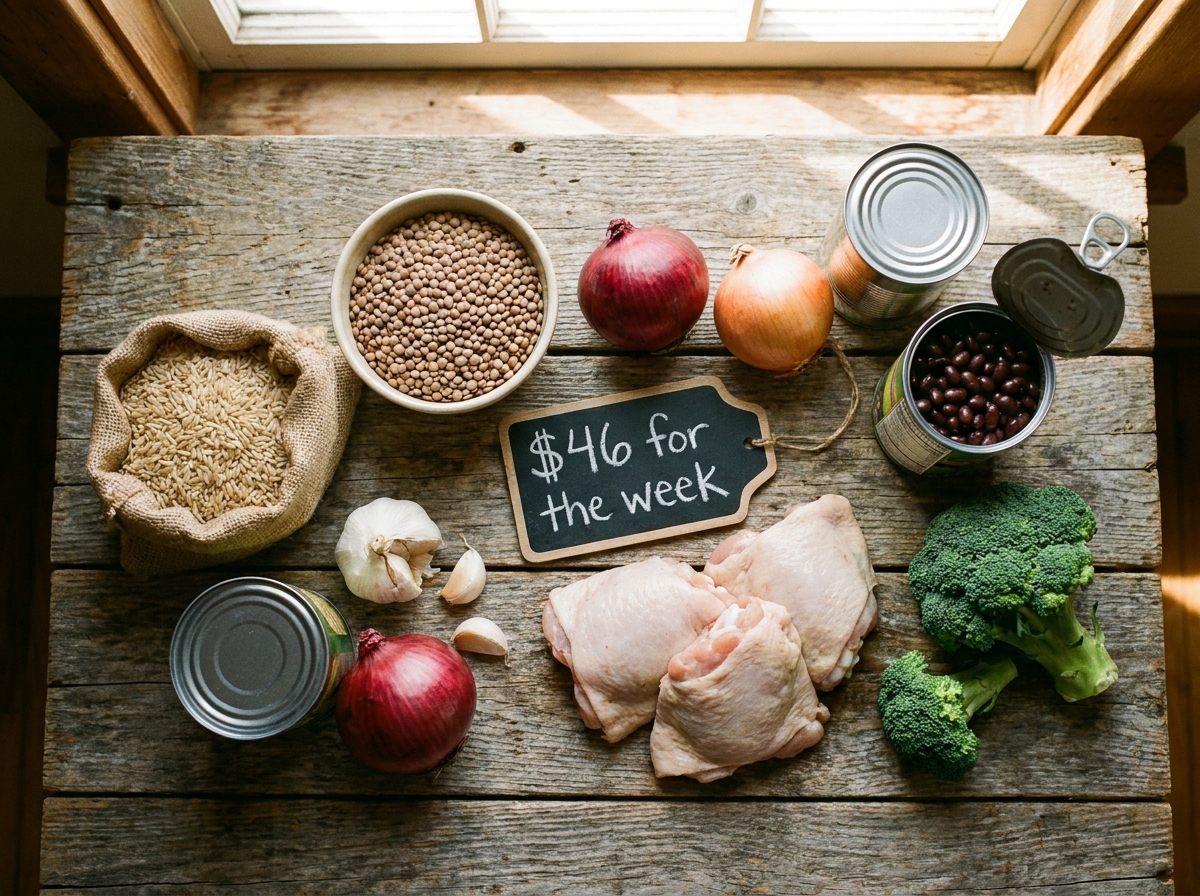
Protein budget (40% of total = $40): Two bulk protein purchases per week. Example: 3 lbs bone-in chicken thighs at $1.99–$2.49/lb ($6–$7.50) + 2 lbs ground turkey at $3.49–$4.99/lb ($7–$10) + 2 lbs dried lentils at $2.19 ($4.38) = $17–$22 for protein covering all 5 dinners and lunches. The remaining $18–$23 protein budget covers eggs and dairy for breakfasts.
Grain budget (15% = $15): A 5 lb bag of brown rice costs $4–$6 and lasts 3–4 weeks. A 2 lb bag of quinoa costs $5–$7. Between the two, grain is nearly free on a per-week basis once stocked.
Produce budget (30% = $30): Two strategies: buy frozen for the high-volume items (broccoli, peas, corn, spinach at $1.50–$2.50/lb frozen vs $2.50–$4.50/lb fresh), and buy fresh only for the lower-volume flavour items (onions, garlic, sweet potatoes, bell peppers). A family of four's weekly vegetable needs can typically be met for $18–$24 with the frozen-heavy approach.
Pantry and dairy (15% = $15): Greek yogurt for breakfasts ($5–$7 for 32 oz), eggs ($4–$6 for 18-count), and pantry replenishment (oils, spices — typically $0–$5/week once stocked).
Total achievable spend: $75–$95 for a family of four with this framework — $5–$25 under the $100 target, providing buffer for sale opportunities or preferred fresh items. The budget meal prep guide covers additional strategies for driving the per-meal cost lower when needed.
What's the Best Family Batch Cooking Sunday Timeline?
For a family of four, the realistic timeline is 2–2.5 hours. The structure mirrors the solo timeline but with larger quantities, a second oven rack in constant use, and a post-cook portioning step that takes 20–25 minutes instead of 10:
- 0:00 — Oven to 425°F, slow cooker on for pulled chicken (if using that protein). Rice started on stovetop.
- 0:10 — Season and prep 3 lbs chicken thighs for sheet pan. Into oven, both racks loaded.
- 0:20 — Prep family vegetable batch (12 cups raw = two sheet pans). Season. Set aside.
- 0:30 — First sheet pan protein checks. Vegetables into oven on second batch rotation.
- 0:35 — Make 5 overnight oat jars for adults' weekday breakfasts.
- 0:50 — First vegetables out. Second vegetable batch in.
- 0:52 — Protein out. Rest. Rice done.
- 1:10 — Everything cooled to near-room temperature. Portioning begins.
- 1:35 — 5 adult lunch containers, 5 children's lunch containers, 5 family dinner components portioned separately. Labelled. Loaded.
- 1:45 — Done.
Frequently Asked Questions About Family Meal Prep
How do you meal prep for a picky eater in the family?
The modular method is the answer. Cook everything as separate components (protein, grain, vegetable separately) and let each family member assemble their own portion. The picky eater takes plain rice and plain chicken with no sauce; the adventurous adult takes the same chicken with chipotle yogurt and roasted sweet potato. One cook. Zero separate meals. The key is serving components in individual dishes at the table rather than pre-assembling complete plates, which removes the child's sense of having something "mixed" that they can't control.
How much does family meal prep cost per week?
A family of four eating well through batch cooking typically spends $75–$100 per week — significantly below the national average of $175–$280 for a family of four eating without a plan. Cost per serving lands at $2.20–$3.50 for family batch cooking, which is $1.50–$3.50 less per meal than meal kit delivery services and $5–$12 less than restaurant or takeout meals. Over a full year, a family of four switching from unplanned eating to batch cooking saves approximately $3,900–$9,360 annually.
What is the best protein for family meal prep?
Bone-in chicken thighs are the best family meal prep protein — for the complete protein-by-protein breakdown, see the high protein meal prep guide. for three reasons: they're the most universally accepted across age groups, they're the most affordable per gram of protein among meat options ($0.08–$0.12/g), and they reheat best after 4 days in the fridge due to their fat content. Ground turkey in taco seasoning is the second choice — the flavour profile is broadly liked and it works in multiple formats (bowls, wraps, quesadillas, pasta). Lentils are the best non-meat protein for family prep — cheap, filling, and the flavour of lentil soup is more broadly accepted by children than most plant-based proteins.
How do you store meal prep for a family without running out of container space?
Use a tiered storage system: large airtight containers for bulk components (one 6-cup container of cooked rice, one 6-cup container of roasted vegetables) rather than 10 individual small containers. Pre-portion only the items that will be taken to school or work. Family dinner components can be stored in large serving-sized containers and portioned directly at the table. A family of four needs approximately: 2 large (6-cup) containers for bulk components, 8 medium (2-cup) containers for individual lunches, and 5 mason jars for overnight oats. Total container count: 15 pieces — far more manageable than the 25–30 individual containers a per-meal approach would require.
Is family meal prep safe for children?
Yes, with attention to the same food safety principles that apply to adults. Per USDA FoodKeeper guidelines, cooked chicken lasts 4 days refrigerated at 40°F or below — the same applies to children's lunches. The critical additional consideration for children's school lunches is cold chain maintenance: school lunches not refrigerated at school need an ice pack to stay below 40°F for the 4–5 hours between home packing and lunchtime. A single ice pack maintains safe temperatures for approximately 5–6 hours in an insulated lunch bag. Avoid packing cooked egg dishes in lunch boxes without reliable refrigeration — they have a shorter safe window than cooked chicken or legumes.