Meal prep for one person has a specific challenge that family or couple prep doesn't: the math works against you at every standard recipe size. A batch of pulled chicken makes 6 servings. Brown rice for a week makes 4–6 cups cooked. Most meal prep guides are implicitly written for 2–4 people, which means a solo prepper following standard recipes either drowns in leftovers by Thursday or wastes 30–40% of what they bought. I've prepped for one for five straight years and the system I'm going to show you eliminates both problems.
This guide covers the half-batch method for scaling any recipe down without losing the efficiency of batch cooking, the weekly theme rotation that prevents variety fatigue, a precise 60-minute solo Sunday timeline, the solo shopping strategy that prevents produce waste, and an honest weekly grocery list at two budget levels ($28–$35 tight / $45–$55 comfortable).
Standard meal prep for one fails for a specific reason: you run out of variety before you run out of food. Five identical chicken rice bowls feels fine on Monday, tolerable on Tuesday, and actively demotivating by Thursday. The solution is not cooking more different things — it's cooking fewer things but combining them in more ways. Two proteins + one grain + one vegetable + three sauces = twelve meaningfully different meal combinations from one 60-minute session.
Why Is Meal Prep for One Actually Easier Than Prepping for a Family?
The scale cuts both ways. Yes, standard recipes over-yield for one person. But the flip side is that solo meal prep is faster, cheaper, and easier to customise than family prep. A 60-minute session covers a full week for one person. The same session for a family of four takes 2.5–3 hours because quantities triple and the number of preferences to accommodate multiplies.
For a solo prepper, every decision is yours alone. You can make food you specifically want to eat without negotiating preferences, you can try an experimental sauce without worrying about whether others will like it, and you can pivot mid-week if you're not feeling a particular meal. The constraint of cooking for one is largely a mindset problem, not a practical one — once you have the right scaling framework, the efficiency of a solo batch session is genuinely impressive.
The financial case for solo meal prep is also compelling: at $28–$55 per week for complete coverage of lunches and dinners, you're spending $5.60–$11 per day on food. The average American spends $13–$22 per day on food when eating without a plan. Solo meal prep saves $7–$11 per day — $2,555–$4,015 annually — with no sacrifice in food quality or variety.
What Is the Half-Batch Method for Scaling Meal Prep for One?
The half-batch method is the framework I developed after two years of wasted food. The core rule: cook exactly 5 portions of protein per week, not more. Five portions — one per weekday — is the precise amount that keeps food fresh within USDA FoodKeeper's 4-day cooked poultry window while generating zero waste.
| Component | Standard Recipe | Half-Batch for One | Yields |
|---|---|---|---|
| Chicken thighs | 3–4 lbs | 1.25–1.5 lbs | 4–5 servings × 4oz |
| Ground turkey | 1.25 lbs | 0.65 lbs | 4–5 servings |
| Brown rice | 2 cups dry | ¾ cup dry | 2.25 cups cooked = 4–5 servings |
| Quinoa | 2 cups dry | ¾ cup dry | 2.25 cups cooked = 4–5 servings |
| Roasted broccoli | 1 large head | ½ large head or 1 lb frozen | 4–5 servings |
| Overnight oats | 5 jars | 5 jars (same — already per-serving) | 5 breakfasts |
The half-batch method also makes shopping more precise. A 1.25 lb package of boneless chicken thighs costs $3.75–$5.00 at most grocery stores and comes as a natural 2–3 piece package — no awkward cutting of a family pack. ¾ cup of dry brown rice weighs about 5.25 oz; measuring from a 5 lb bag and storing the rest is trivial. This approach eliminates the "I bought 3 lbs of chicken and only used 1.5 lbs" food waste problem completely.
How Do You Prevent Boredom When Prepping for One?
The weekly theme rotation is the most effective boredom prevention system I've found for solo meal prep. Instead of trying to prep a wide variety of different foods (which takes longer and creates waste), you rotate the flavour profile of the same core ingredients each week:
- Week 1 — Mediterranean: Chicken thighs with lemon-herb marinade, quinoa, roasted zucchini and peppers. Sauces: tahini lemon, Greek yogurt tzatziki. Add olives, cherry tomatoes, cucumber at serving time.
- Week 2 — Asian-Inspired: Baked chicken thighs, brown rice, broccoli. Sauces: honey soy ginger, peanut satay. Add sesame seeds, green onion, chili flakes at serving time.
- Week 3 — Mexican: Ground turkey taco filling with cumin and chili powder, rice, roasted sweet potato. Sauces: chipotle yogurt, salsa verde. Add black beans, lime, cilantro at serving time.
- Week 4 — Comfort: Slow-cooker pulled chicken, farro, roasted root vegetables. Sauces: BBQ-style tomato, creamy mustard. Add pickled red onion, shredded cabbage at serving time.
The rotation means you're never eating the exact same meal in consecutive weeks, even though the core prep structure stays identical. After month one, you'll have your two favourite weekly themes and settle into a comfortable rotation that feels varied despite requiring minimal creative decision-making on Sunday.
What Does the 60-Minute Solo Sunday Timeline Look Like?
Everything I'm describing cooks in 60 minutes of active prep with about 35 minutes of passive oven time included. Here's the exact sequence:
- 0:00 — Oven to 425°F. Start grain: ¾ cup brown rice + 1.5 cups water. Bring to boil, reduce to lowest, cover, 40 minutes unattended.
- 0:05 — Season 1.25 lbs chicken thighs. Onto sheet pan, skin-side up. Into oven. Timer 35 minutes.
- 0:08 — Prep vegetables (roughly chop half head broccoli + 1 sweet potato). Toss in oil and salt on second pan. Set aside.
- 0:15 — Vegetables into oven on lower rack alongside chicken. Timer 20 minutes.
- 0:18 — Make 5 overnight oat jars. 8–10 minutes. Seal and refrigerate.
- 0:28 — Make 2 sauces. 8 minutes total.
- 0:38 — Vegetables out. Check chicken — should be close to 175°F.
- 0:42 — Chicken out, rest 5 minutes. Rice done.
- 0:47 — Spread everything to cool on open surfaces.
- 1:00 — Portion into containers. 5 lunch/dinner portions, labelled. Load fridge.
- 1:05 — Done, fridge stocked.
The magic of solo prep: smaller quantities actually cook faster. 1.25 lbs of chicken thighs reaches temperature in 33–35 minutes; 3 lbs takes 38–42 minutes. You get a small time bonus compared to family prep, and the cooling and portioning step is dramatically faster.
How Do You Shop for One Without Wasting Money on Produce?
Produce waste is the silent budget killer for solo shoppers. A full head of broccoli is $2.50–$3.50; if you use half and the rest goes slimy by Thursday, your effective cost per serving doubled. Here's the system that solved this for me:
Buy frozen for anything you'll use less than ½ of fresh. A 12 oz bag of frozen broccoli florets costs $1.48–$2.18, provides exactly enough for one week's prep, and stores for 3 months. There's zero waste, and the nutritional difference versus fresh is negligible (frozen vegetables are flash-frozen within hours of harvest; fresh produce in a grocery store may have been in transit and storage for 5–7 days). I exclusively use frozen broccoli, peas, edamame, and spinach in my solo prep. I buy fresh only for sweet potatoes, bell peppers, and onions — items where the serving size naturally matches the weekly quantity I need.
Buy proteins in the smallest available package. For chicken, a 1.25 lb package costs more per pound than a family pack but saves you from freezing and managing excess. The premium is typically $0.40–$0.80/lb — on 1.25 lbs, that's $0.50–$1.00 extra for the convenience of zero waste. Worth it. When chicken thighs are on sale as a family pack, buy and freeze in 1.25 lb portions immediately.
Weekly solo grocery list (tight budget: $28–$35):
- Bone-in chicken thighs, 1.25 lbs — $2.50–$3.75
- Eggs, 6-count — $1.50–$2.50
- Rolled oats (if not stocked) — $1.25 from bulk bin or $0.50/week amortised from container
- Greek yogurt, 16 oz — $2.50–$3.50
- Frozen broccoli, 12 oz bag — $1.48–$2.18
- Sweet potatoes, 2 medium — $1.50–$2.00
- Brown rice (if not stocked) — amortised from 5 lb bag = $0.50/week
- Canned black beans, 1 can — $0.98–$1.25
- Bananas, 4–5 — $0.75–$1.00
- Pantry (oil, spices) — amortised = $1–$2/week
What Are the Best Containers for Solo Meal Prep?
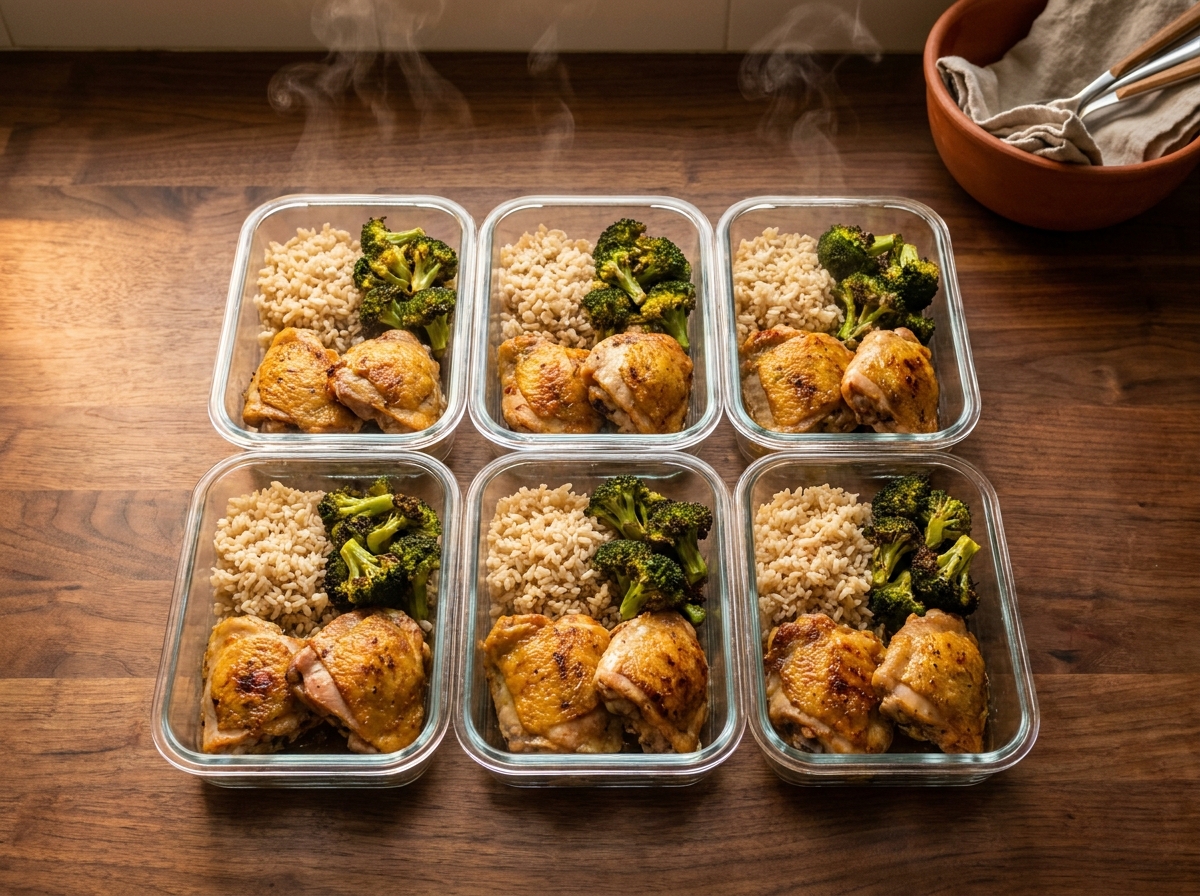
For one person, six containers is the right number: five portioned meals + one overflow container for sauce or extras. Don't buy a 20-piece set — the storage space required doesn't make sense for a single-person household and larger quantities encourage overpreparing (which creates waste).
My recommended solo kit: six 2-cup glass containers with locking lids + five 16-ounce mason jars for overnight oats. Total cost: $25–$40. Glass is the better choice over plastic for meal prep containers: it doesn't absorb odours or colours after repeated use, it's microwave-safe without concerns about plastic leaching at high temperatures, and the lids seal more reliably than most plastic containers after 6+ months of use. The full comparison is in the meal prep container guide.
Frequently Asked Questions About Meal Prep for One
Is it worth meal prepping for just one person?
Yes — arguably more worth it than for a family. The weekly time investment for solo prep is 60–75 minutes for complete coverage of lunches and dinners. The financial saving over buying or ordering food daily is typically $90–$200 per month for one person. The decision-fatigue saving is personal but significant: having meals ready eliminates the daily "what am I eating tonight" problem entirely. The only scenario where solo meal prep is genuinely not worth it is if you eat out for social or professional reasons most days — in that case, prep breakfasts only, which takes 10 minutes per week.
How do you scale meal prep recipes for one person?
Use the half-batch method: take any standard recipe (usually written for 4 servings) and multiply all ingredients by 1.25 rather than dividing by 4. This gives you 5 solo servings from a 4-serving recipe with minimal leftover. For grains: ¾ cup dry rice or quinoa yields 4–5 cooked portions for one person. For proteins: 1.25 lbs chicken thighs yields 4–5 servings. For vegetables: 1 lb frozen or ½ head fresh = 4–5 servings when roasted. These numbers are your standing conversion factors — once memorised, you never have to calculate again.
How do you prevent food waste when meal prepping for one?
Three rules: buy frozen vegetables (no deterioration, buy exactly what you need), buy proteins in the smallest available package (pay the slight per-pound premium to avoid excess), and prep only 4–5 days at a time rather than a full week. If you make Sunday prep for 5 days and something comes up Thursday — dinner with a friend, a work event — you have a Thursday container that hits its 4-day safety limit. A Wednesday refresh takes 15 minutes for a protein-only top-up and solves this problem entirely.
What is the cheapest meal prep for one person per week?
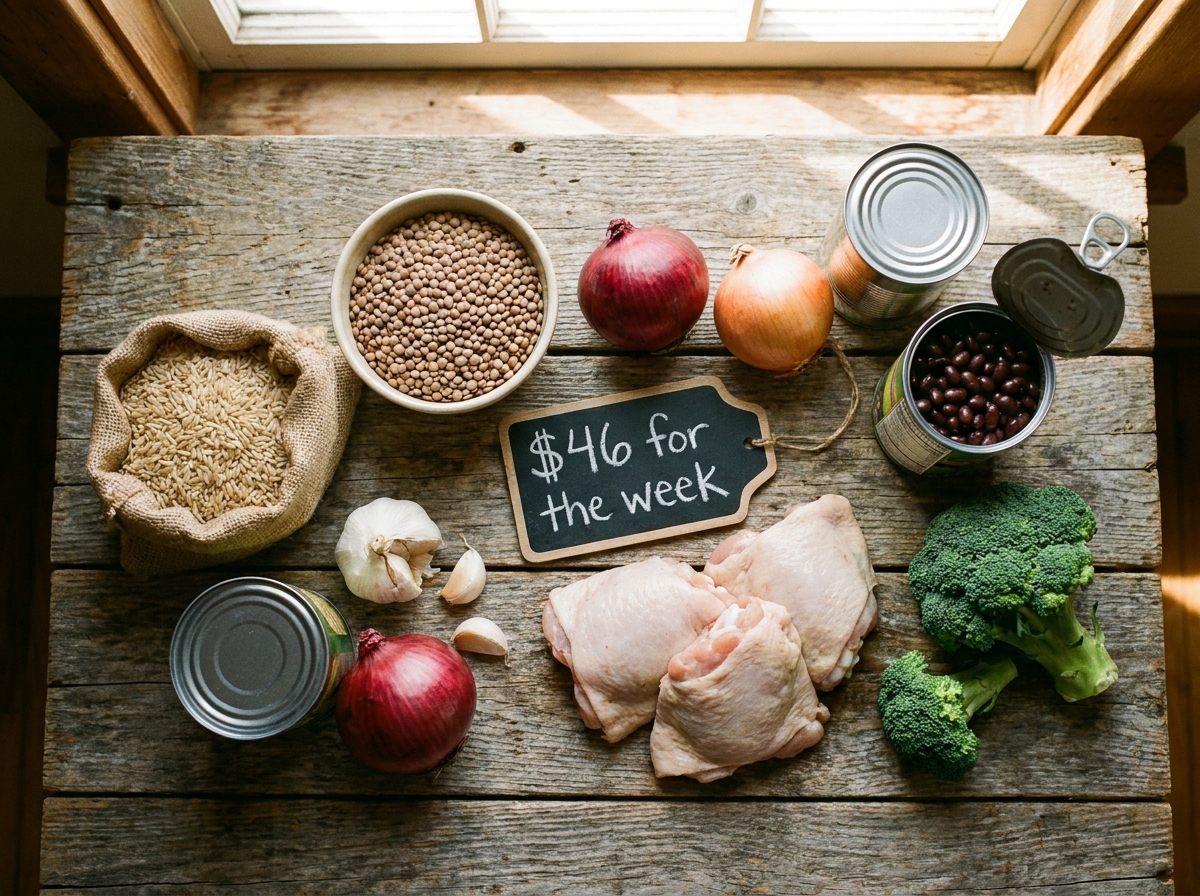
The floor budget for one person is $22–$28 per week using: dried lentils ($2.19/lb, covers the week), brown rice ($0.50/week amortised), rolled oats ($0.50/week amortised), eggs (6 count, $1.50–$2.50), frozen broccoli ($1.48), one sweet potato ($0.75), and a small container of Greek yogurt ($2.50). That covers breakfast through the oats and eggs, lunches through the lentil soup, and dinners through the lentil dahl and sweet potato bowls. Protein-complete, fibre-dense, and genuinely good food at $4.40–$5.60/day total. For the full $45 weekly budget, the budget meal prep guide covers 30 ideas at under $2/serving.