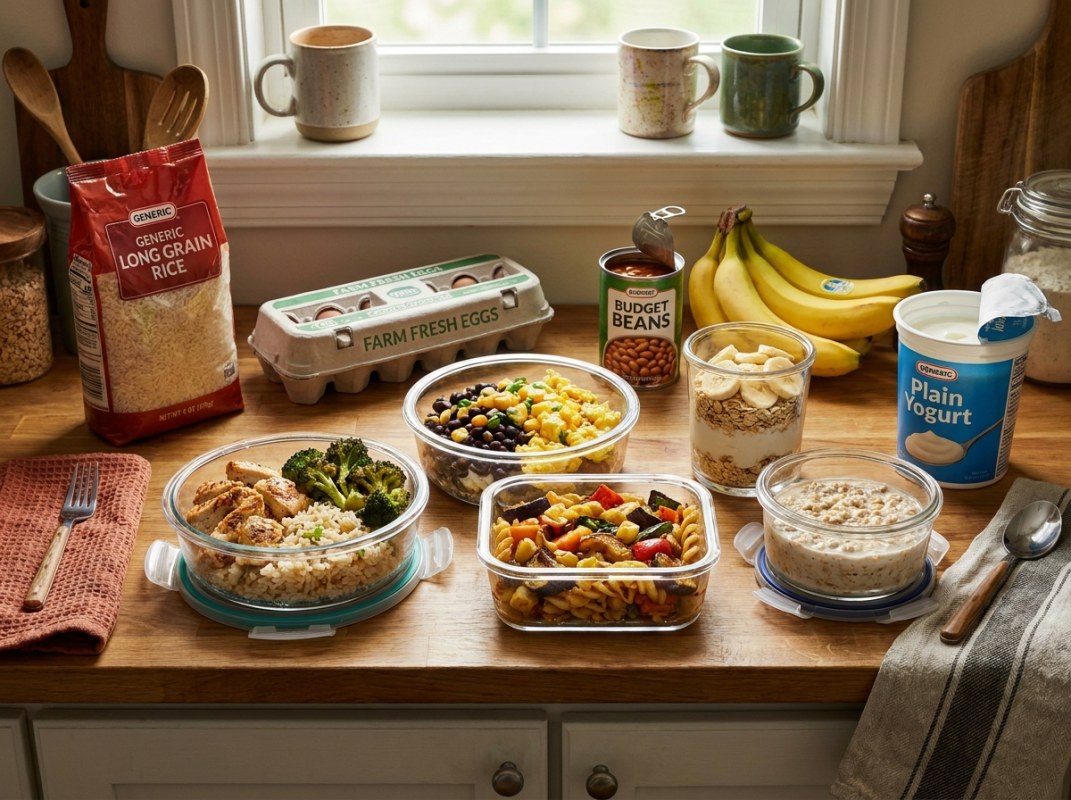
Why Meal Prep for One Is Uniquely Challenging
Meal prep for one person presents challenges that do not exist for couples or families. Almost every recipe on the internet is written for 4–6 servings. Buying produce for one often means purchasing quantities far larger than a single person can consume before spoilage. Proteins at the grocery store are packaged in bulk quantities. Cooking a small amount often takes the same effort as cooking a large amount with none of the efficiency gains.

The result for most solo eaters is a predictable cycle: cook too much, eat the same meal four days in a row, get bored by Wednesday, order delivery Thursday and Friday, waste the remaining food, feel guilty about the waste, and repeat. This guide breaks that cycle with a system designed specifically for single-person households — the right quantities, the right storage approach, and a mix-and-match system that produces variety without requiring different meals every day.
The Solo Meal Prep Mindset Shift
The key mental shift for solo meal prep is this: you are not scaling recipes — you are building a component system. Instead of cooking a quarter of a chicken casserole recipe (which is awkward and inefficient), you cook one full batch of a single protein, one full batch of a grain, and one batch of vegetables. These components produce variety when combined differently across the week.
A single person prepping for 5 days needs approximately:
- 400–600 grams of cooked protein (covers 5 lunches or dinners as the main component)
- 4–5 cups of cooked grain (enough for 5 meals as a base)
- 4–6 cups of roasted or cooked vegetables (enough for 5 meals as a side or bowl component)
- 5 breakfast portions (overnight oats or egg muffins)
These quantities are achievable from small batches that do not produce excessive leftovers. They are also small enough to fit in a standard refrigerator without reorganizing your life around them.
Solving the Food Waste Problem
Food waste is the single biggest obstacle to sustainable solo meal prep. A solo eater who buys a full head of broccoli, a full bunch of celery, and a full bag of spinach will struggle to consume all of it within the storage window. Here is how to solve this structurally:
Buy frozen vegetables for anything you cannot reliably finish fresh. Frozen broccoli, spinach, peas, edamame, mixed vegetables — all available in resealable bags, all nutritionally equivalent to fresh. Use exactly what you need, reseal the bag, and the rest stays frozen for months. This is the most effective single change solo meal preppers can make.
Anchor around cabbage and carrots for fresh vegetables. These are the two fresh vegetables with the longest refrigerator shelf life — 1–2 weeks for cabbage and 2–3 weeks for carrots. They do not need to be consumed on a strict 3-day schedule like spinach or zucchini. A head of cabbage bought on Sunday can appear in Wednesday's stir-fry, Friday's slaw, and next Tuesday's soup without any waste concern.
Buy proteins in portions, not packages. Many grocery stores sell individual chicken breasts, individual salmon fillets, and individual ground meat portions. If yours does not, buy a full package and freeze individual portions on the same day you purchase — wrap each portion in plastic, label with the weight and date, and freeze. Take out only what you need for each week's prep.
Plan to use one ingredient across multiple meals. If you buy a can of coconut milk for a curry, use the remainder in overnight oats or a smoothie. If you buy a bunch of parsley, use it in the grain bowl, the egg muffins, and the yogurt dip. Reduce single-use ingredients to reduce waste.
The Solo Shopper's Buying Guide
Here are the exact quantities to buy for a 5-day solo meal prep session, covering lunches and dinners with minimal waste:
Protein:
- 3–4 bone-in chicken thighs (approximately 600–700g raw, yields 400–450g cooked)
- OR 2 chicken breasts (approximately 500g raw)
- OR 1 pound ground turkey (453g)
- PLUS: 6 eggs (for breakfast egg muffins or snacks)
- PLUS: 1 can of tuna or 1 small can of salmon (for a quick no-cook meal on day 3 or 4)
Grains:
- 1 cup dry white or brown rice (produces approximately 3 cups cooked — enough for 3 meals)
- ½ cup dry quinoa (produces approximately 1.5 cups cooked — enough for 2 meals)
Vegetables:
- 1 bag (12oz–16oz) frozen broccoli — use half this week, half next week
- 2–3 medium sweet potatoes — roast all of them, eat across the week
- ½ head of green cabbage — keeps all week, use in multiple dishes
Breakfast:
- Rolled oats, Greek yogurt, chia seeds, milk — enough for 5 overnight oat jars
Total cost for one person for 5 days of lunches and dinners plus breakfasts: approximately $30–$40.
A 5-Day Solo Meal Plan Using This System
Here is how one week of solo meal prep plays out using the above quantities. The components are chicken thighs, brown rice, quinoa, roasted sweet potatoes, roasted broccoli, and cabbage.
Sunday prep (90 minutes):
- Roast 4 chicken thighs at 425°F for 38 minutes, seasoned with garlic, smoked paprika, salt
- Cook 1 cup brown rice on the stovetop (45 minutes)
- Cook ½ cup quinoa (15 minutes)
- Roast 3 halved sweet potatoes at 425°F for 30 minutes
- Roast half the bag of frozen broccoli at 425°F for 22 minutes (straight from frozen)
- Assemble 5 overnight oat jars (10 minutes)
Monday: Breakfast — overnight oat jar. Lunch — chicken thigh over brown rice with roasted broccoli, drizzled with tahini sauce. Dinner — chicken (shredded from a second thigh) over quinoa with sweet potato and cabbage slaw (raw cabbage, lemon, olive oil, salt).
Tuesday: Breakfast — overnight oat jar. Lunch — quinoa bowl with remaining chicken, broccoli, and a soft-boiled egg. Dinner — stir-fried cabbage with rice, the last chicken thigh sliced, and soy-ginger sauce.
Wednesday: Breakfast — overnight oat jar. Lunch — tuna salad (canned tuna + Greek yogurt + mustard + diced raw cabbage) over brown rice. Dinner — roasted sweet potato stuffed with black beans, Greek yogurt, and hot sauce.
Thursday: Breakfast — overnight oat jar. Lunch — fried rice (leftover rice + 2 scrambled eggs + frozen peas + soy sauce — 7 minutes). Dinner — lentil soup (15 minutes from dry red lentils, canned tomato, garlic, cumin — simple, warm, filling).
Friday: Breakfast — overnight oat jar. Lunch — grain bowl with quinoa, any remaining vegetables, and cottage cheese herb dip. Dinner — freestyle from whatever remains — pasta with canned tomato sauce and an egg poached into it takes 12 minutes.
This is five complete days from one 90-minute session. Minimal waste. Maximum variety for a solo eater.
Solo-Specific Storage Tips
Use single-serve containers. For solo meal prep, individual portions in separate containers is more convenient than large batch containers you serve from multiple times. Each container is a complete meal — grab it from the fridge, reheat, eat. Large batch containers require re-measuring and re-portioning at every meal, which adds friction.
Use the freezer aggressively. When you cook a batch of rice or lentils, freeze half of it in a zip-lock bag immediately. This way you are building a frozen reserve that reduces prep time in future weeks. Cooked grains, cooked legumes, and soups freeze for 3 months without quality loss.
Keep a clear fridge. A solo meal prepper's refrigerator should be organized so prepped food is immediately visible when the door opens. If your prepped containers are buried behind condiments and produce, you will forget about them and they will expire. Designate a specific shelf — eye level, front and center — exclusively for prepped meals.
Label everything with the prep date. After 4 days, anything that has not been eaten should either be eaten that day or frozen. A small piece of masking tape with the date on the container takes 5 seconds and prevents the guessing game of whether 5-day-old chicken is still safe.
Solo Meal Prep on a Very Tight Budget
For a solo eater on a strict budget, the following approach covers 5 days of lunches and dinners for approximately $20–$25:
- 1 pound dried lentils ($1.50–$2.00) — this is 10 cups of cooked lentils
- 2 cups dry white rice ($0.60–$0.80)
- 1 dozen eggs ($3.00–$4.00)
- 1 can diced tomatoes ($1.00)
- 16oz frozen spinach ($1.75)
- 16oz frozen broccoli ($1.50)
- ½ head green cabbage ($0.75)
- Plain Greek yogurt, small container ($2.50)
- Rolled oats 42oz container ($4.50) — covers multiple weeks
This is a plant-forward, extremely economical week. The lentil soup alone — lentils, canned tomatoes, spinach, cumin, garlic — provides 5 generous servings of 18g protein each for roughly $3.50 in ingredients total. Egg fried rice (rice + eggs + frozen peas + soy sauce) provides another 3–4 quick meals. Baked egg muffins with spinach cover breakfast for 6 days. Total cost per meal: approximately $1.30–$1.80.

Frequently Asked Questions for Solo Meal Preppers
Q: How do I avoid getting bored eating the same food for 5 days?
The component approach prevents this. When you store proteins, grains, and vegetables separately rather than in assembled meals, you can combine them differently each day. The same chicken, rice, and broccoli becomes a rice bowl on Monday, a wrap on Tuesday, a salad on Wednesday, and a soup on Thursday. The variety comes from the combination, not from cooking different proteins every day.
Q: How much food should I actually cook for one person?
For 5 days of lunches and dinners: 400–500g of cooked protein (roughly 100g per main meal), 4–5 cups of cooked grain, and 4–6 cups of vegetables. For 5 breakfasts: 5 overnight oat jars or 10–12 egg muffins. This is less than most beginners expect — the tendency to massively over-prep is common in the first month.
Q: Is it worth meal prepping for just one person?
Yes — arguably more so than for couples or families. The daily convenience benefit is identical regardless of household size, but the cost savings per person are proportionally the same. A solo eater who spends $35 on weekly meal prep instead of $18–$25 per meal on delivery saves approximately $130–$175 per week or $6,500–$9,000 annually.
Q: What about fresh fruit and vegetables — are frozen always fine to substitute?
For cooked applications — roasting, stir-frying, soups, sauces — frozen vegetables are genuinely equivalent in nutrition and often superior in cost and storage life. The applications where fresh is clearly better: raw salads, garnishes, fruit eaten as-is. For meal prep purposes, frozen vegetables solve the waste problem so cleanly that they should be the default for anything that will be cooked.