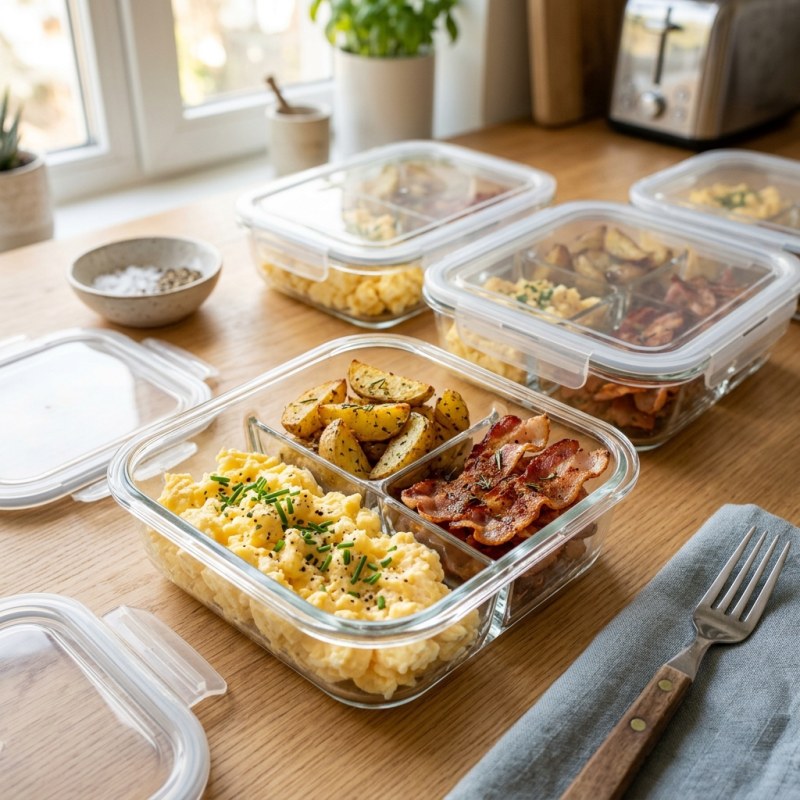
Can you meal prep scrambled eggs? The honest answer is yes, but not in the way you're picturing. If you scramble eggs Sunday night and reheat them cold from the fridge Wednesday morning, they will be rubbery, slightly grey, and noticeably worse than fresh. That's not bad luck or bad technique — it's basic protein chemistry. But there are three methods that genuinely solve this, and one ingredient that makes even straight scrambled eggs hold up far better than you'd expect.
I went through exactly this disappointment when I started meal prepping breakfasts — made a big batch of scrambled eggs on Sunday, and by Tuesday they were squeaky and dry enough that I almost gave up on egg meal prep entirely. The fix wasn't a different cooking technique for scrambled eggs. It was switching to baked egg formats that are structurally different and far more forgiving.

The Actual Science: Why Reheated Scrambled Eggs Turn Rubbery
Eggs are roughly 76% water by weight, with the rest being protein and fat. When you scramble an egg, heat causes the proteins (mainly ovalbumin) to denature and form a loose network that traps moisture — this is what gives fresh scrambled eggs their soft, custardy texture. The problem starts the moment they cool and go into the fridge.
As scrambled eggs sit, the protein network continues to tighten and contract, a process called syneresis, which squeezes water out of the structure. You'll often see this as a small pool of liquid at the bottom of your container by day 2. When you reheat, the proteins tighten further from the additional heat, expelling even more moisture and leaving you with a noticeably denser, rubbery texture. This isn't reversible — once the water is squeezed out and the protein structure has reset, you can't get back to the original fluffy texture no matter how you reheat it.
What Actually Works: 3 Methods Ranked
| Method | Texture Quality | Fridge Life | Why It Works |
|---|---|---|---|
| Baked egg muffin cups | ⭐⭐⭐⭐⭐ Excellent | 5 days | Baking sets a firmer structure from the start — less moisture to lose on reheat |
| Frittata slices | ⭐⭐⭐⭐ Very good | 4 days | Denser protein matrix than scrambled, holds shape and moisture better |
| Hard-boiled eggs | ⭐⭐⭐⭐⭐ Excellent | 7 days in-shell | No reheating needed at all — the texture problem never occurs |
| Scrambled eggs (standard) | ⭐⭐ Poor by day 3 | 3–4 days | Loose protein structure loses moisture fastest under repeated heat cycles |
| Scrambled eggs + cream cheese | ⭐⭐⭐ Acceptable | 4 days | Fat slows moisture loss but doesn't eliminate it entirely |
The pattern is clear: anything baked holds up significantly better than anything scrambled on the stovetop, because baking creates a tighter initial protein set with less trapped excess moisture to lose. This is the entire reason egg muffin cups have become the standard recommendation for egg meal prep — it's not a trend, it's a direct response to the texture problem scrambled eggs have.

Egg Muffin Cups: The Best Solution
Baked egg muffin cups solve the scrambled egg problem by changing the cooking method entirely. Instead of stovetop scrambling, you whisk eggs with mix-ins (cheese, vegetables, cooked breakfast meat) and bake in a muffin tin at 350°F (177°C) for 18 to 22 minutes. The oven's even, sustained heat sets the protein structure more uniformly and at a slightly lower overall moisture content than rapid stovetop scrambling, which means there's simply less water available to be squeezed out during storage and reheating.
They reheat in 30 to 45 seconds in the microwave with almost no texture degradation through day 4, and acceptable texture through day 5. This is the format I switched to entirely after the scrambled egg disappointment, and it's been the single biggest improvement to my breakfast meal prep routine.
Frittata: The Middle Ground
A frittata is essentially a thick, oven-finished omelet — started on the stovetop, finished under low oven heat or a broiler, which creates a denser protein matrix than free-scrambled eggs while still being faster to make than individual muffin cups. Slice into wedges or squares for portioning. It holds 4 days reliably and reheats well in 60 to 90 seconds in the microwave, though I'd give the edge to muffin cups for sheer reheat consistency since frittata slices can sometimes reheat unevenly depending on thickness.
Hard-Boiled Eggs: The No-Reheat Option
If you genuinely don't want to deal with any reheating texture issues, hard-boiled eggs sidestep the entire problem because you eat them cold or at room temperature — there's no second heating cycle to trigger additional moisture loss. Stored in-shell, unpeeled, in the refrigerator, they last 7 days according to USDA guidelines. Once peeled, that drops to 5 days. This is the most texture-stable egg meal prep option that exists, simply because it avoids the variable that causes the problem in the first place.
If You Really Want Scrambled Eggs: The Best Practical Approach
Some people genuinely prefer the texture of true scrambled eggs and don't want to switch formats entirely. If that's you, here's the most realistic approach: cook scrambled eggs slightly underdone — pull them off the heat while they still look just a touch wet, since they'll continue cooking from residual heat and during reheating. Add the cream cheese trick above. Portion into small, flat containers rather than deep ones — a thinner layer cools faster and more evenly, which reduces the time spent in the temperature danger zone and slightly slows protein tightening. Eat within 3 days rather than pushing to 4 or 5. Reheat gently: low microwave power (50%) in 30-second bursts, stirring between each, rather than one long blast on full power, which overcooks the edges before the center is even warm.
Even with all of this, expect a texture downgrade from fresh scrambled eggs. It will be better than doing nothing, but it won't match a baked alternative.


Frequently Asked Questions
Why do my meal prepped scrambled eggs taste rubbery?
This happens because of protein syneresis — as scrambled eggs cool and sit in the fridge, the egg protein network continues to tighten and squeeze out the water it originally trapped during cooking. Reheating tightens the proteins further, compounding the moisture loss. This is a structural change in the protein, not a flavor or freshness issue, which is why it can't be fixed by reheating technique alone. Switching to baked formats like egg muffin cups largely avoids the problem because the initial protein set is tighter and holds moisture more consistently.
How long do scrambled eggs last in the fridge for meal prep?
3 to 4 days refrigerated at 40°F (4°C) or below, per USDA FoodKeeper (foodkeeper.usda.gov). This is a food safety limit, separate from the texture issue — even if the eggs were going to taste perfect, you shouldn't keep them past day 4. In practice, the texture degrades to an unappetizing point well before the food safety window closes, which is the real reason most people give up on scrambled egg meal prep.
What's the best egg dish for meal prep?
Baked egg muffin cups are the most reliable choice for meal prep specifically because they reheat with minimal texture change through 4 to 5 days. They're versatile — you can mix in vegetables, cheese, and cooked meats to vary the flavor across the week without changing the base cooking method. Hard-boiled eggs are the most texture-stable option overall since they require no reheating at all, but they're less versatile in terms of flavor variety.
Does adding milk or cream to scrambled eggs help with meal prep storage?
Slightly, but less than cream cheese does. Milk and cream add liquid to the raw egg mixture, which can actually make the syneresis problem worse over time since there's more water present to be expelled during storage. Cream cheese works better because it introduces fat that physically coats the protein structure rather than additional water, genuinely slowing the moisture-loss process rather than adding to it.
So yes, you can meal prep scrambled eggs — but if you want eggs that actually taste good by Wednesday, baked egg muffin cups or hard-boiled eggs are the more reliable choice. Scrambled eggs work in a pinch for 2 to 3 days with the cream cheese trick, but they're not the format built for a full week of storage.