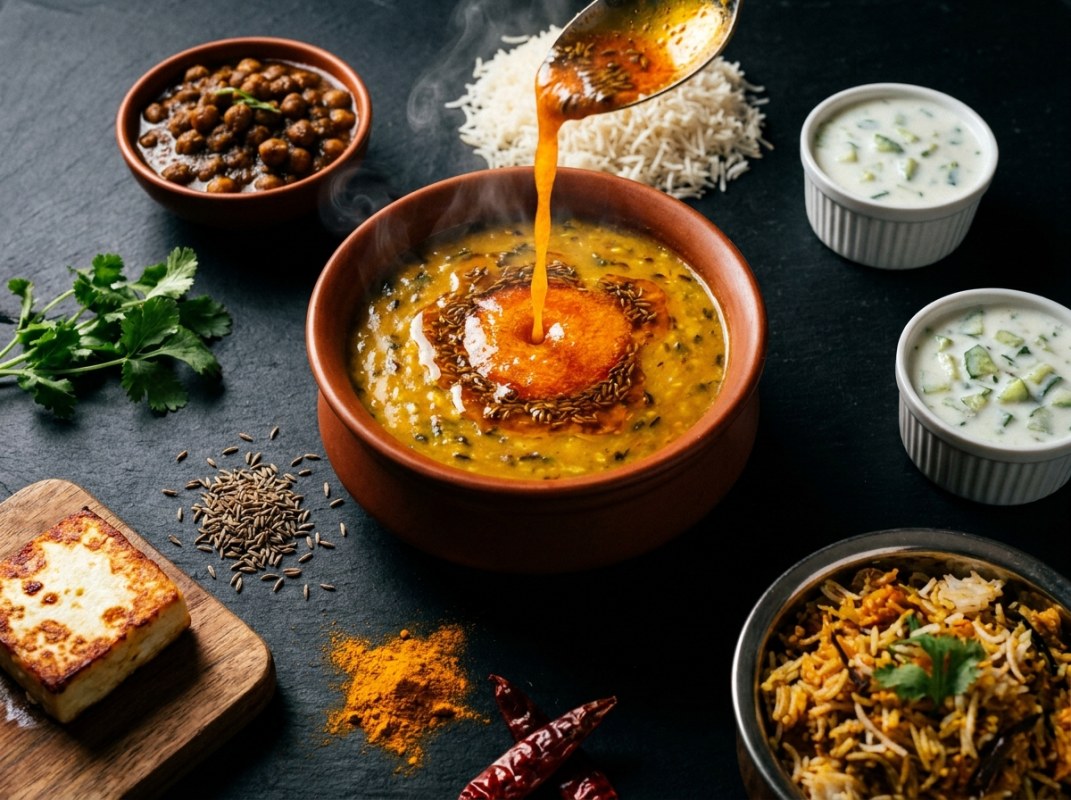
Indian meal prep is the most underrated meal prep category on the internet, and I'm genuinely surprised it's taken this long for people to figure it out. Here's the thing nobody talks about: most Indian food is literally designed to hold. Dal, chana masala, chicken tikka masala, rajma, sambar — these are dishes developed in cultures where batch cooking and next-day eating weren't a trend, they were just how food worked. The spices improve with time. The flavors develop and deepen. A dal on day 3 is measurably better than the dal you made on Sunday. Try that argument for a green salad.
What you'll have after this: 12 dishes with exact storage times, cost per serving, and freeze-worthiness ratings. A clear split between dishes that work for the full 5 days and those that need to be eaten earlier. Specific spice costs (spoiler: absurdly cheap). And the honest trade-offs — because a couple of these don't meal prep well and I'll tell you which ones and why.

Why Indian Food Is the Best Cuisine for Meal Prep
Three structural reasons why Indian cooking is unusually well-suited to batch cooking and storage:
1. Fat and spice act as natural preservatives. The ghee, oil, and coconut milk base in many Indian curries creates a protective layer on top of the dish that slows oxidation and moisture loss. The antimicrobial properties of certain spices — turmeric, cloves, cinnamon — are well-documented. This doesn't replace refrigeration (nothing does), but it does explain why a chicken tikka masala tastes better on day 2 than day 1. The fat carries flavor compounds into the protein as it cools and reabsorbs.
2. Most of the flagship dishes are liquid-based. Soups, curries, and dal are inherently freezer-compatible because liquid expands less dramatically than water and the dish structure survives the freeze-thaw cycle. Compare this to trying to freeze a salad, a stir-fry, or most pasta dishes. Liquid is actually an advantage for long-term storage.
3. The flavor profile benefits from resting time. This is something I confirmed over years of making dal every Sunday and eating it through Friday. The cumin, coriander, turmeric, and garam masala in a proper dal need 24 to 48 hours to fully bloom and integrate. Fresh dal tastes good. Day-2 dal tastes great. The same is true for rajma, chana masala, and any curry with a complex spice base. This is the opposite of most Western meal prep dishes, which slowly decline from their freshest state on day 1.
12 Indian Dishes Ranked for Meal Prep
| Dish | Fridge Life | Freeze Life | Cost/Serving | Prep Time |
|---|---|---|---|---|
| Dal tadka (lentil soup) | 5 days | 3 months | $0.40 | 30 min |
| Chana masala (chickpea curry) | 5 days | 3 months | $0.52 | 35 min |
| Rajma (kidney bean curry) | 5 days | 3 months | $0.58 | 40 min |
| Chicken tikka masala | 4 days | 2 months | $2.10 | 50 min |
| Palak paneer (spinach + cheese) | 4 days | 2 months | $1.80 | 35 min |
| Sambar (lentil vegetable soup) | 4 days | 3 months | $0.55 | 45 min |
| Aloo gobi (potato cauliflower) | 4 days | 2 months | $0.70 | 30 min |
| Chicken curry | 4 days | 2 months | $1.90 | 45 min |
| Basmati rice (plain) | 4–6 days | 1 month | $0.18 | 15 min |
| Biryani (rice + protein) | 3 days | 1 month | $2.40 | 75 min |
| Raita (yogurt condiment) | 3 days | Do not freeze | $0.35 | 5 min |
| Parathas (flatbread) | 3 days | 2 months | $0.40 | 25 min |
The clear pattern: legume-based dishes (dal, chana masala, rajma) are the champions — cheapest, longest storage, freeze indefinitely. Protein curries (tikka masala, chicken curry) hold 4 days in the fridge and 2 months frozen. Biryani and rice-protein combinations are the weakest for long-term storage because the rice texture degrades faster than the protein when frozen together.

Dal: The $0.40 Meal That Freezes 3 Months
Dal tadka is the single most cost-effective meal prep food in any cuisine. I'm not being dramatic: a full batch of 8 servings costs about $3.20 in ingredients at 2026 US grocery prices. That's $0.40 per serving for a dish that provides 14g plant protein, 38g complex carbohydrates, and enough flavor complexity to eat twice a week without getting bored.
The math: 2 cups dry red lentils ($1.89/lb = $0.95) + 1 can diced tomatoes ($0.89) + 1 onion ($0.20) + 4 cloves garlic ($0.15) + fresh ginger ($0.20) + cumin seeds, coriander, turmeric, garam masala ($0.35 combined at bulk spice prices) + ghee or butter ($0.25) = $2.99 for 8 servings at $0.37 each. Round up to $0.40 with salt and oil.
The reason dal works so well frozen: red lentils have very little structural integrity to begin with (they cook to a smooth, porridge-like consistency), so the freeze-thaw cycle doesn't degrade the texture noticeably. Yellow dal holds even better frozen than brown or green lentils, which have more firm texture to lose. Freeze in 2-cup portions — the right amount for a single serving with rice.
Chicken Tikka Masala: The Best Freezer Curry
Chicken tikka masala is the most practically useful Indian meal prep recipe for people who aren't vegetarian. At $2.10 per serving it costs more than the lentil dishes, but it delivers 32g protein per serving and it freezes for 2 months without perceptible quality loss. I've been doing this for four years and I maintain a 6-portion rotation in my freezer at all times — whenever I make a batch, I freeze half and eat the other half that week.
The key detail most recipes skip: the chicken must be marinated for at least 4 hours (overnight is better) in yogurt, lemon juice, and spices before cooking. The yogurt contains lactic acid that partially denatures the muscle proteins — this is what makes the chicken tender rather than rubbery after reheating. Skip the marinade and you get chicken with good flavor but texture that tightens on reheating. The overnight marinade is worth every minute of advance planning.
Freezing tikka masala: cool completely, portion into 2-cup containers, freeze. Thaw overnight in the fridge — never on the counter. Reheat in a saucepan over medium-low heat, add 2 tbsp water if it's thickened from freezing, stir until heated through to 165°F (74°C). Don't microwave from frozen — the sauce separates and becomes grainy.
Spice Costs: Why Indian Meal Prep Is Cheaper Than It Looks
The main thing that scares people off Indian meal prep is the spice list. A dal recipe lists 8 different spices and most people price that out at $40 in their head. The actual math is different.
Buying spices in bulk bins (Whole Foods, Indian grocery stores, Patel Brothers if you have one nearby) versus pre-packaged jarred spices cuts cost by 60 to 80%. Here's the per-serving cost of the spice blend for a standard dal tadka: cumin seeds $0.04, coriander $0.03, turmeric $0.02, garam masala $0.04, red chili powder $0.02, mustard seeds $0.02. Total: $0.17 in spices per batch of 8 servings = $0.02 per serving. That's not a typo. The upfront cost of buying 8 spices is roughly $20 to $30 at bulk prices. Amortized over 50 batches of dal, that's $0.40 to $0.60 total per batch.
If you don't have access to an Indian grocery store, Amazon sells bulk spices through their pantry program. Cumin seeds 1lb is about $7.99 and will last you 2 years of weekly cooking. The spice cost becomes irrelevant within 3 to 4 uses.

Dishes That Don't Meal Prep Well (Be Honest)
Not everything in Indian cooking translates to meal prep, and I'd rather you know this now than discover it on Thursday.
Pakoras and samosas: Fried items that need to be crispy. They soften within 4 hours in a container. Not meal prep food. Eat them fresh.
Dosa: South Indian rice and lentil crepes. They require fresh batter and a hot griddle. The fermented batter lasts 5 days in the fridge, but the crepes themselves must be cooked fresh. You can prep the batter — not the finished dosa.
Biryani: This one is controversial. Biryani is technically meal-preppable — it lasts 3 days in the fridge and 1 month frozen. But the layered texture that makes biryani special (the contrast between fluffy top rice and saucy bottom) disappears when it's reheated in a container. Day-2 biryani is a rice-curry mash. Still tasty, but not biryani in the way you'd want it.
Fresh chutneys: Mint-cilantro chutney lasts 3 days refrigerated and browns by day 4. Tamarind chutney lasts longer — up to 2 weeks. Make tamarind chutney in bulk; buy or make mint chutney fresh in small amounts.
The Complete Indian Meal Prep Sunday Session (2 Hours, 10 Servings Each)
The most efficient Indian meal prep session I've settled on after years of iteration: one big batch of dal, one curry (either chana masala or chicken tikka masala depending on whether I want a vegetarian week), and plain basmati rice. That's three components that combine into 10 to 12 complete meals. Here's the exact sequence:
- Start dal first (30 min total, mostly simmering). Rinse 2 cups red lentils, add to pot with 5 cups water. Bring to boil, reduce heat, simmer 20 minutes while you do everything else. Don't leave it — check every 5 minutes as lentils can boil over.
- While dal simmers, make the curry base (15 min active). Finely dice 2 onions, cook in ghee over medium-high 8 minutes until golden. Add ginger-garlic paste (or finely minced fresh — 1 tbsp each). Add tomatoes, spices, let it reduce 5 minutes. Add your protein or legumes. For chana masala: add 2 cans chickpeas + ½ cup water, simmer 15 minutes. For chicken: add marinated chicken pieces, cook 20 minutes covered.
- Cook basmati rice (15 min, unattended). 2 cups dry rice, 3.5 cups cold water, bring to boil, lid on, 12 minutes on low, 5 minutes rest off heat. Wash rice first — rinse 3 times until water runs clear. This removes excess starch and makes it fluffier.
- Make tadka for dal (3 min). Once lentils are soft and creamy: heat ghee in a small pan, add cumin seeds, let them pop 30 seconds, add sliced garlic, let it turn golden, pour over dal. Stir in salt, lemon juice, fresh cilantro if you have it.
- Cool everything on sheet pans. Spread rice, dal, and curry each on separate sheet pans for 20 minutes. Never seal warm food in containers — steam creates condensation that speeds spoilage.
- Portion and pack. Freeze half the dal and half the curry (8 servings each — 4 in fridge, 4 in freezer). Rice: all in fridge, use within 4 to 6 days.
Frequently Asked Questions
How long does Indian food last in the fridge?
Most Indian curries and dal last 4 to 5 days refrigerated at 40°F (4°C) or below per USDA FoodKeeper (foodkeeper.usda.gov) guidelines for cooked dishes containing meat or legumes. Legume-based dishes like dal and chana masala often hold the full 5 days well because there's no animal protein to spoil. Chicken-based curries are best consumed within 4 days. Cooked basmati rice: 4 to 6 days. Fresh raita with yogurt: 2 to 3 days maximum.
Can you freeze Indian curry?
Yes — Indian curry is one of the best foods to freeze. Liquid-based curries (dal, chana masala, tikka masala, chicken curry) freeze for 2 to 3 months with minimal quality loss. Freeze in individual 2-cup portions in airtight containers or freezer bags. Thaw overnight in the fridge, not on the counter. Reheat in a saucepan with 2 tablespoons of water over medium-low heat. Do not microwave from frozen — the sauce texture separates. Dishes with cream or yogurt can separate slightly on reheating; whisk in 1 tablespoon of fresh cream to restore texture.
What Indian dishes are best for meal prep beginners?
Start with dal tadka and chana masala. Both are entirely plant-based, nearly impossible to overcook, require no special technique, and cost under $0.55 per serving. Dal tadka takes 30 minutes and you cannot mess it up — it's essentially boiling lentils and pouring seasoned ghee over them. Chana masala requires one extra step (making the onion-tomato base) but is equally forgiving. Master these two dishes and you have 10 to 12 meals per Sunday for under $6 total.
Does Indian food taste better the next day?
Yes, for most dishes — and this isn't just a comforting belief. It's a real culinary phenomenon. The fat-soluble flavor compounds in spices like cumin, coriander, and garam masala continue to infuse into the liquid and protein as the dish cools and rests. The onion-tomato base also mellows and integrates overnight, losing any raw sharpness. Dal and most curries genuinely taste better on day 2 and sometimes day 3 than they did the moment you made them. This makes Indian food one of the rare exceptions to the "meal prep food declines over time" rule.
Is Indian meal prep good for weight loss?
Legume-based Indian dishes are excellent for weight management. Dal and chana masala are high in protein and fiber, low in fat, and have a relatively low glycemic index — lentils score around 32 on the GI scale versus 72 for white rice. A serving of dal with basmati rice provides roughly 400 to 450 calories with 18 to 20g protein and 12 to 15g fiber, which creates lasting satiety. The one area to watch: ghee and cream-based dishes like butter chicken or palak paneer are calorie-dense — a full restaurant portion of butter chicken can hit 600 to 700 calories. Make at home with lighter proportions of ghee and cream and the same dish runs 380 to 420 calories per serving.
At $0.40 per serving for dal and under $2.50 for the most complex chicken curries, Indian meal prep is the cheapest way to eat interesting, nutritionally complete food all week. Two hours on Sunday. A jar of ghee, a bag of lentils, and 8 spices that will outlast a full year of cooking. The freezer does the rest.