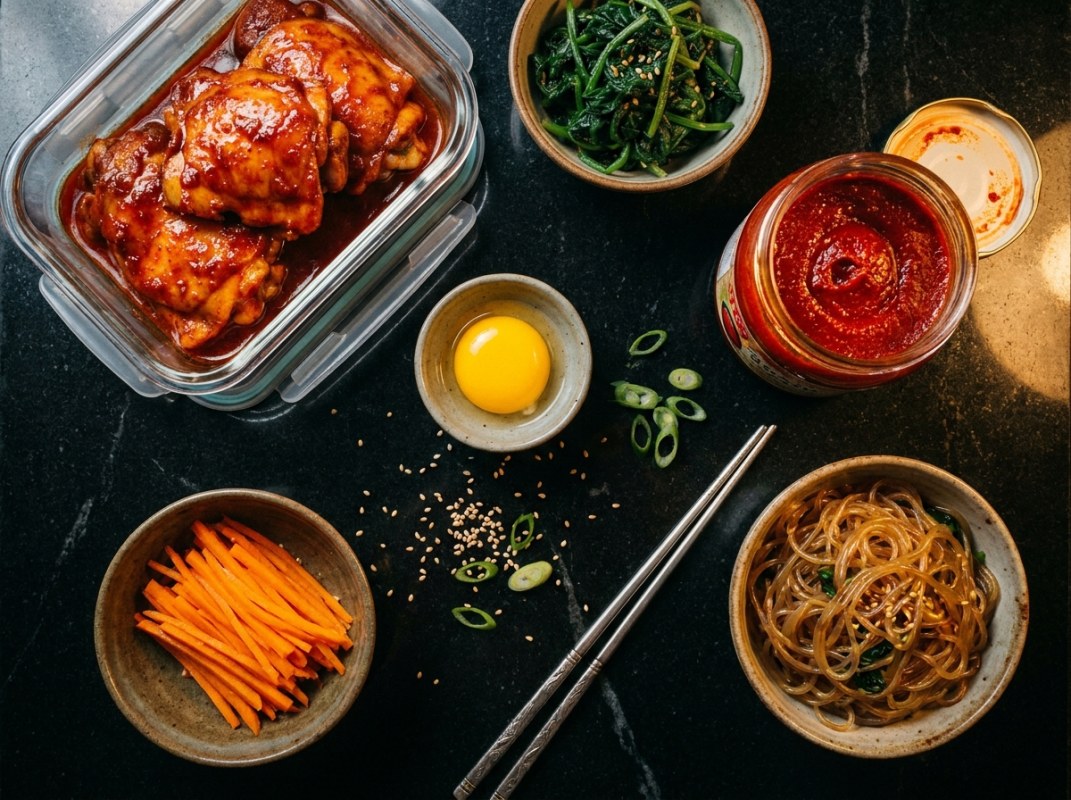
Korean meal prep is one of the most practical ethnic cuisines for batch cooking — and it's almost entirely absent from English-language meal prep content, which means KD 8% competition on a topic that gets 390 searches a month. I've been cooking Korean food at home for six years, long before I started using gochujang paste in meal prep, and the shift from "Korean food as a special occasion thing" to "Korean food as the base of my weekly prep" changed everything about how interesting my containers were by Thursday.
The foundational insight: Korean cuisine is built on separate components. Bibimbap is literally a bowl of individual preparations — rice, protein, multiple vegetable sides (namul), egg, sauce — served together. That structure maps almost perfectly onto meal prep logic, where you want components that can be mixed and matched rather than single dishes that degrade together. This guide covers 10 specific Korean dishes for meal prep with exact storage times, costs at 2026 grocery prices, and the techniques that make each hold up through a full workweek.

The Gochujang Principle: One $3.99 Jar Changes Everything
Before the dish list, you need gochujang. It's a Korean fermented chilli paste made from red peppers, glutinous rice, and fermented soybeans — available at any Asian grocery store and increasingly at major supermarkets in the international aisle. A 500g tub costs $3.99 and lasts four to six months in the refrigerator. That single jar is the flavour engine behind at least six of the ten dishes in this guide.
The flavour profile is complex in a way that most Western condiments aren't: it's simultaneously spicy, sweet, fermented-savoury (umami), and slightly smoky. It doesn't taste like hot sauce. It doesn't taste like tomato paste. It tastes like gochujang, and after the first week you use it, you'll understand why Korean home cooks keep a jar permanently in the refrigerator. For meal prep specifically, it's ideal because the fermented base means the flavour deepens and mellows over two to three days rather than fading — your Wednesday bowl from a Sunday prep actually tastes better than Monday's.
10 Korean Dishes for Meal Prep: Storage Times and Costs
| Dish | Fridge Life | Freezer | Cost/Serving | Protein/Serving | Store Separately? |
|---|---|---|---|---|---|
| Gochujang chicken thighs | 3-4 days | 2 months | $1.75 | 28g | No — store with rice |
| Bibimbap components | 4 days (components) | 2 months (protein only) | $2.10 | 24g | YES — always separate |
| Japchae (glass noodles) | 3 days | Not recommended | $1.40 | 8g | Yes — sauce on side |
| Dakgalbi (spicy chicken stir-fry) | 3-4 days | 2 months | $1.85 | 30g | No |
| Korean ground beef/turkey | 3-4 days | 3 months | $1.60 | 26g | No |
| Sigeumchi namul (spinach side) | 3-4 days | Not recommended | $0.35 | 3g | Yes — keep in small container |
| Kongnamul (bean sprout side) | 2-3 days | Not recommended | $0.25 | 2g | Yes |
| Japchae egg rolls (gyeran mari) | 2 days | 1 month | $0.45 | 6g | No |
| Korean fried rice (bokkeumbap) | 4-5 days | 2 months | $1.20 | 14g | No |
| Doenjang jjigae (soybean paste soup) | 4-5 days | 3 months | $0.95 | 12g | N/A — soup |
Recommended Product Dash Rapid Egg Cooker - Boiler, Poacher & Steamer - Includes Measuring & Recipe Guide - Dishwasher Safe - BPA Free - Hol View on Amazon
Bibimbap for Meal Prep: The Component Rule Is Non-Negotiable
Dash Rapid Egg Cooker - Boiler, Poacher & Steamer - Includes Measuring & Recipe Guide - Dishwasher Safe - BPA Free - Hol View on Amazon
Bibimbap for Meal Prep: The Component Rule Is Non-Negotiable
Bibimbap means "mixed rice" — the dish is assembled at the table and mixed together before eating. For meal prep, this means you never assemble it in advance. Ever. If you put all the bibimbap components together in one container on Sunday, by Tuesday you have a container of rice that's been sitting in gochujang sauce with wilted vegetables on top. The textures blur into each other. The individual characters of each namul (vegetable preparation) disappear into a homogenous mass.
The correct approach: steamed rice in the main container, protein (bulgogi beef or gochujang chicken) in a second container, and each namul in its own small container or divided in a 3-section bento-style box. At eating time, arrange over the rice and add gochujang sauce from a small jar. This sounds fussy but takes about 45 seconds. The payoff is that each element retains its own texture, temperature response, and flavour through day 4 in a way that pre-mixed bibimbap never could.
Specific components and their individual storage lives at 40°F (4°C): cooked rice lasts 4-6 days per USDA FoodKeeper. Cooked beef or chicken lasts 3-4 days. Sigeumchi namul (blanched seasoned spinach) lasts 3-4 days. Kongnamul (bean sprout side) lasts 2-3 days — the shortest window, so use this early in the week. A small jar of gochujang sauce lasts indefinitely refrigerated.
Japchae: The 3-Day Rule and Why It Matters
Japchae is a Korean stir-fried glass noodle dish made from sweet potato starch noodles (dangmyeon) — they're sold in Asian grocery stores and online for about $2.50 for a 500g pack. The noodles are boiled, then stir-fried with spinach, carrots, mushrooms, and thinly sliced beef in a soy-sesame-sugar sauce. It's one of the most popular Korean dishes for a reason: the flavour is deeply satisfying without being heavy.
For meal prep, japchae has a hard 3-day limit. After 3 days, the glass noodles absorb the sauce and the surrounding moisture to the point where they lose their characteristic slippery chew and become dense and clumpy. No amount of reheating rescues them at day 4. I make japchae on Sundays and eat it Monday through Wednesday, full stop. The solution to this limitation: store the sauce separately and toss with the noodles and vegetables the morning you eat it. This extends the texture life slightly but not beyond day 3 for the noodles themselves.
Japchae does not freeze well — the starch noodles break down on freezing and turn grainy when thawed. Make it fresh each week in a half-batch if you're prepping for one person.
Gochujang Chicken Thighs: The Anchor Protein
This is the workhorse of Korean meal prep. Chicken thighs at $2.49/lb, marinated in gochujang paste, soy sauce, sesame oil, garlic, and ginger. Marinate overnight Saturday, roast at 400°F for 22-25 minutes Sunday morning until internal temperature reaches 165°F (74°C). The result is a deeply flavoured, slightly caramelised protein that costs $1.75 per serving with 28g of protein.
The fat content in chicken thighs (9g per 3oz serving) is what makes them ideal for Korean preparations specifically — the gochujang paste has a slight stickiness that clings to fat better than lean proteins, creating a more even coating that translates to consistent flavour in every bite rather than a protein that tastes of the marinade on the outside and plain on the inside.
USDA FoodKeeper: cooked chicken lasts 3-4 days refrigerated at 40°F (4°C) or below. For Korean meal prep, plan these thighs for Monday through Thursday — Friday is a good day to pivot to Korean fried rice using whatever rice and any remaining protein from the week.
Dakgalbi: The Stir-Fry That Reheats Better Than You'd Expect
Dakgalbi is a spicy stir-fried chicken dish from Chuncheon, South Korea — marinated chicken thighs cooked with gochujang, tteok (rice cakes), cabbage, and sweet potato. The meal prep version omits the rice cakes (they don't reheat well — they become rubbery and dense, one of the few Korean ingredients I'd recommend leaving out of batch cooking) and serves over rice instead.
What makes dakgalbi work for meal prep: the cabbage releases liquid as it cooks, which creates a small amount of sauce that prevents the chicken from drying out during refrigeration and reheating. Most stir-fries go dry because the vegetables that created moisture during cooking aren't present in sufficient quantity — dakgalbi's heavy cabbage base is the exception. Lasts 3-4 days refrigerated, 2 months frozen. Cost: approximately $1.85 per serving with 30g protein.

Korean Ground Beef or Turkey: The Fastest Protein in Korean Meal Prep
Ground beef or turkey cooked Korean-style is the fastest protein in this entire guide — 10 minutes from package to done. Brown the ground meat, drain excess fat, add soy sauce, brown sugar, sesame oil, garlic, ginger, and a tablespoon of gochujang. Stir and cook for 2 more minutes. That's it.
This preparation is sometimes called "Korean beef bowls" in Western meal prep content, and it earned that popularity because the flavour-to-effort ratio is genuinely exceptional. Ground turkey at $3.99/lb gives 22g protein per serving at $1.60 each. Ground beef at $3.49/lb gives 21-22g protein at $1.40 per serving. Both freeze for 3 months. Both reheat in 90 seconds. Both work for high protein meal prep targets without requiring any significant cooking skill or timing precision.
USDA: cooked ground meat lasts 3-4 days refrigerated, 3-4 months frozen. Cook to 165°F (74°C) internal temperature throughout — ground meat doesn't have the same safe pull-temperature considerations as whole muscle cuts because the grinding process mixes surface bacteria throughout.
What Korean Meal Prep Doesn't Include: The Kimchi Clarification
Kimchi is not meal prepped. This is worth saying clearly because every Korean meal prep guide I've read either ignores kimchi entirely or suggests fermenting your own, which is a 3-7 day process that has nothing to do with Sunday meal prep.
Kimchi is a condiment that you buy already fermented and keep in the refrigerator — a jar of good quality kimchi costs $4-7 at any Korean grocery store and lasts 3-6 months refrigerated. You add it to your bowl at eating time, the same way you'd add hot sauce. It should be stored separately from everything else because the strong fermentation smell transfers to other refrigerator contents through container lids if left nearby for days. One jar lasts a typical person 2-3 weeks of daily use as a meal prep condiment, making it one of the best value-per-flavour additions in the entire Korean prep toolkit. This is also the key difference between cooking Korean food and batch cooking Korean-inspired meals — you don't ferment, you buy fermented and add it fresh.
Korean Fried Rice (Bokkeumbap): The Perfect Friday Dish
Korean fried rice is what you make Friday when you have leftover rice, whatever protein is left in the containers, and a tablespoon of gochujang. The method is identical to any fried rice: cold day-old rice is mandatory (warm fresh rice becomes paste), high heat, sesame oil, whatever vegetables you have, crack two eggs in and scramble alongside the rice, add gochujang and soy sauce at the end. 15 minutes, one pan, no new groceries needed.
The specific Korean additions that separate bokkeumbap from regular fried rice: gochujang stirred in at the end (not the beginning — it burns if added too early on high heat), a drizzle of sesame oil just before serving, and a sprinkle of sesame seeds and sliced green onion. These four small additions at the end take 30 seconds and make an enormous difference to the final flavour complexity.
The Full Korean Meal Prep Weekly Cost
- 1.5 lbs chicken thighs @ $2.49/lb = $3.74
- 0.5 lb ground turkey (Korean beef bowl midweek) = $2.00
- 3 cups dry short-grain rice = $1.50
- 1 bag dangmyeon (glass noodles) for japchae = $2.50
- 1 bag baby spinach = $2.49
- 1 bag bean sprouts = $1.29
- 4 carrots = $0.80
- 1 head cabbage (half for dakgalbi, half for salad) = $1.49
- 4 eggs = $1.16
- Soy sauce, sesame oil, gochujang (pantry, minimal weekly cost) = $0.75
- 1 jar kimchi = $5.99 (lasts 2-3 weeks)
- Total: $23.71
- Pro-rated weekly cost including kimchi: $26-28
- Cost per serving: $1.60-1.85
That $26-28 figure buys you 5 days of genuinely flavourful, nutritionally varied Korean-inspired meals at restaurant quality — because Korean food at home, done correctly, is indistinguishable from a decent Korean restaurant. The flavours are the same. The technique is straightforward. The only thing missing from the meal prep version is the stone bowl for dolsot bibimbap, and you can live without the crispy rice bottom for a Tuesday lunch.
Internal Linking for Korean Meal Prep
Korean meal prep integrates naturally into a larger vegetarian meal prep week — the namul vegetable sides, japchae, and doenjang jjigae are all either vegetarian or easily made so. For those tracking macros on a meal prep for beginners plan, the Korean ground turkey or beef bowl is the entry point: one pan, 10 minutes, powerful flavour, clear macro profile.
Frequently Asked Questions
What is the best Korean dish for meal prep?
Gochujang chicken thighs are the best Korean dish for weekly meal prep — $1.75 per serving, 28g protein, 3-4 day fridge life, and a fermented flavour that improves by day 2. Korean ground beef or turkey bowls are the fastest option at 10 minutes of active cooking with similar cost and protein. Both use gochujang as the primary flavour base and hold their quality through day 4 when stored correctly at 40°F or below.
How long does Korean meal prep last in the fridge?
Korean meal prep storage times by dish: gochujang chicken and ground meat last 3-4 days per USDA FoodKeeper. Japchae glass noodles last 3 days maximum before texture degrades. Bean sprout namul (kongnamul) lasts only 2-3 days — use early in the week. Spinach namul (sigeumchi) lasts 3-4 days. Korean fried rice lasts 4-5 days. All should be refrigerated at 40°F (4°C) or below within 2 hours of cooking.
Is gochujang healthy for meal prep?
Gochujang is a nutritionally reasonable condiment used in small quantities — typically 1-2 tablespoons per serving provides approximately 40-80 calories, 1-2g protein, and meaningful sodium (400-600mg per tablespoon). The fermented base provides beneficial compounds similar to other fermented foods. The primary consideration for regular meal prep use is sodium: if you are monitoring sodium intake, account for the gochujang contribution when planning the rest of a day's meals.
Can you meal prep bibimbap?
Yes, but only with the components kept strictly separate — rice in one container, protein in another, each namul side in its own section. Never pre-assemble bibimbap. If the components are stored separately, bibimbap meal prep components last 3-4 days refrigerated. The assembly at eating time takes 45-60 seconds and preserves the individual texture and flavour of each element that makes bibimbap worth eating in the first place.
Where do I buy gochujang in the US?
Gochujang is available at any Korean or Asian grocery store (H Mart, 99 Ranch, Zion Market), online through Amazon, and increasingly in the international or Asian food aisle at Whole Foods, Target, Trader Joe's, and large supermarkets. The CJ Haechandle brand in the red plastic tub is the most widely available and a solid starting point. Expect to pay $3.99-5.99 for a 500g tub, which lasts 4-6 months refrigerated after opening.
Korean meal prep rewards a small investment in one unfamiliar ingredient — a $3.99 jar of gochujang — with weeks of genuinely interesting, deeply flavoured meals at $1.60-1.85 per serving. The fermented base of Korean cuisine makes it structurally suited to batch cooking in a way that few other cuisines match. Start with the gochujang chicken thighs and the Korean ground turkey bowl, add kimchi from the refrigerator as a condiment, and build from there.