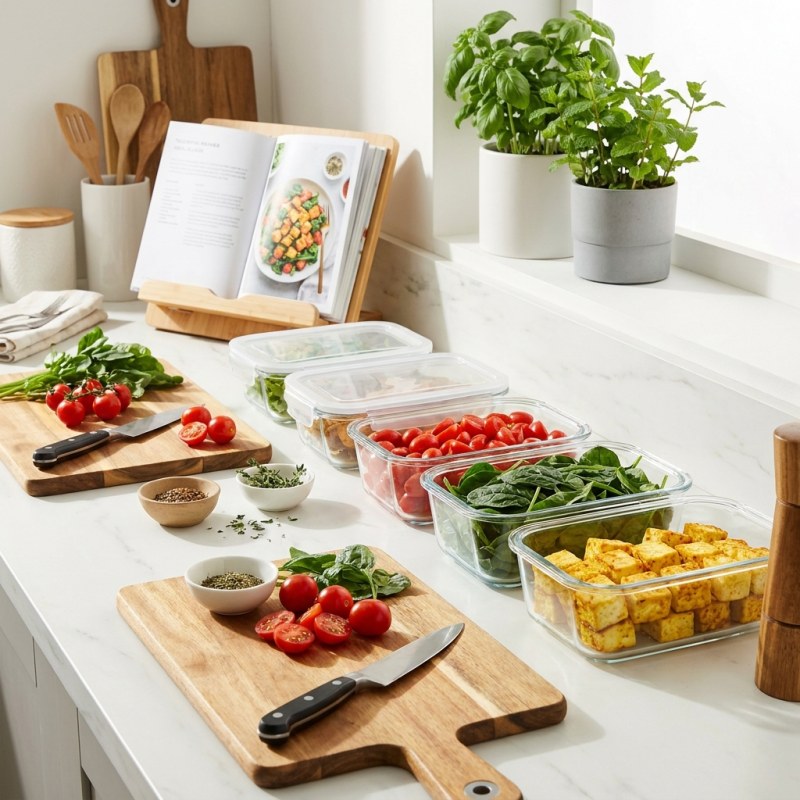
This 5-day plan is built specifically for a genuine first attempt at vegetarian meal prep — low ingredient counts, forgiving timing, and only two dishes to manage across the whole week rather than five different recipes. I built this exact structure after watching too many beginners try to prep five separate elaborate meals in their first week and quit by Wednesday from sheer overwhelm.

The 5-Day Breakdown
Day 1 (Monday): Easy Vegetarian Pasta with roasted vegetables and pesto. 420 calories, 22g protein.
Day 2 (Tuesday): Same pasta, reheated — no new cooking required.
Day 3 (Wednesday): Sheet-pan chickpeas and roasted vegetables over rice, a genuine change of pace with minimal new effort.
Day 4 (Thursday): Same chickpea bowl, reheated.
Day 5 (Friday): Overnight oats with peanut butter — no cooking at all, made the night before as a lighter end to the week.
Weekly Shopping List and Real Cost
- 1 lb pasta — $1.50
- Jar of pesto — $4.99
- 2 cans chickpeas — $2.58
- 1 cup dry rice — $1.20
- Mixed vegetables for both roasting sessions — $10.00
- Oats, peanut butter, milk (partial cost) — $4.50
Total: $24.77 for the week, or about $4.13 per serving across the five main meals plus the overnight oats.
Daily Nutrition Targets
Each main meal in this plan lands between 310-420 calories and 14-22g of protein, with the overnight oats adding another 380 calories and 15g protein for the fifth day. This isn't a strict calorie-controlled plan — it's designed around building the meal prep habit first, with nutrition optimization as a secondary goal for later once the routine feels comfortable.

Storage Notes for the Full Week
Per USDA FoodKeeper guidance, keep all containers refrigerated at 40°F (4°C) or below. Cooked pasta and roasted vegetables both hold for 3-5 days, and overnight oats last 4-5 days sealed. None of this week's dishes require anything beyond standard refrigeration or special handling.
This plan works because it deliberately limits the number of new things you're learning at once. Two dishes, repeated with minimal variation, is enough to prove the concept works for you before adding complexity in week two.
Adjusting the Plan Once You're Comfortable
Once this 5-day structure feels easy rather than effortful — usually after 2-3 weeks of repeating it — that's the signal to add a third dish into the rotation, try a new sauce on the existing pasta, or attempt one of the other ten ideas from the full beginner guide. There's no need to rush this; a comfortable, repeatable two-dish week that actually happens every week beats an ambitious five-dish week that only happens once.
What to Do If Even This Feels Like Too Much the First Week
If two dishes still feels overwhelming, cut it down further to just the overnight oats and one cooked dish. There's no rule that says a first week of meal prep needs to cover five full days — even successfully prepping breakfast for a week while easing into one cooked lunch or dinner is a real, legitimate starting point worth building from. The goal at this stage isn't covering every meal of every day; it's proving to yourself that the basic process — cook, portion, store, reheat — works and fits into your actual life, not the idealized version of a meal prep routine you might see elsewhere.


Why This Plan Deliberately Repeats Meals
Repetition across the week is intentional here, not a limitation. Cooking two dishes and eating each one twice means only two actual cooking sessions to manage, which is a meaningfully lower bar than five different meals requiring five different sets of ingredients and techniques. Once the routine of cooking once and eating from it multiple times feels natural, adding more variety becomes a matter of choice rather than something that has to be figured out all at once alongside everything else that's new about meal prep as a habit.