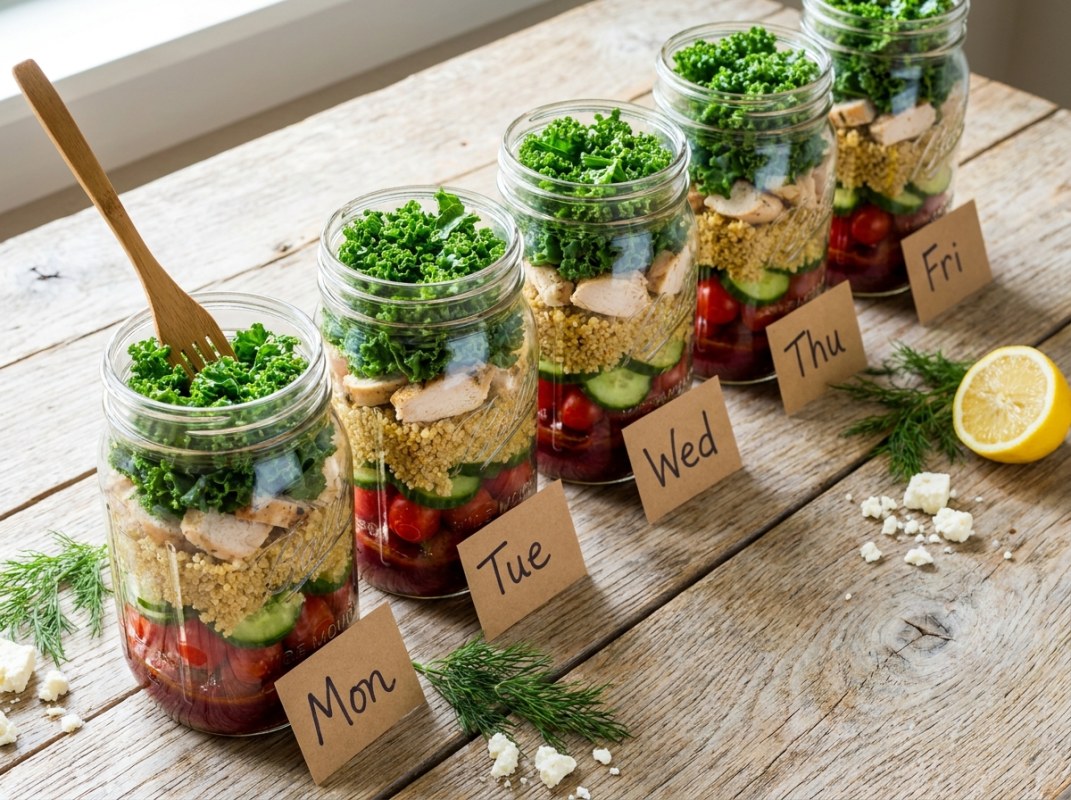
Meal prep salad has a reputation problem — and it's almost entirely self-inflicted. The mistake isn't prepping salads ahead. The mistake is treating them like a bowl when you need to think like a jar. I've been making meal prep salads for six years and the single biggest thing I changed was the layering order. That one shift took my salads from wilted messes on day 2 to genuinely crisp, fresh-tasting lunches through Friday.
Here's what you'll have by the end of this: the exact no-soggy layering method, a ranked table of greens by how long they actually last, the dressings that work versus the ones that destroy everything, and a system for building 5 different salads in about 25 minutes on Sunday. No fancy equipment. Just mason jars, a bit of planning, and a few rules you don't break.
Why Your Meal Prep Salad Goes Soggy (It's Not the Dressing)
Most people blame the dressing. It's not the dressing — it's contact between the dressing and the greens. When acid from vinaigrette or even just moisture from other ingredients sits against leafy greens, it starts breaking down the cell walls. You're essentially starting the wilting process the moment you assemble it wrong.
The real culprits are three things happening together: wet proteins sitting against greens, soft vegetables releasing moisture over 24 hours, and dressing pooling at the bottom of a flat container where greens absorb it from below. Fix all three and your salads stay crisp. Here's the actual science: romaine and kale have waxy cuticles on their leaves that resist moisture — but only if they're not in direct contact with liquid. Once liquid gets between that cuticle and the leaf surface, osmosis pulls water into the tissue and the wax layer can't recover.
The other thing nobody talks about: not all greens are equal for meal prep. I tested every common green I could find over three weeks, prepped identically, same dressing, same jar. The difference was dramatic.
Greens Ranked by Meal Prep Storage Life
| Green | Fridge Life (prepped) | Best Use | Notes |
|---|---|---|---|
| Kale (massaged) | 5 days | Hearty lunch bowls | Massage with oil — breaks down bitterness, extends life |
| Romaine | 4 days | Classic salads, Caesar style | Chop thick, pat completely dry |
| Cabbage (shredded) | 5 days | Asian-style, slaw base | Gets better as it sits — lightly pickled effect |
| Iceberg | 3–4 days | Crunchy base, tacos | High water content — keep separate from warm foods |
| Mixed greens / spring mix | 2–3 days | Quick weekday salads | Fragile — add Tuesday through Thursday only |
| Spinach (baby) | 2–3 days | Lighter salads, grain bowls | Wilts fast — better for Mon/Tue jars only |
| Arugula | 2 days | Monday lunch only | Delicate, peppery — do not prep ahead past day 2 |
| Butter lettuce | 1–2 days | Not recommended for prep | Too fragile — use fresh only |
The practical takeaway: if you're prepping for the full week, build your Monday and Tuesday jars with spinach or arugula, and your Wednesday through Friday jars with kale or cabbage. This isn't complicated — it just takes about 30 seconds of extra planning when you're portioning.
The Exact Layering Order (This Is the Method)
I've seen every variation of this online. Some people put cheese on the bottom, some people put grains right against dressing. After testing every combination that makes logical sense, here's the order that actually works:
- Dressing (2 tbsp) — goes in first, at the bottom. Not the top. Not in a separate container. The bottom. Gravity keeps it away from the greens as long as everything above it is a barrier. A wide-mouth quart mason jar is the right vessel — narrow jars make this harder to execute.
- Hard vegetables — directly on top of the dressing. Cucumbers, cherry tomatoes, bell peppers, carrots, red onion. These don't absorb dressing the way greens do, and they form a physical barrier. Cut them thick enough that they don't compress. Cherry tomatoes work well here because they don't absorb liquid at all.
- Grains or beans — third layer. Quinoa, farro, chickpeas, black beans, cooked lentils. These soak up any dressing that migrates upward and act as insulation for the protein above. They're also filling and calorie-dense, which matters for a lunch that's supposed to hold you until dinner.
- Protein — fourth layer. Cooked chicken, hard-boiled eggs, canned tuna, roasted chickpeas (extra crunch), sliced steak. Keep protein at room temperature for no more than 2 hours before eating — take the jar out of the fridge when you get to work, eat it at lunch.
- Soft vegetables and toppings — fifth layer. Avocado (add fresh, not prepped — it browns), shredded cheese, croutons (in a separate small bag), dried cranberries, nuts. Anything with moisture goes at the bottom of this layer; anything dry or crispy goes at the top.
- Greens — last, packed in tight. Don't be shy about how much you pack. Greens compress as they sit, so what looks like too much on Sunday is exactly right by Wednesday. Leave about half an inch of headspace so the lid seals without crushing them.
When you're ready to eat, shake the jar vigorously with the lid on. The dressing travels from bottom to top and coats everything. Or dump it into a bowl if you'd rather. Either works — the point is that the greens haven't touched dressing for 4 days and they're still crisp.
Dressings That Work vs. Dressings That Destroy Everything
I learned this the hard way on a batch of tahini-dressed kale salads that I was convinced would be fine. By day 3, the tahini had separated, pooled, and made everything taste like wet cardboard. Not all dressings behave the same way in a sealed jar over 4 days.
| Dressing Type | Max Storage Days | Verdict |
|---|---|---|
| Red wine vinaigrette | 5 days | ✅ Best choice — stable, improves flavor |
| Lemon + olive oil | 4–5 days | ✅ Clean, brightens over time |
| Balsamic vinaigrette | 4–5 days | ✅ Works perfectly, holds emulsion |
| Miso-sesame | 3–4 days | ✅ Umami-forward, good on kale |
| Greek yogurt-based | 3 days | ⚠️ Acceptable but thickens — add 1 tsp water before shaking |
| Caesar (store-bought) | 3 days | ⚠️ Holds but can separate — shake well |
| Tahini | 2 days | ⛔ Separates and pools — not recommended |
| Ranch (dairy-based) | 2–3 days | ⛔ Gets thin and watery — add fresh |
| Creamy avocado | 1 day | ⛔ Oxidizes and separates — make fresh |
How to Actually Build 5 Salads in 25 Minutes
The first time I tried to meal prep salads I spent an hour making 5 different ones from scratch. Total waste of time. The system that actually works: start with two protein batches and three dressing options, then mix and match. Here's the Sunday sequence:
- Cook your proteins first (15 min active, 20 min oven). Sheet pan chicken thighs at 425°F (218°C) for 22 minutes while you prep everything else. Hard-boil 8 eggs in a separate pot simultaneously — 12 minutes from cold water to ice bath. While those cook, you do everything else.
- Prep vegetables in bulk (8 minutes). One cucumber, two bell peppers, one pint cherry tomatoes, one head of romaine or a bunch of kale. Wash, dry completely (wet greens are a death sentence for storage life), and cut everything. Lay greens on a clean kitchen towel for 5 minutes if you're in a rush — a salad spinner works better but a towel is fine.
- Set up your assembly line. 5 jars in a row. All your prepped ingredients in bowls. This is the fastest part — takes 5 minutes once everything is prepped and your proteins are cool. Never add warm proteins to jars — steam from hot chicken creates condensation inside the jar and ruins the whole thing.
- Assemble in order (5 minutes). Dressing, hard veg, grains or beans, protein, soft toppings, greens. Move down the line and fill one layer at a time across all 5 jars rather than finishing one jar at a time. Way faster.
- Seal and refrigerate immediately. Label with a piece of tape: M / T / W / Th / F. Use the Monday jar first, obviously, but if something comes up and you eat out on Tuesday, Wednesday's jar is still fine — kale salads at day 3 are genuinely better than day 1.
Proteins for Meal Prep Salads: What Works, What Doesn't
Not every protein is equal in a cold salad jar over 4 days. Some hold texture and flavor. Others turn rubbery, release moisture into the jar, or pick up off-odors from other ingredients. Here's what I've learned from prepping salads weekly for years:
Works great (4–5 days): Grilled or roasted chicken thighs (more fat = better texture), hard-boiled eggs (keep in-shell until the day of — crack and quarter for that morning's jar), canned tuna or salmon (drain completely), chickpeas (roasted for crunch — store separate and add day-of if you want them crispy), cooked lentils, diced tofu (press and bake at 400°F / 204°C for 25 minutes first).
Works for 2–3 days: Chicken breast (dries out faster), sliced flank steak, shrimp (mild off-flavor develops by day 3 — fine for some people, not others).
Don't prep ahead: Salmon at room temp for more than 2 hours, rare or medium-rare steak (food safety concern — reheat to 165°F / 74°C if storing), any fried protein (coating softens, defeats the purpose).
The Component Separation Strategy for Bigger Salads
Sometimes a mason jar isn't the right format — maybe you want a larger portion, or you're prepping for a family and jars aren't practical. The component separation strategy works for any container. The principle is the same: keep wet ingredients away from dry ingredients, and keep greens separated until serving.
In a standard 2-cup or 4-cup container: store greens in one bag or section, proteins and cooked vegetables in another, grains in a third. Pack everything separately on Sunday. Each morning, take 90 seconds to assemble your salad from the components. This sounds like more work but it's actually faster because you batch-prep each component once.
The component approach also gives you more flexibility. Instead of committing to "kale Caesar on Wednesday," you can mix and match based on what you feel like. Some weeks I do this and it keeps things from getting monotonous — a real problem with meal prep that nobody talks about enough.
5 Salad Formulas That Actually Keep 5 Days
These aren't generic recipe suggestions. Each one is built around the greens and dressings I've confirmed hold up for the full week. Kale and cabbage are the base for anything Thursday-Friday; romaine for Monday-Wednesday.
1. Kale Caesar (5 days): Massaged kale + parmesan + croutons (separate bag) + 2 hard-boiled eggs + 2 tbsp store-bought Caesar. Massage the kale with 1 tsp olive oil before packing — it softens the fiber and actually improves over 3 days. 24g protein. $2.10/serving.
2. Greek Quinoa Salad (5 days): Romaine + ½ cup cooked quinoa + cucumber + cherry tomatoes + kalamata olives + feta crumbles + red wine vinaigrette. 18g protein with feta, 28g if you add 2oz chicken. $1.90/serving without chicken.
3. Chicken and Cabbage Asian Slaw (5 days): Shredded red and green cabbage + roasted chicken thigh strips + edamame + shredded carrots + miso-sesame dressing. Cabbage gets better as it sits. 32g protein. $2.30/serving.
4. Lemon Herb Chickpea Salad (5 days, vegan): Shredded kale + roasted chickpeas + sun-dried tomatoes + red onion + cooked farro + lemon-olive oil dressing. 18g protein entirely from plants. $1.60/serving.
5. Black Bean Southwest Salad (4–5 days): Romaine + black beans + corn + roasted red pepper + avocado (add day-of) + lime-cumin vinaigrette. 16g protein from beans alone. Skip the avocado until you eat it — brown avocado on day 3 is one of the more depressing meal prep outcomes. $1.50/serving without avocado.
Frequently Asked Questions
How long does meal prep salad last in the fridge?
Properly layered mason jar salads with vinaigrette-based dressings last 4 to 5 days refrigerated at 40°F (4°C) or below. Kale and cabbage-based salads often hit the full 5 days. Delicate greens like arugula and spinach max out at 2 to 3 days. Cream-based dressings reduce shelf life to 2 to 3 days. Per USDA FoodKeeper, cooked proteins in the jar should be consumed within 3 to 4 days.
Can you put dressing in a mason jar salad ahead of time?
Yes — the layering order is what matters. Dressing goes at the bottom of the jar, greens go on top. As long as the greens never touch the dressing until you shake and serve, they stay crisp. Vinaigrettes and oil-based dressings work best this way. Cream-based dressings like ranch or tahini are less stable over multiple days and tend to separate or pool.
What is the best container for meal prep salad?
Wide-mouth quart mason jars (32oz) are the best option for single-serving salads. The wide mouth makes layering and eating out of the jar easy, and glass doesn't retain odors or stains. Airtight glass containers also work well for the component separation method. Avoid plastic containers with lids that aren't truly airtight — moisture from the seal causes faster wilting.
Does kale hold up better than romaine for meal prep?
Yes, by a significant margin. Massaged kale lasts 5 days in a prepared salad; romaine holds 3 to 4 days at best. Kale's thicker, waxier leaves resist moisture absorption better than romaine's more open cellular structure. Massaging kale with a small amount of olive oil before packing further extends its texture by pre-softening the fibers without breaking down the protective cuticle.
How do you keep avocado from browning in a meal prep salad?
You don't — you add it fresh. Prepped avocado browns within 4 to 6 hours even with lemon juice, and the texture becomes soft and unappetizing after 24 hours in a jar. The only reliable approach is to slice avocado the morning you eat that salad. Keep a small avocado at your desk or prep space and add it right before eating. Frozen avocado chunks thawed in the jar are an acceptable alternative but the texture changes noticeably.
At $28 for the full week and 25 minutes on Sunday, the no-soggy salad method is one of the highest-value things you can add to your meal prep rotation. Pick one formula from above, grab 5 wide-mouth jars, and do it this weekend — Friday-you will be genuinely grateful.