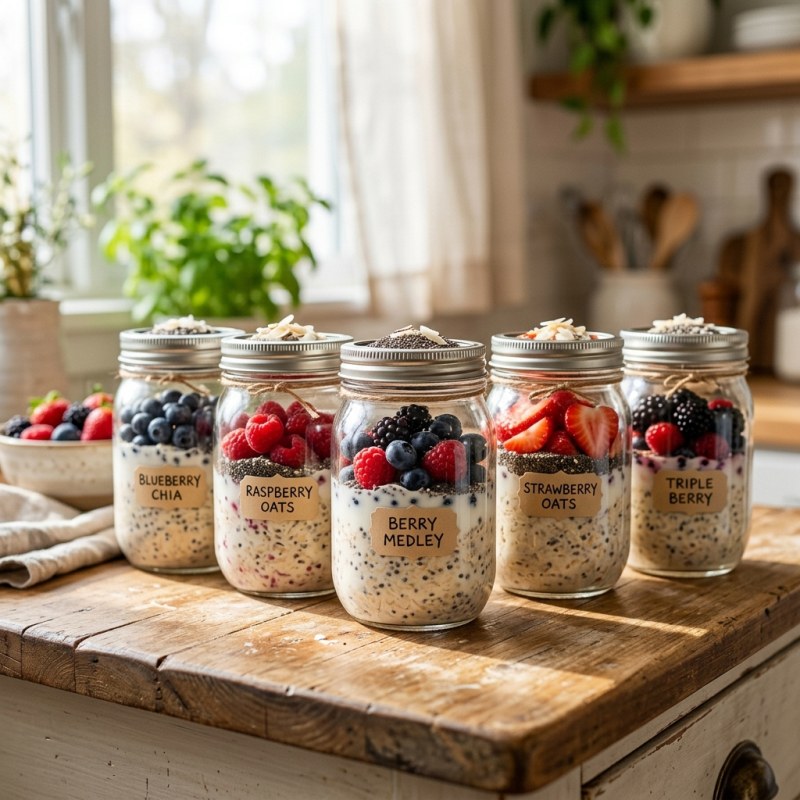
Oatmeal is one of the cheapest, most nutritionally solid breakfast options available, and it's also one of the most flexible foods to meal prep — but only if you pick the right method for how you actually eat breakfast. There are three genuinely distinct approaches: overnight oats (no cooking, cold, ready to eat), baked oatmeal (cooked once, sliced like a casserole, reheated), and stovetop batch-cooked oatmeal (cooked once, portioned, reheated with added liquid). Each produces a different final texture, has a different storage window, and suits a different kind of morning.
I've made all three for extended stretches and the honest answer is that none of them is universally "best" — it depends on whether you want a cold breakfast you can eat at your desk, a baked good you slice and reheat, or something closer to traditional hot oatmeal. Here's the full comparison so you can pick the one that actually matches your routine instead of guessing.

Method 1: Overnight Oats (No Cooking Required)
Overnight oats work through a different mechanism than the other two methods — there's no heat involved at all. Raw oats soak in liquid (milk, plant milk, or yogurt) overnight in the fridge, and the oats absorb the liquid and soften through hydration alone, similar to how dried beans soften when soaked. By morning, you have a cold, pudding-like texture that's ready to eat straight from the container.
| Factor | Overnight Oats |
|---|---|
| Cooking required | None — pure hydration |
| Texture | Cold, creamy, pudding-like |
| Storage life | 5 days refrigerated |
| Best for | People who genuinely prefer cold breakfast or eat on the go |
| Prep time | 5 minutes per jar, no active cooking |
| Cost per serving | $0.55–$0.85 depending on mix-ins |
The ratio that works reliably: 1/2 cup rolled oats to 1/2 cup liquid, plus 2 tablespoons of a binder like chia seeds or Greek yogurt to thicken the texture further. Use rolled oats, not steel-cut — steel-cut oats don't soften enough through cold soaking alone and stay unpleasantly chewy. Quick oats can work but tend to turn slightly mushy by day 3 or 4 since they absorb liquid faster and keep absorbing past the ideal point.
Method 2: Baked Oatmeal (Cooked Once, Sliced Like a Casserole)
Baked oatmeal is structurally closer to a dense breakfast bar or casserole than to traditional oatmeal. Oats, eggs, milk, and a binder bake together in a casserole dish, setting into a sliceable block you portion and reheat throughout the week. The egg content is what sets it apart structurally — it creates a firmer, more cohesive texture than either overnight oats or stovetop oatmeal.
| Factor | Baked Oatmeal |
|---|---|
| Cooking required | 35–40 minutes baking, one-time |
| Texture | Dense, slightly cake-like, holds its shape when sliced |
| Storage life | 5–6 days refrigerated, 2 months frozen |
| Best for | People who want a more substantial, less liquid breakfast |
| Prep time | 10 minutes active, 35–40 minutes baking (unattended) |
| Cost per serving | $0.60–$0.70 |
Baked oatmeal reheats remarkably well because of its denser structure — a 60 to 90 second microwave reheat brings it back to nearly its original texture with minimal degradation, even on day 5 or 6. This is the most freezer-friendly of the three methods as well, since the dense, lower-moisture structure handles the freeze-thaw cycle without much textural loss.

Method 3: Stovetop Batch-Cooked Oatmeal
This is the closest to traditional hot oatmeal — oats simmered in liquid on the stovetop, cooked through, then portioned and refrigerated. The challenge with this method is reheating: oatmeal continues absorbing liquid as it sits, even after cooking, which means it thickens significantly by day 2 or 3 and needs added liquid at reheat time or it turns into something closer to a dense paste than oatmeal.
| Factor | Stovetop Batch-Cooked |
|---|---|
| Cooking required | 10–15 minutes stovetop, one-time |
| Texture | Traditional hot oatmeal texture when fresh; thickens significantly on storage |
| Storage life | 4–5 days refrigerated |
| Best for | People who specifically want traditional hot oatmeal texture and don't mind adding liquid at reheat |
| Prep time | 10–15 minutes active |
| Cost per serving | $0.40–$0.55, the cheapest of the three |

Which Method Should You Actually Use?
If you eat breakfast at your desk or in the car and don't have access to a microwave, overnight oats is the only method that makes sense — there's no reheating step required at all. If you want something more substantial that holds its shape and reheats with the least fuss, baked oatmeal wins on convenience and freezer-friendliness, even though it requires real oven time upfront. If you specifically want the traditional hot, creamy oatmeal experience and don't mind a 30-second extra step of adding liquid before microwaving, stovetop batch cooking is the cheapest option and gets you closest to that classic texture.
Mixing methods across the week is also entirely reasonable — some people do overnight oats for 3 days when they're rushing out the door, then baked oatmeal slices for 2 days when they have a few extra minutes at home. There's no rule that says you have to commit to one method exclusively.
Storage and Food Safety Across All Three Methods
Cost Comparison and Nutritional Notes
All three methods are inexpensive relative to most breakfast options — a batch of any of them, sized for 5 servings, typically runs between $2 and $4.25 total depending on mix-ins like fruit, nut butter, or protein powder. Dry rolled oats themselves cost roughly $0.15 to $0.20 per half-cup serving at bulk prices, making the oats themselves almost a non-factor in the total cost; what you add (fruit, nuts, protein sources) drives the price more than the oats do.
Nutritionally, plain oats provide roughly 150 calories, 5g protein, and 4g fiber per half-cup dry serving, with a moderate glycemic index that's lower than most other grain-based breakfasts due to the beta-glucan fiber content, which slows digestion and helps with sustained fullness. Adding Greek yogurt, nut butter, or a scoop of protein powder to any of the three methods is the most efficient way to boost the protein content, since oats alone are relatively low in protein for a full breakfast.
Frequently Asked Questions
How long does meal prepped oatmeal last in the fridge?
Overnight oats: 5 days. Baked oatmeal: 5 to 6 days, or 2 months frozen. Stovetop batch-cooked oatmeal: 4 to 5 days, though it thickens considerably by day 3 and needs added liquid at reheat time. All figures assume refrigeration at 40°F (4°C) or below and proper cooling before sealing in airtight containers.
Can you freeze oatmeal?
Baked oatmeal freezes the best of the three methods due to its denser, lower-moisture structure — up to 2 months with minimal texture loss. Overnight oats generally aren't recommended for freezing since the liquid-to-oat ratio that creates the right hydrated texture doesn't translate well through a freeze-thaw cycle; the result tends to be watery and separated. Stovetop batch-cooked oatmeal can be frozen but the texture change is noticeable — expect a grainier consistency after thawing.
Why does my batch-cooked oatmeal turn into a thick paste in the fridge?
Oats continue absorbing the surrounding liquid even after cooking is complete, which is why oatmeal that looked perfectly creamy on Sunday can look like a dense, almost solid block by Wednesday. This isn't spoilage — it's continued starch hydration. The fix is simple: add 2 to 3 tablespoons of milk or water per serving when reheating, stirring it in before and once more halfway through microwaving, to bring it back to a creamy consistency.
What's the best ratio for overnight oats?
A 1:1 ratio of rolled oats to liquid by volume (1/2 cup oats to 1/2 cup milk or plant milk) is the standard starting point, with 1 to 2 tablespoons of chia seeds or Greek yogurt added as a thickener if you want a denser, pudding-like result. If your overnight oats come out too thick the next morning, add a splash more liquid and stir; if too thin, the ratio likely needs slightly less liquid next time, or an extra tablespoon of chia seeds to absorb more moisture.
All three methods solve the same basic problem — a quick, inexpensive, nutritionally solid breakfast that doesn't require cooking on a weekday morning. Pick based on whether you want cold or hot, sliceable or spoonable, and how much active time you're willing to spend on a single Sunday session.