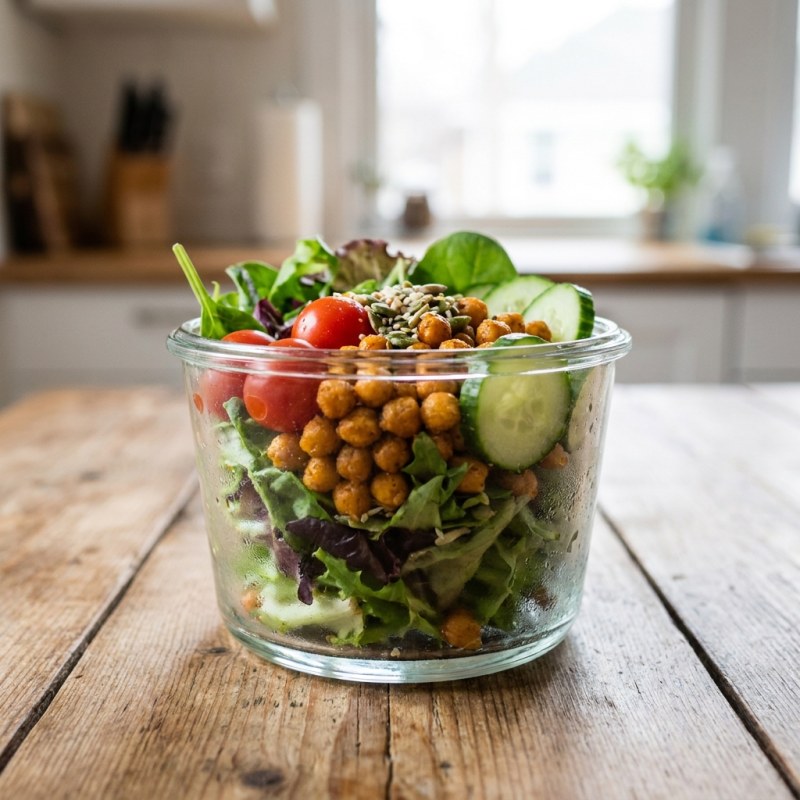
A 1,400 calorie vegan meal prep to lose weight 1400 cal plan sounds restrictive on paper, but the actual eating experience depends entirely on food volume, not just the calorie number — and plant-based meals built around vegetables, legumes, and whole grains genuinely deliver more food per calorie than most meat-based equivalents. That volume difference is the entire reason this approach doesn't leave people starving the way a lot of low-calorie plans do.

This guide covers why volume matters more than the calorie number itself, which vegan foods deliver the most fullness per calorie, a real cost breakdown, the meal prep process I'd use, and a full 5-day plan built around 1,400 calories that doesn't feel like deprivation.
This isn't a guide built around willpower or gritting your teeth through hunger. The entire premise is that the right food choices make a calorie target feel manageable without constant hunger management as a background task all day — which is really the difference between a plan that lasts a few weeks and one that becomes a genuinely sustainable way of eating.
Quick note before going further: 1,400 calories is a general reference point, not a number that fits everyone. Individual needs vary significantly based on age, activity level, height, and other factors — this is general information, not personalized medical or nutrition advice, so check with a doctor or registered dietitian to find a target that's actually right for you.
Why Does Food Volume Matter More Than the Calorie Number?
Hunger is driven more by stomach stretch and meal volume than by calorie count alone, which is why 400 calories of leafy greens and roasted vegetables feels dramatically more filling than 400 calories of a small portion of oil-heavy food. Vegetables and legumes are both low in calorie density (fewer calories per gram) and high in fiber and water content, which is exactly the combination that makes a lower-calorie plan feel sustainable instead of like constant hunger.
The first time I tried a calorie-restricted plan built around lean meat and rice, I was hungry within two hours of every meal. Switching to a plant-based structure with the same calorie target but roughly twice the food volume changed that completely — same calories, dramatically different hunger experience.

Which Vegan Foods Deliver the Most Fullness Per Calorie?
Skip this section if you already track calorie density — but if the concept is new, it's simply a measure of how many calories a given weight of food contains. Foods low in calorie density (mostly water and fiber) let you eat a larger physical volume for the same calorie total compared to calorie-dense foods (mostly fat or refined starch). This is the single most useful concept for anyone trying to eat at a calorie deficit without constant hunger, vegan or otherwise.
- Leafy greens (spinach, kale) — Extremely low calorie density, adds volume with almost no calorie cost.
- Broccoli, cauliflower, zucchini — High fiber and water content, filling for very few calories.
- Lentils and beans — Higher in calories than vegetables but deliver protein and fiber together, which is the combination most linked to satiety.
- Berries — Lower in calories than most fruit, with fiber that slows digestion compared to fruit juice or dried fruit.
- Air-popped popcorn or roasted chickpeas — Genuinely filling, crunchy snack options at a fraction of the calories of most packaged snacks.
If you're already familiar with budget vegan meal prep, the ingredient list here overlaps heavily — the difference is mainly in portion structure, not which foods you're buying.
What Mistakes Make Vegan Weight Loss Meal Prep Harder Than It Needs to Be?
The biggest one: relying too heavily on calorie-dense vegan convenience foods — vegan cheese, oil-heavy dressings, and processed plant-based meat substitutes — which can pack as many calories as their animal-based counterparts without the same volume or fullness. A tablespoon of oil alone runs about 120 calories, which adds up fast if it's used generously across every meal without measuring.
The Calorie Density Comparison Table Every Vegan Weight Loss Plan Needs
| Food | Calories per 100g | Meal Prep Note |
|---|---|---|
| Spinach, raw | 23 | Nearly unlimited volume for very few calories |
| Broccoli, cooked | 35 | High fiber, very filling per calorie |
| Lentils, cooked | 116 | Higher calorie, but protein and fiber combo drives satiety |
| Olive oil | 884 | Measure carefully — easy to overuse |
| Vegan cheese shreds | ~300-350 | Similar calorie density to dairy cheese — use sparingly |
How I'd Build a 5-Day 1,400 Calorie Vegan Meal Prep in One Sunday
- Roast a large tray of low-calorie vegetables — broccoli, zucchini, bell pepper — at 400°F for 20-25 minutes with a light measured amount of oil.
- Cook a batch of lentils or chickpeas as the protein and fiber anchor for each meal.
- Portion grains carefully — 1/2 cup cooked rice or quinoa per meal, measured rather than eyeballed, since grains are more calorie-dense than vegetables.
- Wash and portion large volumes of leafy greens to bulk up each meal without meaningfully raising the calorie count.
- Make a light vinaigrette, measuring the oil rather than pouring freely, to keep dressing calories in check.
- Portion everything into 5 containers, prioritizing vegetable and green volume over grain and oil quantity.
What Does a Week of 1,400 Calorie Vegan Meal Prep Cost?
- 2 cups dry lentils @ $1.79/lb = $2.68
- Large volume of mixed vegetables and greens = $14.00
- 1 cup dry rice or quinoa = $2.00
- Olive oil, vinegar, seasonings (partial cost) = $2.50
- Fresh fruit for snacks = $6.00
Total: roughly $27.18 for 5 days = about $5.44 per day — genuinely affordable, since vegetables and legumes are both inexpensive relative to the volume of food they provide. Buying vegetables in season and choosing frozen over fresh for anything not eaten within a few days both bring this cost down further without sacrificing the volume or nutrition this plan depends on.


How Long Does This Style of Meal Prep Stay Safe in the Fridge?
Per USDA FoodKeeper guidance, cooked lentils and grains both hold safely for 4-6 days refrigerated at 40°F (4°C) or below, and roasted vegetables last about 4-5 days. Fresh leafy greens are best washed and portioned but added just before eating, since they wilt faster than roasted vegetables once combined with warm food.
The Biggest Mistake People Make on Vegan Weight Loss Meal Prep
Assuming plant-based automatically means low-calorie, and eating oversized portions of oil-heavy or nut-heavy dishes as a result. A generous handful of nuts, a heavily-oiled stir-fry, or a large serving of hummus can add up to a meaningful calorie total quickly, even though every ingredient is technically "healthy" and vegan. Measuring the calorie-dense additions (oils, nuts, nut butter) while eating vegetables and greens more freely is the actual strategy, not avoiding any single food category.
If you're building this into a broader vegan meal prep to lose weight routine, that measuring habit for oils and nuts specifically is the one adjustment worth making early — everything else about volume-based eating stays intuitive.
The second common mistake: cutting vegetables and greens along with the calorie-dense foods, out of a general instinct to "eat less" across the board when a plateau or slow progress shows up. This works against the entire strategy this plan is built on. Vegetables and greens are the foods you want to eat more of, not less, when trying to manage hunger within a calorie target — they're doing the heavy lifting of keeping the plan feel sustainable in the first place.
How Do You Handle Eating Out on a 1,400 Calorie Vegan Plan?
Restaurant vegan options are often more calorie-dense than they look, since restaurants tend to compensate for flavor with extra oil, sauce, or fried components. When eating out, requesting sauce and dressing on the side, and choosing grilled or roasted preparations over fried ones, keeps a restaurant meal closer to what you'd build at home. This isn't about avoiding restaurants entirely — it's about applying the same "measure the calorie-dense stuff, eat vegetables freely" principle even when someone else is doing the cooking.
Does Exercise Change How Much You Should Eat?
Activity level meaningfully affects calorie needs, and 1,400 calories that works fine for someone with a largely sedentary day may leave someone doing regular intense exercise under-fueled. If you're active, particularly with strength training, prioritizing adequate protein becomes even more important to help preserve muscle during a calorie deficit, and your total calorie target may need to be higher than 1,400 to support that activity level sustainably. This is exactly the kind of individual variation that makes a conversation with a doctor or dietitian more useful than a fixed number from an article.
What Should You Do If Weight Loss Stalls?
Plateaus are common and don't necessarily mean something is wrong. Before making changes, it's worth checking whether measuring has become less precise over time — a common pattern where oil, nut butter, or dressing portions creep up gradually without anyone noticing. If measurements are accurate and a plateau persists for several weeks, that's a reasonable point to revisit your calorie target with a professional rather than cutting calories further on your own, since very low intakes can backfire and aren't something this guide is designed to walk you through.
Is This Approach Sustainable Long-Term, or Just a Short-Term Plan?
The volume-based, whole-food structure in this guide is meant to be something you could reasonably keep doing well past any specific weight loss goal, unlike more extreme short-term approaches. Once a target weight is reached, the same meal structure generally works fine at a higher calorie level — simply increasing portion sizes of the same foods, rather than needing an entirely different eating pattern once weight loss is no longer the immediate goal.
Frequently Asked Questions
Can you lose weight on a vegan diet without counting calories?
It's possible for some people, especially if the diet naturally emphasizes high-volume, low-calorie-density foods like vegetables and legumes over processed vegan convenience foods. That said, tracking calories at least loosely for the first few weeks helps most people calibrate portions accurately before switching to a more intuitive approach.
Is 1,400 calories enough for vegan weight loss?
For many adults, 1,400 calories represents a reasonable deficit for gradual weight loss, but individual needs vary significantly based on activity level, height, age, and other factors. This is general information, not personalized advice — check with a doctor or registered dietitian to determine an appropriate calorie target for your specific situation.
What vegan foods are most filling for weight loss?
Leafy greens, broccoli, and other high-fiber, high-water-content vegetables are the most filling per calorie, since fiber and water both contribute to fullness without adding significant calories. Lentils and beans add protein and fiber together, which is particularly effective for satiety despite carrying more calories than vegetables alone.
Why am I not losing weight on a vegan diet?
The most common reason is underestimating calorie-dense additions like oils, nuts, vegan cheese, and processed plant-based meat substitutes, which can carry as many calories as their non-vegan counterparts. Measuring these specific ingredients rather than eating them freely often resolves a weight-loss plateau on an otherwise plant-based diet.
How much protein do you need on a vegan weight loss diet?
Most guidance suggests prioritizing adequate protein even in a calorie deficit, since protein supports satiety and helps preserve muscle mass during weight loss. Building meals around lentils, beans, tofu, or tempeh as a genuine portion (not a garnish) makes hitting a reasonable protein target realistic even at 1,400 calories.
At roughly $5.44 a day and a meal prep structure built around volume rather than restriction, this plan is designed to feel sustainable rather than like a countdown to the next meal. Start with the roasted vegetable and lentil base this week, and measure your oils carefully from day one.