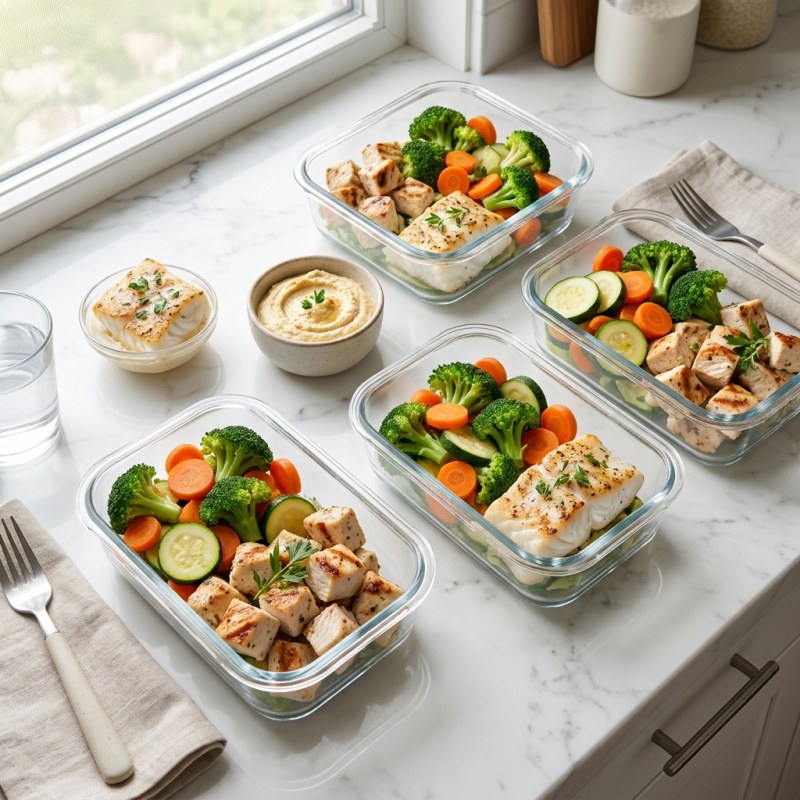
The gap between standard meal prep advice and bariatric meal prep is exactly 2 inches — the difference between a 2-cup container and a 2oz portion cup. Every guide that tells you to batch cook five chicken thighs for the week is written for someone eating 4–6oz per meal, not 2–4oz. The logistics are completely different, the containers are completely different, and the protein math requires a different approach entirely.
This is not medical advice. Your bariatric care team has specific guidelines for your surgery type and phase — follow those. What I can offer is the meal prep logistics that make following those guidelines easier, based on working through the actual numbers with real foods.

What Makes Bariatric Meal Prep Different From Standard Meal Prep?
Three things separate bariatric meal prep from everything else on this site.
Portion size. A standard meal prep serving is 1.5–2 cups. A bariatric serving ranges from 2oz (purée phase) to 4oz (soft food phase) to 6oz (regular texture phase). At 2oz per eating occasion eating five times daily, you're consuming 10oz of food total — less than what most people eat in a single lunch. This means you're prepping 10–15 bariatric servings from an amount of food that would make 2–3 standard servings. A single chicken breast becomes five bariatric portions.
Protein density per ounce. Because portion size is so constrained, every ounce has to deliver as much protein as possible. A food with 2g protein per oz requires eating 30oz to hit 60g daily — at 2oz per eating occasion, that's 15 eating occasions. Impossible. You need foods hitting 2.5–3g protein per oz minimum. This narrows the field significantly and is why standard meal prep advice about building a balanced bowl with grains, protein, and vegetables doesn't apply in early bariatric phases.
Texture requirements that change by week. The phase progression that most surgeons use: liquid (days 1–2 post-surgery), full liquid and purée (approximately days 3–14), soft foods (approximately weeks 2–6), regular textures (approximately 6 weeks+). Every timeline varies by surgeon and surgery type. Your meal prep approach changes completely between phases — what you prep in week 2 is nothing like what you prep in week 8.

What Are the Best High-Protein Soft Foods for Each Post-Surgery Phase?
Here are the foods I rely on for bariatric meal prep, ranked by protein density — the number that matters most when you're eating 2–4oz at a time:
| Protein Source | Protein per oz | Texture Phase | Cost per oz | Notes |
|---|---|---|---|---|
| **Canned chicken breast (drained)** | 2.7g | Soft/regular | $0.18 | Best backup pantry item — no cooking, 2.7g/oz |
| **Ground turkey (well cooked)** | 2.6g | Soft/regular | $0.22 | Needs broth to stay moist |
| **Greek yogurt 0%** | 2.5g | Full liquid/purée | $0.14 | Easiest protein — ready as-is |
| **Soft-scrambled eggs** | 1.9g | Soft | $0.08 | Cook until just set, not dry |
| **Cottage cheese 1%** | 1.8g | Soft | $0.10 | Check for tolerance individually |
| **Ricotta cheese (part-skim)** | 1.7g | Purée/soft | $0.15 | Blends smoothly for purée phase |
| **Fat-free refried beans** | 1.4g | Purée/soft | $0.07 | Ready from can, no prep needed |
| **Red lentils (cooked very soft)** | 1.2g | Soft | $0.08 | Cook 25+ minutes until fully dissolved |
For purée phase: Greek yogurt, ricotta, fat-free refried beans, and blended ground turkey are your core options. The blending step is what makes ground turkey work — cooked and blended with ¼ cup chicken broth per 3oz of meat, it becomes a smooth, spoonable protein source.
For soft food phase: ground turkey (without blending), well-cooked eggs, cottage cheese, canned chicken, and very soft lentils. The texture test: if it mashes easily between your tongue and the roof of your mouth, it's soft food phase appropriate.
For regular texture phase: all of the above plus standard meal prep proteins — chicken breast (brined), fish, and harder legumes. At this stage you're eating 4–6oz per meal and have the most flexibility.
How Do You Hit 60–80g Protein Daily in 2–4oz Portions?
The math is the hardest part to get right, so I'll show the actual numbers. At 2oz portions eating 5 times daily = 10oz total food intake. To hit 70g protein from 10oz of food, you need an average of 7g protein per oz across the day — higher than any single food in the table above.
This means you can't hit 70g protein from one food alone at bariatric portion sizes. You need stacking: the highest-protein options across all eating occasions. Here's what that actually looks like:
- Eating occasion 1 (morning): 2oz Greek yogurt (5g) + 1 egg white scrambled (3.6g) = 8.6g
- Eating occasion 2 (mid-morning): 2oz ground turkey purée or soft (5.2g) + 1oz cottage cheese (1.8g) = 7g
- Eating occasion 3 (lunch): 3oz canned chicken mixed with 1 tbsp plain Greek yogurt (9.9g) = 9.9g
- Eating occasion 4 (afternoon): 2oz Greek yogurt (5g) + 1 tbsp hemp seeds (3.3g) = 8.3g
- Eating occasion 5 (dinner): 3oz ground turkey (7.8g) + 1oz ricotta (1.7g) = 9.5g
- Eating occasion 6 (evening if needed): 2oz cottage cheese (3.6g)
- Running total: approximately 48.9g — plus protein from any tolerated soft grains or vegetables
Reaching 70g requires either larger portions as you progress to later phases, or adding a protein supplement as your care team directs. Most people reach 60–70g by week 6–8 as portion tolerance increases.

What Containers Actually Work for Bariatric Portions?
Purée phase: 2oz souffle cups with lids, sold as condiment or portion cups. A 50-pack costs $8–$12 at restaurant supply sections of Amazon, Webstaurant Store, or Walmart. The snap-on plastic lids make them stackable in the fridge. Fill each cup with blended protein, seal, and refrigerate. You'll need 10–15 cups for a 3-day prep batch.
Soft food phase: 4oz glass containers with locking lids. These are marketed as baby food containers or small snack containers. A 10-pack runs $15–$20. Glass doesn't absorb odours after repeated use, which matters when you're reheating the same containers daily.
Regular texture phase (approaching standard): 6–8oz glass containers. You're still eating smaller than standard, but standard 2-cup containers are starting to make sense for some meals.
The one container to avoid entirely: any container marketed for standard meal prep with 2-cup capacity. At 2oz per serving, a 2-cup container is psychologically defeating — the food looks like a tiny sample at the bottom of a large container, which doesn't help with the mental adjustment to bariatric portions.
For a full comparison of container options across all meal prep types, see the meal prep containers guide.

What Does a 5-Day Bariatric Meal Prep Session Look Like?
This session is designed for soft food phase (approximately weeks 2–6). Total active time: 25 minutes. Oven time: 18 minutes, unattended.
What to prep:
- Ground turkey (8 × 2oz portions): 1lb 93% lean ground turkey in a non-stick skillet, broken into very fine pieces, cooked through to 165°F (74°C), then add ¼ cup low-sodium chicken broth, cover 3 minutes. The broth is mandatory — dry ground turkey is difficult to tolerate post-surgery. Cool 20 minutes before portioning into 2oz portions using a kitchen scale. This yields 14g protein per portion.
- Mini egg cups (12 × half-size): Whisk 6 eggs + 3 tbsp plain Greek yogurt (adds creaminess and extra protein) + salt. Pour into a 12-cup mini muffin tin sprayed with cooking spray. Bake 350°F (175°C) for 16–18 minutes until set. Each mini egg cup = approximately 1.5g protein. 2 cups = 3g protein — a quick snack addition.
- Greek yogurt portions (8 × 2oz): Plain 0% Greek yogurt, portioned directly into 2oz cups. No prep. 5g protein per 2oz. These are your no-cook, highest-convenience portions.
- Cottage cheese portions (6 × 2oz): Same approach — portion directly. 3.6g protein per 2oz. To the printed date refrigerated.
- Canned chicken portions (4 × 3oz): Drain 2 cans, mix with 2 tbsp plain Greek yogurt + lemon juice + salt for flavour. Portion into 4 × 3oz servings. 9.9g protein per portion per USDA nutrition data for canned chicken breast.
Total protein prepped across all components:
- 8 ground turkey portions × 14g = 112g
- 12 egg cups × 1.5g = 18g (used as additions, not primary)
- 8 Greek yogurt portions × 5g = 40g
- 6 cottage cheese portions × 3.6g = 21.6g
- 4 canned chicken portions × 9.9g = 39.6g
- Total: approximately 231g protein across all prepped components
At 60–70g protein daily, this covers 3+ days of protein needs. Do a small refresh mid-week.
How Long Does Bariatric Meal Prep Last in the Fridge?
Per USDA FoodKeeper database guidelines:
- Cooked ground turkey: 4 days refrigerated at 40°F (4°C). Salmonella and Campylobacter are the primary risks in ground poultry — these are fully destroyed at 165°F (74°C) cooking temperature, but the 4-day window applies from cook date.
- Cooked egg dishes (mini egg cups): 3–4 days refrigerated.
- Greek yogurt (opened): to the printed date, typically 1–2 weeks after opening.
- Cottage cheese (opened): to the printed date.
- Canned chicken once opened: 3–4 days in an airtight container in the fridge. Do not store in the opened tin — the metal affects flavour.
Practical approach: batch on Sunday, eat through Wednesday on the ground turkey and egg cups. Greek yogurt and cottage cheese run the full week to their printed dates. Do a 15-minute mid-week refresh on Wednesday to replenish the perishable protein sources for Thursday and Friday.
For single-person portioning logistics that overlap with bariatric needs, the meal prep for one guide covers the efficiency principles.


Frequently Asked Questions About Bariatric Meal Prep
What can you eat on bariatric meal prep?
Phase-appropriate whole foods: Greek yogurt, soft-scrambled eggs, cottage cheese, ricotta, well-cooked ground turkey with broth, canned chicken breast, and red lentils cooked until very soft. All are high in protein (1.7–2.7g per oz) and suitable for soft food phase eating. Avoid fibrous raw vegetables, dry meats, and bread until cleared for regular texture phase by your care team.
How much protein do you need after bariatric surgery?
Most bariatric programs target 60–80g protein daily, achieved across 4–6 small eating occasions of 2–4oz each. Hitting this target requires choosing protein-dense foods: canned chicken at 2.7g per oz, Greek yogurt at 2.5g/oz, and ground turkey at 2.6g/oz. Always follow your specific bariatric care team's protein target — it varies by surgery type, phase, and individual recovery.
How long does bariatric meal prep last in the fridge?
Per USDA FoodKeeper: cooked ground turkey 4 days, cooked egg dishes 3–4 days, cottage cheese and Greek yogurt to the printed date. Most bariatric patients do a Sunday prep covering Monday through Wednesday, then a quick mid-week refresh on Wednesday evening for Thursday and Friday.
What containers work best for bariatric meal prep?
2oz souffle cups with snap-on lids ($8–$12 per 50-pack) for purée and early soft food phases. 4oz glass containers with locking lids for soft food and regular phases. Standard 2-cup meal prep containers are too large and psychologically discouraging at bariatric portion sizes.
What are the best soft foods for bariatric meal prep?
Ranked by protein density: canned chicken breast (2.7g/oz), well-cooked ground turkey (2.6g/oz), Greek yogurt 0% (2.5g/oz), soft-scrambled eggs (1.9g/oz), cottage cheese 1% (1.8g/oz), ricotta (1.7g/oz), and fat-free refried beans (1.4g/oz). All appropriate for soft food phase, all can be stored 3–5 days refrigerated.
What Is the Best Backup Pantry Item for Bariatric Meal Prep?
Canned chicken breast is the answer, and most bariatric meal preppers I've talked to discover it late rather than early. At $2.99–$3.49 per 10oz can at Walmart, it delivers 2.7g protein per oz — the highest protein density in the table above — with zero cooking required. Drain the can, mix with 1 tablespoon of plain Greek yogurt and a squeeze of lemon, and you have a soft, moist, high-protein bariatric-appropriate food in under 2 minutes.
This matters specifically for bariatric meal prep because the 3–4 day refrigerator window on cooked proteins means you cannot batch cook on Sunday and coast through Friday without some mid-week intervention. Canned chicken eliminates the cooking barrier on Wednesday evening — when energy is low and the idea of firing up the stove again is discouraging. One can, a fork, and 2 minutes of mixing gives you 4 days' worth of protein top-ups with nothing to reheat or cook.
Keep 4–6 cans in your pantry at all times during the first 3 months post-surgery. They don't go bad, they don't require cooking, and they bail you out every time your Sunday batch runs short.
A Note on Progressing Through Phases
Everything in this guide is written for soft food phase. The same proteins — ground turkey, canned chicken, Greek yogurt, eggs — remain relevant as you progress to regular texture phase. What changes is the portion size and the container type, not the protein selection. At 6oz portions in regular texture phase, 1lb of ground turkey yields just 2–3 servings instead of 8. Scale your shopping accordingly.
The 60–80g daily protein target also becomes more achievable as portions increase. At 2oz soft food phase portions it requires 5–6 eating occasions and careful selection. At 4oz regular phase portions it takes 3–4 eating occasions with the same foods. The system outlined here builds the habit during the hardest phase — when you get to regular texture phase, hitting protein targets feels almost automatic by comparison.