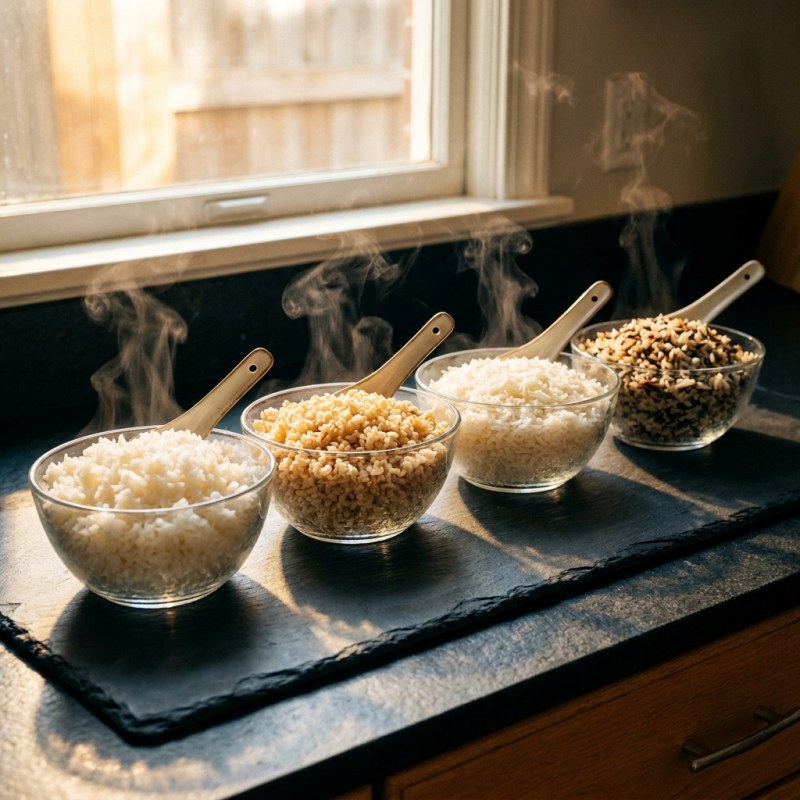
The rice question for meal prep is not which rice tastes best fresh — it is which rice holds up through 4 days in the refrigerator and a reheating cycle without becoming a starchy, gluey block. Those are different questions with different answers, and the answer most people arrive at by trial and error (brown rice) is correct, but not for the reason they think.
This is a data comparison of five rice types across the variables that actually matter for meal prep: texture after 4 days refrigerated, reheating behaviour, protein content, glycaemic index, cost per serving, and cook time. The winner is clear but the full picture is worth understanding.
Brown vs White vs Jasmine vs Basmati vs Cauliflower Rice — Complete Comparison
| Rice type | Cook time | Cal/cup cooked | Protein/cup | GI | Day-4 fridge texture | Cost/serving | Verdict |
|---|---|---|---|---|---|---|---|
| Brown rice (long grain) | 40–45 min | 216 | 5g | 50 | ✅ Best — stays separate | $0.18 | Best for meal prep |
| White rice (long grain) | 18 min | 206 | 4g | 72 | ⚠️ Gets sticky day 2+ | $0.12 | Acceptable |
| Jasmine rice | 18 min | 205 | 4g | 89 | ❌ Clumps badly by day 2 | $0.18 | Avoid |
| Basmati rice | 20 min | 200 | 4g | 58 | ✅ Good — stays fluffy | $0.22 | Strong #2 |
| Wild rice | 45–55 min | 166 | 7g | 57 | ✅ Excellent | $0.55 | High cost |
| Cauliflower rice | 5 min | 25 | 2g | 15 | ⚠️ Gets watery by day 2 | $0.40 | Low carb only |
| Quinoa | 15 min | 222 | 8g | 53 | ✅ Excellent | $0.45 | High protein |
Brown rice wins for meal prep not because of its nutritional profile (though the GI of 50 versus jasmine's 89 is meaningful), but because of its physical structure. Brown rice retains its bran layer — the outer coating that white rice has milled off. That bran layer prevents the starch granules from absorbing water from refrigeration and from neighbouring foods in the container. White rice has no bran — its surface starch is exposed and continues absorbing moisture during cold storage, producing the sticky, clumped texture by day 2.
Basmati is the strong second choice. Its long, thin grain structure and lower starch content (amylose to amylopectin ratio) means it clumps less than other white rices after refrigeration. Indian and Pakistani rice dishes that are often meal-prepped use basmati specifically for this reason. If you need white rice texture for a specific dish (Persian, Indian, Middle Eastern), basmati is the correct choice.
Jasmine rice should be avoided for meal prep containers. Jasmine is specifically bred for fragrance and soft, clingy texture — which is exactly what makes it excellent fresh and problematic stored. By day 2 in a refrigerator container, jasmine rice has reabsorbed moisture and fused into a solid mass that reheats unevenly.


Why Does Brown Rice Stay Better for 4 Days?
The chemistry behind the texture difference is worth understanding because it tells you how to handle white rice on weeks you want to use it.
Brown rice: The bran layer (the outer husk) is an insoluble fibre that acts as a physical barrier between the starch core and the moisture in the refrigerator environment. When brown rice is refrigerated, the bran prevents retrograde starch crystallisation (the process that makes rice hard and gluey when cold) from happening as quickly. The result is rice that remains separate and fluffy after 4 days.
White rice: Without the bran layer, the starch on the surface of each grain is directly exposed. In a refrigerator at 40°F (4°C), retrograde starch crystallisation happens within 12–24 hours — this is what makes day-2 white rice dense and clumped. Reheating with steam (adding 1 tbsp water and microwaving covered) partially reverses this, but the texture is never as good as brown rice stored under the same conditions.
The practical fix for white rice meal prep: Toss hot cooked white rice with ½ tsp sesame oil or olive oil immediately after cooking. The oil coats each grain and creates a physical barrier similar to what the bran does in brown rice. Properly oiled white rice stays significantly more separate after 4 days refrigerated.
If you prefer white rice, add ½ teaspoon of sesame oil (or olive oil) per cup of cooked rice immediately after cooking, while hot. Toss to coat every grain. The oil creates a thin coating that prevents the exposed starch from fusing as the rice cools and sits in the refrigerator. Day-4 oiled white rice reheats to approximately 80% of the texture quality of brown rice — a significant improvement over untreated white rice.
What Is the Best Way to Cook Brown Rice for Meal Prep?
Cooking method matters more than rice variety for the final texture. Properly cooked brown rice holds through 4 days; overcooked brown rice goes mushy by day 2.
The stovetop absorption method (most reliable for large batches):
The correct ratio for long-grain brown rice: 1 cup dry to 2¼ cups water (not 2:1 — that ratio is for white rice and produces mushy brown rice).
- Rinse rice in cold water until the water runs nearly clear. This removes excess surface starch that causes clumping. Skip this step and the rice will be stickier at every stage.
- Combine rice and cold water in a heavy-bottomed pot. Bring to a full boil uncovered.
- Reduce to the lowest heat setting possible. Cover with a tight-fitting lid. Timer: 40 minutes. Do not lift the lid — the steam pressure is doing the work.
- At 40 minutes: remove from heat. Leave the lid on. Rest 10 minutes — the residual steam finishes the cooking and allows excess moisture to redistribute. Lifting the lid early vents the steam and produces undercooked, hard rice.
- Uncover and fluff with a fork. Spread on a wide tray to cool — do not cool in the pot, where trapped steam continues cooking the bottom layer.
The rice cooker method: Set and forget. Use the same 2¼:1 water ratio. Brown rice setting if available; otherwise standard setting will work but check — some rice cookers produce mushy brown rice on the standard setting.
Batch size: 2 cups dry brown rice produces approximately 5–6 cups cooked — enough for 6–8 meal prep containers at ¾ cup per container. This is the ideal weekly batch size for one person.
Per USDA FoodKeeper: cooked rice 4–6 days refrigerated at 40°F (4°C). The primary food safety concern with cooked rice is Bacillus cereus — a spore-forming bacteria that survives cooking and can produce toxins if rice is left at room temperature for extended periods. Cool cooked rice within 1 hour of cooking. Never leave cooked rice at room temperature for more than 2 hours.
Bacillus cereus spores survive boiling and begin multiplying rapidly once rice cools to the bacterial growth zone (40°F–140°F/4°C–60°C). The toxins produced are heat-stable — reheating does not destroy them. This is why "fried rice syndrome" (nausea and vomiting 1–5 hours after eating rice left at room temperature) is a well-documented foodborne illness. The rule: cool cooked rice on an open tray within 1 hour of cooking. Refrigerate once below 70°F (21°C). Do not leave cooked rice sitting on the counter while you portion other containers.
How Do You Reheat Rice from the Fridge Without It Turning Hard?
The reheating problem with refrigerated rice is retrograde starch crystallisation — the starch has tightened during cold storage. Water + heat reverses this.
The correct reheating method: Add 1 tablespoon of water per cup of rice directly to the container. Cover with a vented lid or microwave-safe plate. Microwave on full power 90 seconds. The steam from the added water penetrates the rice and reverses the starch crystallisation, producing fluffy, separate grains. Without the added water, the rice heats but the starch stays tight — the result is dry, hard rice even when hot.
Stovetop reheating: Add rice to a cold skillet with 2 tablespoons of water. Medium-low heat. Cover and steam 3–4 minutes. Fluff and serve. Produces better results than microwave for large portions.
Which Rice Is Best for Specific Meal Prep Goals?
| Goal | Best rice | Why |
|---|---|---|
| Maximum texture through day 4 | Brown rice | Bran layer prevents starch fusion |
| Indian/Persian dishes | Basmati | Long-grain, low-starch, stays fluffy |
| Low carb | Cauliflower rice | 25 cal vs 216 cal per cup |
| Highest protein | Quinoa | 8g protein vs 5g (brown rice), complete amino acid profile |
| Fastest cook time | White rice | 18 min vs 40 min |
| Budget | Long-grain white | $0.12/serving vs $0.18 (brown) |
| Best overall for meal prep bowls | Brown rice | Texture, nutrition, cost balance |
How Much Rice Per Meal Prep Container?
The standard is ¾ cup cooked brown rice per container — 162 calories, 4g protein, 34g carbohydrates. This leaves room for 4–5oz of protein (160–250 cal) and 1 cup of vegetables (25–55 cal) in a 350–550 calorie total container.
Adjustments by goal:
- Weight loss (under 400 cal container): Reduce to ½ cup rice (108 cal), increase vegetables
- Bulking (over 600 cal container): Increase to 1 cup rice (216 cal), add avocado or olive oil drizzle
- High protein focus: Swap rice for quinoa — same volume, 60% more protein per cup
For the full bowl building system that uses rice as the base, see the meal prep bowls for work lunches guide. For the rice cooking method specifically tested for meal prep, see the how to meal prep rice guide.
Frequently Asked Questions About Rice for Meal Prep
Which rice is best for meal prep?
Brown rice (long grain). The bran layer prevents the starch fusion that makes white rice gluey after 2 days in the refrigerator. Brown rice stored correctly at 40°F (4°C) stays separate and fluffy through day 4. Basmati is the second-best choice if you prefer white rice texture.
How long does cooked rice last in the fridge?
Per USDA FoodKeeper: 4–6 days at 40°F (4°C). The outer limit is 6 days — quality peaks at day 1–2 and declines toward the end of the window. The primary concern is Bacillus cereus — cool within 1 hour of cooking and refrigerate promptly.


Can I meal prep jasmine rice?
Technically yes, but it produces the worst results of any rice type. Jasmine rice is bred for soft, clingy texture — ideal fresh, problematic stored. By day 2 it fuses into a solid mass that reheats unevenly. If you prefer jasmine, cook fresh in 18 minutes on the days you eat it rather than prepping it 4 days ahead.
Does brown rice freeze well?
Yes — per USDA FoodKeeper, cooked brown rice freezes for up to 6 months. Portion into individual containers before freezing. Thaw in the refrigerator overnight or microwave from frozen with 2 tbsp water, covered, full power 2–3 minutes. Frozen and thawed rice is indistinguishable from fresh-made for most people.
Why does my meal prep rice get hard in the fridge?
Retrograde starch crystallisation — the starch molecules tighten during cold storage. Fix: add 1 tbsp water per cup of rice before reheating and cover during microwaving. The steam reverses the crystallisation. Also: using brown rice instead of white rice significantly reduces this problem because the bran layer slows the crystallisation process.