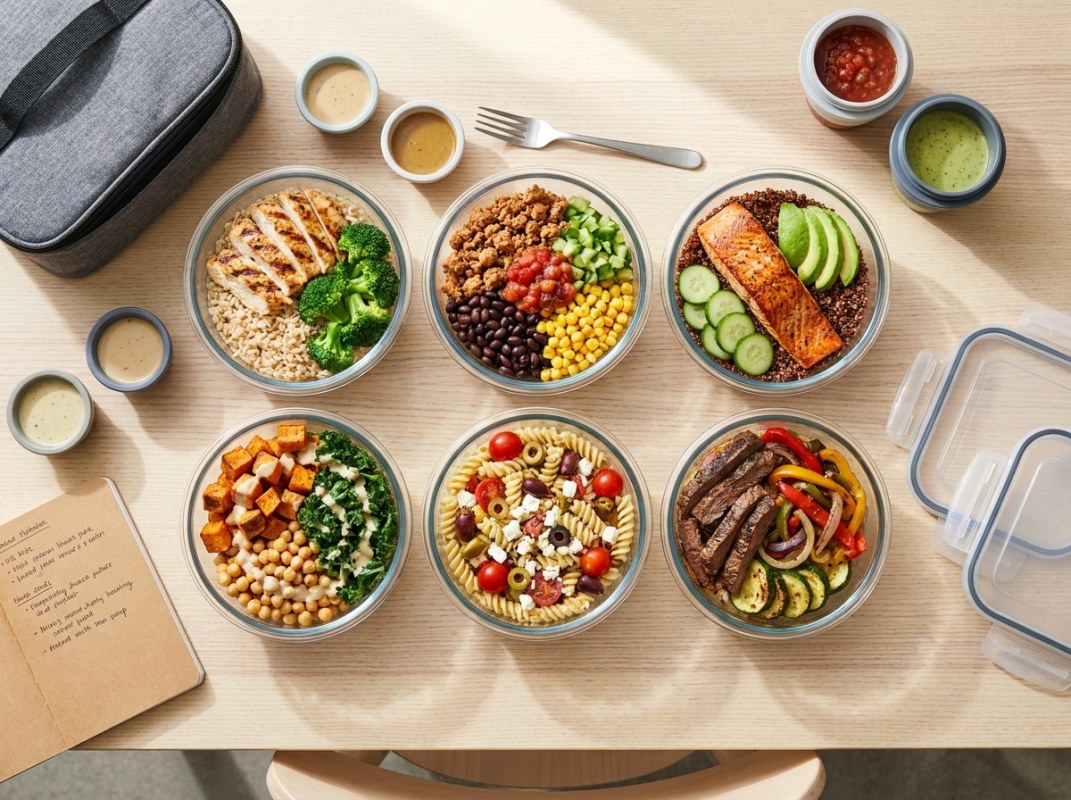
What Makes a Good Work Lunch Meal Prep Bowl?
A work lunch meal prep bowl has specific requirements that differ from a meal eaten at home. It needs to travel in a bag without leaking. It needs to taste genuinely good after being reheated in a shared office microwave, or eaten cold if no microwave is available. It needs enough protein and fiber to keep you focused through the afternoon without an energy crash. And it needs to stay safe and appealing through day 4 or 5 of the work week.

Most meal prep bowl guides focus on aesthetics — the colourful, Instagram-worthy arrangements that look impressive but are impractical for a Monday-to-Friday lunch rotation. This guide focuses on practicality: which bowls are genuinely portable, which ingredients survive the work week without quality degradation, and which combinations deliver the protein and satiety needed for afternoon productivity.
The Work Lunch Bowl Formula
Every practical work lunch bowl follows the same underlying structure. Understanding the formula allows you to build any combination that suits your taste preferences without following a specific recipe:
Base (40–50% of volume): A grain or starch that provides sustained energy. Brown rice, white rice, quinoa, farro, couscous, or sweet potato. The base should be pre-cooked and stored separately if possible — grain bowls where the base is pre-assembled with other components become soggy faster than bowls assembled at serving time.
Protein (25–30% of volume): Whatever keeps you full until dinner. For work lunches, the key protein property is reheating quality — it should taste good after 90 seconds in a shared microwave. Chicken thighs, ground turkey, hard-boiled eggs, chickpeas, edamame, lentils, and canned tuna all reheat or require no heating at all.
Vegetables (25–30% of volume): For hot bowls, pre-roasted vegetables that reheat without becoming mushy. Broccoli, Brussels sprouts, roasted bell peppers, sweet potato, and cauliflower all hold up well. For cold bowls, raw or lightly cooked vegetables that do not wilt — cabbage, carrots, cucumber, cherry tomatoes, edamame, corn.
Sauce or dressing (stored separately): Always transport dressing in a separate small container. This single habit prevents soggy bowls and preserves crispy elements. The dressing adds freshness and flavor at the moment of eating that would be lost if mixed in during storage.
Hot Bowl vs Cold Bowl for Work Lunches
Hot bowls (reheated at work): Best when you have reliable microwave access and a moment to heat your food. Hot bowls are more satisfying in cooler months, more filling per volume, and allow better integration of cooked proteins and grains. Downside: requires microwave access, produces food smells in open offices, and takes 2–3 minutes you may not always have.
Cold bowls (eaten at room temperature or chilled): Best for open offices where microwave smells are unwelcome, for people without reliable microwave access, and for warmer months when cold food is appealing. Cold bowls require different ingredient selection — proteins that taste good cold (tuna, hard-boiled eggs, chickpeas, edamame, cold chicken) and vegetables that do not need cooking.
10 Work Lunch Bowl Ideas That Actually Travel Well
1. Teriyaki chicken rice bowl (hot): Brown rice base, chicken thigh sliced and reheated, roasted broccoli, shredded carrots, sesame seeds. Teriyaki sauce in a separate container. This is the most universally liked work lunch bowl — familiar flavors, filling, 38g protein. Store grain and protein together, sauce and carrots separate. Microwave 90 seconds. Stores 4 days.
2. Mediterranean grain bowl (cold or hot): Quinoa base, canned chickpeas drained, cucumber diced, cherry tomatoes halved, Kalamata olives, feta crumbled. Dressing: olive oil, lemon, dried oregano, salt. Works cold at desk — no microwave required. 18g protein. Stores 4 days. The cucumber and tomato hold up well to day 3; add feta day-of for maximum freshness.
3. Ground turkey taco bowl (hot): Brown rice, seasoned ground turkey, black beans, corn, shredded cheese in the container. Salsa, Greek yogurt (sour cream substitute), and hot sauce in separate containers. 42g protein. This bowl is the highest-protein practical work lunch on this list. Stores 4 days. The components stay distinct — nothing goes soggy because nothing is wet until serving.
4. Asian peanut noodle bowl (cold): Soba noodles or rice noodles, shredded chicken or edamame, shredded cabbage, shredded carrots, sliced scallions. Peanut sauce (peanut butter, soy sauce, lime, ginger, sesame oil, honey) in a separate container. Shake or stir the sauce into the bowl at your desk. 28–35g protein depending on protein choice. Stores 3 days (noodles begin absorbing the sauce if pre-dressed). Always store sauce separately.
5. Salmon and farro bowl (hot or cold): Farro base, flaked baked salmon, roasted asparagus, sliced avocado (add day-of, avocado browning is the limiting factor), lemon-dill dressing. 35g protein. Stores 3 days for salmon component — eat this bowl Monday, Tuesday, and Wednesday of the work week. Keep avocado whole and slice at lunch if your office has a knife.
6. Lentil and roasted vegetable bowl (hot, vegan): Brown lentils cooked with cumin and garlic, roasted sweet potato cubes, roasted cauliflower, fresh spinach (wilts slightly when reheated — add cold spinach after microwaving if preferred raw). Tahini-lemon dressing separate. 22g plant protein. Stores 5 days — the most storage-stable bowl on this list. Ideal for Thursday and Friday when other bowls have been eaten.
7. Harvest quinoa bowl (cold): Quinoa, roasted butternut squash or sweet potato, dried cranberries, pepitas (store separately to maintain crunch), baby spinach. Dressing: apple cider vinegar, Dijon mustard, maple syrup, olive oil. 15g protein. Stores 4 days (keep pepitas and dressing separate). This bowl works cold or warm — versatile for any season and preferred by people who find protein-heavy bowls too dense for lunch.
8. Greek yogurt chicken bowl (cold): Rice or quinoa base, diced cold chicken breast, cucumber, cherry tomatoes, red onion thin-sliced, fresh dill if available. Dressing: Greek yogurt, lemon, garlic, olive oil (essentially tzatziki thinned to dressing consistency). 40g protein. Works cold — the Greek yogurt dressing is the key element and must be stored separately. Stores 3 days for optimal quality.
9. Burrito bowl (hot): White rice, seasoned ground turkey or black beans, roasted bell peppers and onion, corn, shredded cheese. Salsa in a separate small container. This bowl is the simplest to prep (requires the least precise timing or technique) and the most broadly enjoyed by people who are skeptical about meal prep. 35–42g protein depending on protein choice. Stores 4 days.
10. Tuna and white bean bowl (cold, no microwave): Canned chunk light tuna, canned white beans, diced celery, cherry tomatoes, lemon juice, olive oil, salt, pepper, fresh parsley if available. Served over a base of arugula or spinach packed in the bottom of the container (greens add volume without cooking). 35g protein. Requires no cooking at all — the ultimate low-effort work lunch. Stores 3 days (tuna limits this). The beans and tuna can be pre-mixed; add the greens fresh daily to prevent wilting.
How to Pack Meal Prep Bowls That Do Not Leak or Go Soggy
The golden rule: wet things separate. Any liquid element — dressings, sauces, salsas, soups — should be in a separate small container. Not "drizzled on top" in the main container — in its own sealed container. Even if you plan to eat the bowl cold, moisture migrates from sauces into grains during storage and produces a soggy result within 24 hours.
Layer strategically in the container. When assembling work lunch bowls: grain on the bottom, protein in the middle, vegetables on top. This minimizes the surface area where moisture transfers. Wet or soft items (cooked vegetables, proteins with any sauce) go below dry or crispy items (raw vegetables, nuts, seeds, croutons).
Use leakproof containers for transport. For bowls carried in bags, a container with a silicone gasket and four-tab snap-lock lid is essential. Press-and-snap lids leak when containers are tilted — which happens in every bag, on every commute. Spend the extra $5–$10 per container for a genuinely leakproof seal. This is the single most impactful equipment upgrade for people who carry lunch to work.
Keep crunchy elements separate. Anything that loses texture in contact with moisture — nuts, seeds, croutons, roasted chickpeas, granola — should be in a small side container and added at eating time. A small zip-lock bag inside the main container works adequately if you do not have extra small containers.
 Glass Meal Prep Containers 3 Compartments, 5 Pack 36 oz, Glass Food Storage Containers with Lids, Airtight Lunch Bo 8" class="mpw-pb-img" loading="lazy">
Frequently Asked Questions
Q: How do I reheat a bowl at work without a microwave?
Pre-heat your food thoroughly before leaving the house and transport it in a high-quality insulated container (like Thermos brand food jars). Food pre-heated to 165°F and placed in an insulated container stays above the 140°F safety threshold for 4–6 hours. This works for soups, stews, and thick grain bowls — anything with enough density to retain heat effectively.
Q: Which work lunch bowl has the longest storage life?
The lentil and roasted vegetable bowl (option 6 above) stores for 5 full days — lentils are the most storage-stable protein in meal prep, and roasted root vegetables maintain quality through the full week. If you prep on Sunday and eat through Friday, this is the bowl that remains genuinely good on day 5 when others have declined.
Q: Can I eat these bowls cold if I do not want to use the microwave?
Yes, with the right selection. Bowls 2, 4, 7, 8, and 10 are specifically designed to be eaten cold or at room temperature. For hot bowls that you prefer not to microwave, pre-heat them in the morning before leaving and transport in an insulated container.
Q: How much protein should a work lunch bowl have?
Aim for 25–40 grams for most people. This quantity provides satiety through the afternoon without the food coma that can follow a very high-calorie lunch. Research on afternoon productivity consistently shows that lower-glycemic lunches with adequate protein produce better cognitive performance in the 2–5pm window than high-carbohydrate or high-calorie lunches.