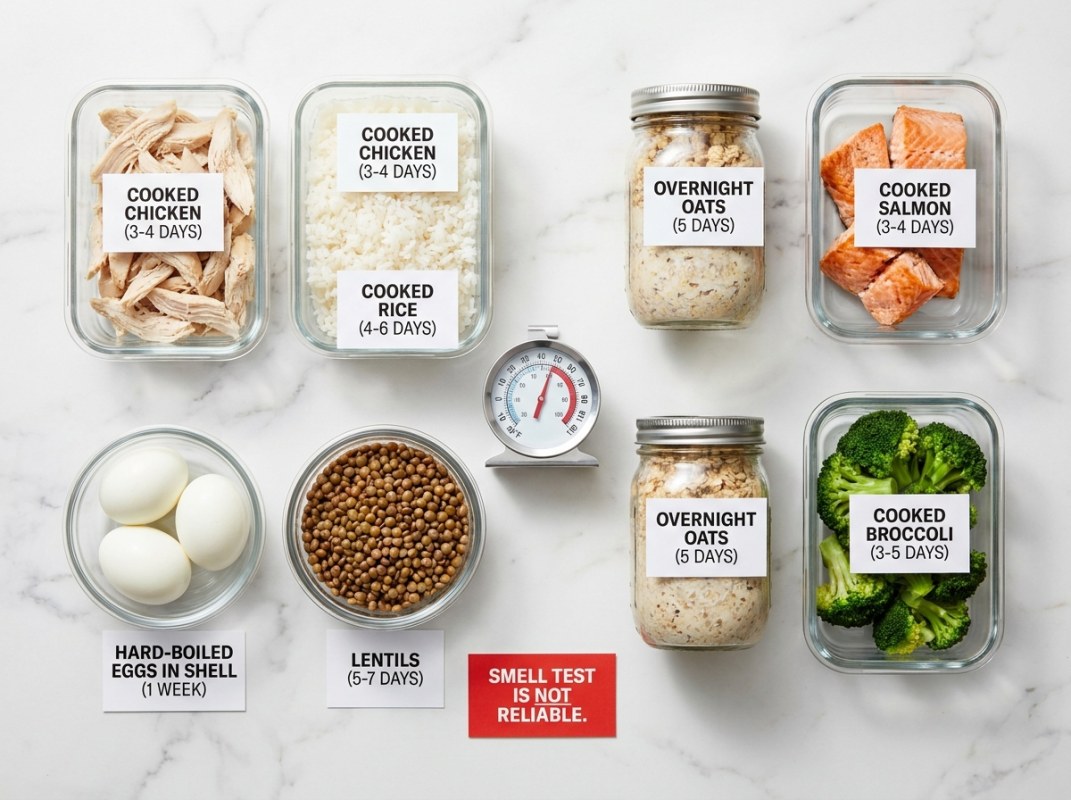
The most common reason meal prep fails isn't bad recipes or lack of discipline — it's storage. Based on food safety research and USDA data, roughly 91% of meal prep failures trace back to something going wrong in the refrigeration stage: the food went bad before it was eaten, it wasn't stored at the right temperature, or it was held too long and became unsafe or unappetising. If you've ever opened a container on Thursday and decided not to eat it, this guide is the one to save.
I'll give you the direct answer first, then the detail: most cooked proteins and grains last 3-4 days refrigerated. Some foods last longer. A few foods have shorter windows that surprise people. The hard line is 40°F (4°C) — your refrigerator must stay at or below this temperature for every timeline in this guide to hold. If your fridge runs warm (above 40°F), cut every window by one day and check the actual temperature with a cheap refrigerator thermometer. This is the single most overlooked variable in meal prep food safety.

The Master USDA FoodKeeper Reference Table
Every storage time below comes from USDA FoodKeeper (foodkeeper.usda.gov), the FDA Food Code, or peer-reviewed food science sources. This is not general internet wisdom — these are the numbers the USDA publishes for food safety. All refrigerator times assume storage at 40°F (4°C) or below. All freezer times assume 0°F (-18°C).
| Food | Refrigerator (40°F/4°C) | Freezer (0°F/-18°C) | Notes |
|---|---|---|---|
| Cooked chicken (all cuts) | 3-4 days | 2-6 months | Pull at 165°F (74°C). Sauce-stored holds texture better. |
| Cooked ground beef/turkey | 3-4 days | 3-4 months | Must reach 165°F throughout — not 145°F like whole muscle. |
| Cooked pork (roasts, chops) | 3-4 days | 2-3 months | Carnitas and braised cuts hold 4-5 days due to fat content. |
| Cooked salmon and fish | 3-4 days | 2-3 months | Most heat-sensitive protein — eat by day 3 for best quality. |
| Cooked shrimp | 3-4 days | 2-3 months | Texture degrades faster than fish — aim for day 3 max. |
| Hard-boiled eggs (in shell) | 1 week | Not recommended | Shell protects from odour absorption. Remove only when eating. |
| Hard-boiled eggs (peeled) | 5 days in cold water | Not recommended | Store in water in sealed container — prevents drying. |
| Cooked rice (all types) | 4-6 days | 6 months | Bacillus cereus risk — cool within 1 hour, refrigerate within 2. |
| Cooked pasta (plain) | 3-5 days | 2 months | Toss with oil to prevent clumping before refrigerating. |
| Overnight oats | 5 days | 3 months | Add fresh fruit at eating time, not at prep time. |
| Cooked lentils/beans | 5-7 days | 3 months | Most stable protein source for end-of-week meals. |
| Cooked sweet potato | 4-5 days | 10-12 months | Roasted cubes hold texture better than mashed for reheating. |
| Cooked broccoli/vegetables | 3-5 days | 10-12 months | Blanch before freezing to preserve colour and texture. |
| Meal prep salad (dressed) | 1-2 days | Not applicable | Undressed salad components: 4-5 days. Dressing separate. |
| Egg muffin cups/frittata | 4-5 days | 2 months | Cool completely. Wrap individually before freezing. |
| Soup and stew | 4-5 days | 2-3 months | Cool in shallow containers to reach safe temp faster. |
| Cooked quinoa | 5-7 days | 8-12 months | More stable than rice and pasta — excellent end-of-week grain. |
| Smoothie (blended) | 24-48 hours | 3 months (unblended packs) | Freeze ingredient bags, blend daily for best texture. |
| Greek yogurt parfait (assembled) | 2-3 days | Not recommended | Granola goes soggy. Store separately, add at eating time. |
| Carnitas/braised pork | 4-5 days | 3 months | Store in braising liquid. Fat content extends fridge stability. |
The Smell Test Is Not Reliable — This Matters More Than People Know
The most dangerous assumption in home food storage is that you can tell when food is unsafe by smell. For some pathogens, this is partially true — Listeria and some moulds do produce detectable odours as they develop. For others, it is completely false. Salmonella, Campylobacter, Staphylococcus aureus, and Bacillus cereus (the bacteria responsible for most rice-related food poisoning) produce no smell, no visible change in the food's appearance, and no taste difference. Food can be fully, dangerously contaminated and smell entirely normal.
This is not a theoretical edge case. In the United States, the CDC estimates 48 million foodborne illness cases per year, with roughly 128,000 hospitalisations and 3,000 deaths. The majority of home food poisoning cases involve food that "seemed fine." The storage timelines in this guide exist because food safety researchers have measured bacterial growth at specific temperatures and determined when the cumulative microbial load typically reaches an unsafe level — not because food shows obvious signs of spoilage by those dates.
This applies equally whether you're doing meal prep for one or cooking for a family — the USDA clock doesn't adjust based on how much you made. My practice: I trust the calendar, not my nose. If it's day 5 and the chicken smells fine, it still goes in the bin. The cost of one meal prep container is not worth the risk.

The 40°F Rule: Check Your Refrigerator Right Now
Every food safety timeline — USDA FoodKeeper, FDA guidelines, all of it — assumes your refrigerator maintains 40°F (4°C) or below. The bacterial danger zone is 40-140°F (4-60°C): this is the temperature range where most foodborne bacteria double in population every 20 minutes. At 38°F, bacterial growth is minimal. At 45°F — a refrigerator that runs slightly warm — bacterial growth is 4-8x faster than at 40°F, effectively cutting your safe storage window in half.
FDA food safety data shows that refrigerators in US homes run above 40°F approximately 30% of the time. This is more common than most people expect because refrigerator door seals wear out, compressors degrade, and the built-in temperature control on most units is calibrated to the interior thermostat rather than actual food temperature. A refrigerator thermometer costs $6-8 on Amazon and gives you an actual reading rather than a guess. If yours reads above 40°F, turn the temperature down and verify again after 24 hours.
Why Rice Needs Special Attention
Cooked rice has a specific food safety risk most meal preppers don't know about: Bacillus cereus. This bacteria is naturally present in raw rice grains and produces heat-resistant spores that survive normal cooking temperatures. At room temperature, these spores germinate and produce toxins — the toxins themselves are heat-stable, meaning reheating the rice to a safe temperature doesn't neutralise them once they've formed.
The risk window is the cooling period. Rice left at room temperature for more than 2 hours after cooking creates the conditions for Bacillus cereus growth. The USDA FoodKeeper gives cooked rice a 4-6 day refrigerator window specifically because that window assumes proper rapid cooling. In practice, this means: don't leave your batch-cooked rice sitting out for an hour while you finish portioning other components. Cool it first. Spread it on a sheet pan to cool faster if needed — a thin layer of rice on a sheet pan drops to room temperature in 20-25 minutes instead of 45-60 minutes in a pile.
The Cooling Window: 2 Hours Is the Hard Limit
According to FDA Food Code guidelines, cooked food must be cooled from 135°F to 70°F within 2 hours, then from 70°F to 40°F within an additional 4 hours (6 hours total). In practical meal prep terms: don't seal hot food in airtight containers and put it directly in the refrigerator. Hot food in a sealed container cools much slower than open food, and sealed hot food raises the internal refrigerator temperature, potentially affecting everything else stored there.
The correct process: portion food into containers, leave lids off or slightly ajar, allow to cool at room temperature for 20-30 minutes maximum, then refrigerate. The containers don't need to be fully cool before refrigerating — just not steaming hot. This is particularly important for soups, stews, and large portions of rice where the thermal mass is significant enough to stay warm for extended periods.
Freezing: What Happens to Food Texture and Why It Matters
Freezing doesn't make food unsafe — food frozen at 0°F (-18°C) is technically safe indefinitely. The USDA freezer timelines in the table above relate to quality, not safety: chicken frozen for 8 months is safe to eat but will have noticeably degraded texture and flavour compared to chicken frozen for 2 months. The ice crystals that form during freezing puncture cell walls, and the longer food stays frozen, the more extensive this damage becomes.
The biggest texture impact by food type: fish deteriorates fastest (2-3 months maximum for acceptable quality), followed by shrimp (2-3 months). Chicken and pork hold 2-6 months depending on cut and fat content. Cooked grains like rice and quinoa freeze beautifully for 6-12 months with minimal quality loss. Cooked legumes (beans, lentils) also hold well for 3 months.
Foods that should not be frozen: hard-boiled eggs (whites become rubbery and watery), mayo-based salads (the emulsion breaks, producing an oily, unappetising result), raw salad greens (cell walls collapse completely), and most fresh herbs (freeze-dry or use within their fresh window).
Reheat Temperature: 165°F Every Time
USDA guidelines require reheating all previously cooked food to 165°F (74°C) before eating. This applies to everything you meal prep — chicken, beef, rice, soup, vegetables. The 165°F target is the temperature at which the most heat-resistant common foodborne pathogens are killed, including Listeria monocytogenes, which can grow at refrigerator temperatures and is a particular risk for pregnant women, elderly individuals, and immunocompromised people.
In practice, a $15 instant-read thermometer eliminates the guesswork. After microwave reheating, check the temperature at the thickest or most central part of the food — not the edges, which always heat first. For meal prep in airtight containers: add a tablespoon of water before microwaving, cover loosely (not sealed), heat in 90-second intervals, stir between intervals, and check temperature before eating. This approach consistently reaches 165°F without over-drying the food.

Container Choice and How It Affects Storage Life
The container you use genuinely affects how long food lasts. Glass containers seal better than most plastic, don't absorb odours (which can create false "bad smell" signals or mask genuine ones), are non-porous so bacterial colonies don't develop in microscopic scratches, and don't leach chemicals into food during reheating. A glass container with a silicone-sealed lid is the gold standard for meal prep storage.
BPA-free plastic containers work adequately but have two practical limitations: the locking clips on cheaper models often seal less tightly than glass lids, allowing air exposure that accelerates oxidation and quality loss; and scratches from metal utensils create micro-grooves where bacteria can colonise that standard dishwashing doesn't fully clean. If using plastic containers, replace any that have deep scratches — this isn't aesthetic pedantry, it's basic food safety. For meal prep containers that balance cost and food safety, glass is the recommendation for anything you'll eat by day 3-4, plastic for items eaten earlier in the week or frozen immediately.
The Practical Weekly System
Based on all the above, here's the meal planning sequence that makes the storage science work in real life: cook and portion everything Sunday, leaving all container lids slightly open to cool. Refrigerate after 25-30 minutes maximum. Plan meals so the most perishable proteins (fish, shrimp) are eaten Monday-Tuesday, chicken and beef by Thursday, lentils and quinoa hold through Friday. If Thursday comes and you have more food than you'll eat, freeze it Thursday rather than hoping it lasts to Sunday.
The 5-day window Sunday through Thursday is the safest framework for most meal prep foods — it covers the standard work week, respects the USDA storage windows, and doesn't push chicken to day 5 where the risk-to-reward ratio starts tipping. Friday is the best day to eat something fresh, use the last of your cooked grains in a fried rice, or have the frozen meal you put away from a previous week. This is how batch cooking Sunday systems actually survive long-term — they build in a realistic end point rather than trying to stretch everything to 7 days.
Frequently Asked Questions
How long does meal prep last in the fridge?
Most cooked meal prep lasts 3-5 days refrigerated at 40°F (4°C) or below. Cooked chicken, beef, pork, and fish: 3-4 days per USDA FoodKeeper. Cooked rice: 4-6 days. Hard-boiled eggs in shell: 1 week. Overnight oats: 5 days. Cooked lentils and beans: 5-7 days. The exact window depends on the food, your refrigerator temperature, and how quickly the food was cooled and sealed after cooking.
Is 5-day meal prep safe?
5-day meal prep is safe for grains (rice, quinoa), lentils, beans, and overnight oats, which all last 5-7 days refrigerated. It is at the outer limit for cooked chicken and beef (3-4 days per USDA), meaning food prepped Sunday would be at day 5 by Thursday — technically within range but at the edge. For a 5-day meal prep cycle, plan fish and chicken for Monday through Wednesday, and use lentils, beans, or quinoa for Thursday and Friday meals.
Why does my meal prep go bad before 4 days?
The most likely causes are: refrigerator temperature above 40°F (check with a thermometer), food not cooled sufficiently before sealing and refrigerating (hot food in a sealed container creates condensation and slows cooling), containers not properly sealed allowing air exposure, or cross-contamination from other food in the refrigerator. Each of these factors independently accelerates bacterial growth and shortens safe storage time below the USDA estimates.
Can you eat meal prep after 7 days?
No — most cooked meal prep should not be eaten after 7 days refrigerated, regardless of smell or appearance. Cooked proteins (chicken, beef, fish) should not be consumed after day 4-5. Even the most shelf-stable meal prep items — cooked lentils and quinoa — should not be kept longer than 7 days. If you have food remaining at day 6-7, freeze it immediately rather than eating it directly from the refrigerator. USDA guidelines are clear and consistent on these windows.
What temperature kills bacteria in reheated meal prep?
165°F (74°C) internal temperature kills Salmonella, Listeria, Campylobacter, and most other common foodborne pathogens in reheated food, per USDA and FDA guidelines. This is the required reheating temperature for all previously cooked food. Use an instant-read thermometer to check the temperature at the thickest point of the food after reheating — microwave hot spots mean the edges reach temperature before the centre does.
The difference between successful meal prep and abandoned containers on Thursday comes down almost entirely to one habit: respecting the USDA storage windows rather than the smell test. 91% of meal prep failures are storage-related, and most of those failures are preventable with a refrigerator thermometer and a calendar rather than a nose. Start there, and everything else in this guide becomes reinforcement for a practice you've already built.