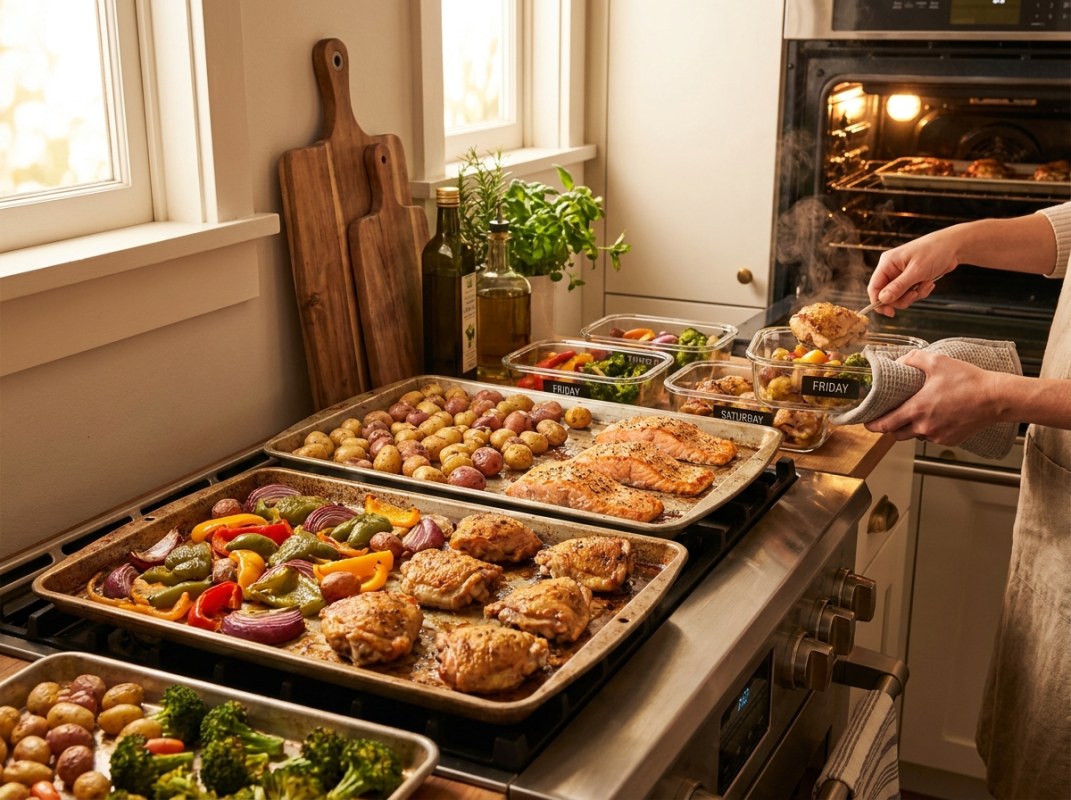
Why Sheet Pan Cooking Is Ideal for Meal Prep
Sheet pan cooking solves the primary obstacle most people cite when explaining why they do not meal prep: the amount of active time required. Chopping, sautéing, flipping, stirring, and monitoring multiple pans simultaneously is mentally taxing and time-consuming. A sheet pan meal requires approximately 10–15 minutes of active preparation, then 25–40 minutes of completely unattended oven time. During that oven time, you can prep overnight oats, clean the kitchen, or do anything else that needs doing.
For meal prep specifically, sheet pan cooking has two additional advantages. First, it produces food that stores and reheats more reliably than stovetop cooking — roasted proteins and vegetables maintain their structure and flavor better than stir-fried or sautéed equivalents after 3–4 days in the refrigerator. Second, two sheet pans in a standard oven cook enough food for 4–6 servings simultaneously — exactly the quantity needed for a 5-day meal prep session for one or two people.
The one disadvantage of sheet pan meal prep worth understanding: crispy textures do not survive refrigeration and reheating well. Crispy chicken skin, crispy roasted Brussels sprouts, and roasted potato wedges with crunchy edges all go soft during storage. If crispy texture is important to you, plan to reheat sheet pan meals in an air fryer (3–5 minutes at 375°F restores crispiness effectively) or under the broiler (3–4 minutes). Standard microwave reheating will not restore crispiness.
The Temperature Rule: 425°F for Almost Everything
The single most useful piece of sheet pan knowledge is that 425°F (220°C) is the correct oven temperature for virtually all sheet pan meal prep cooking. This temperature is hot enough to produce caramelization and browning on both proteins and vegetables, cook proteins through to safe internal temperatures in reasonable timeframes, and evaporate surface moisture quickly — which is what produces the roasted flavor rather than the steamed flavor you get at lower temperatures.
The exceptions are worth knowing:
- Delicate fish (sole, tilapia, thin cod): 400°F for 12–15 minutes. At 425°F, thin fillets overcook and dry out before the surface has time to color.
- Salmon fillets: 400°F for 12–15 minutes achieves medium doneness; 425°F for 10–12 minutes for fully cooked. Salmon at 425°F cooks faster than most people expect.
- Dense root vegetables alone (whole beets, thick carrot halves): 400°F for 45–60 minutes. At 425°F, the outside chars before the center is cooked.
- Bread or grain-based items on the same pan: Lower temperature or add late in cooking. Pita, naan, or grain-based crusts burn quickly at 425°F.
The Timing Problem — and How to Solve It
The central challenge of sheet pan cooking is that different ingredients have different cooking times. Chicken thighs need 35–40 minutes. Broccoli florets need 20–22 minutes. Cherry tomatoes need 15 minutes. If everything goes on the pan at the same time at the same temperature, either the fast-cooking items are burnt or the slow-cooking items are underdone.

There are three solutions, in order of simplicity:
Solution 1: Stagger additions. Start the longest-cooking item first. After the appropriate interval, add the next-longest item. This requires checking the timer but no additional planning. Example: chicken thighs go in at minute 0; broccoli goes in at minute 18; cherry tomatoes go in at minute 25. Everything finishes at minute 40.
Solution 2: Cut to matching sizes. Larger pieces cook slower; smaller pieces cook faster. If you cut dense root vegetables (carrots, parsnips, beets) into small cubes (half-inch) while leaving proteins large, they reach doneness at roughly the same time. This works for vegetable combinations but is less effective for protein-vegetable pairings where the cooking time difference is large.
Solution 3: Use two pans. Put proteins on one pan, vegetables on another. The protein pan goes in first; the vegetable pan goes in 15–20 minutes later. Both come out at the same time. This is the most reliable approach for meal prep where you are making large quantities and do not want to babysit the oven.
Protein Cooking Times at 425°F (Reference Guide)
- Bone-in chicken thighs: 35–40 minutes, internal 175°F
- Boneless chicken thighs: 25–28 minutes, internal 175°F
- Boneless chicken breast (6oz): 20–25 minutes, internal 165°F
- Salmon fillet (1 inch thick): 12–15 minutes at 400°F, flakes easily
- Shrimp (large, peeled): 6–8 minutes, pink and curled
- Pork tenderloin (1lb): 20–25 minutes, internal 145°F
- Ground meat (turkey, beef) formed into patties: 18–22 minutes, internal 165°F
- Firm tofu (1-inch cubes, pressed dry): 25–30 minutes, golden exterior
- Chickpeas (drained, dried): 25–30 minutes, crispy
Vegetable Cooking Times at 425°F (Reference Guide)
- Broccoli florets: 18–22 minutes (charred edges are desirable)
- Cauliflower florets: 20–25 minutes
- Brussels sprouts (halved): 20–25 minutes
- Sweet potato (½-inch cubes): 25–30 minutes
- Sweet potato (halved): 30–35 minutes
- Bell pepper (strips): 20–25 minutes
- Asparagus (medium spears): 12–15 minutes
- Green beans: 15–18 minutes
- Zucchini (½-inch rounds): 15–18 minutes
- Cherry tomatoes (whole): 15–18 minutes (burst and caramelize)
- Carrots (½-inch coins): 22–28 minutes
- Frozen broccoli (from frozen, no thawing): 22–25 minutes
- Frozen mixed vegetables (from frozen): 20–22 minutes
8 Proven Sheet Pan Meal Prep Combinations
These are complete combinations tested for compatible cooking times, flavor pairing, and 4-day storage quality. All use 425°F unless noted.
1. Garlic chicken thighs + broccoli + sweet potato: Season thighs with olive oil, garlic powder, smoked paprika, salt. Cubed sweet potato on the same pan. Thighs and sweet potato go in together for 35 minutes; broccoli florets added at minute 15. Total time: 35 minutes. One of the most reliable meal prep combinations — stores 4 days, reheats without quality loss.
2. Lemon herb salmon + asparagus + cherry tomatoes: Salmon fillets on one half of the pan; asparagus spears and halved cherry tomatoes on the other. Season salmon with lemon zest, dill, olive oil. Season vegetables with olive oil, salt. Everything goes in together at 400°F for 14 minutes. Best consumed days 1–3; fish quality declines noticeably on day 4.
3. Soy-ginger chicken breast + bok choy + frozen broccoli: Marinate chicken breasts in soy sauce, ginger, sesame oil, garlic, honey for at least 30 minutes. Chicken on one pan for 22 minutes at 425°F; frozen broccoli and halved bok choy added in the final 15 minutes. Serve over rice. Stores 4 days.
4. Tex-Mex turkey meatballs + bell peppers + black beans: Form ground turkey into 1.5-inch meatballs seasoned with cumin, chili powder, garlic. Bell pepper strips and rinsed black beans (dried slightly) spread around them. All at 425°F for 20–22 minutes until meatballs reach 165°F. Serve in bowls with rice and avocado (add avocado day-of). Stores 4 days.
5. Balsamic chicken + Brussels sprouts + red onion: Toss chicken thighs in balsamic vinegar, Dijon mustard, olive oil, garlic. Halved Brussels sprouts and sliced red onion on the same pan. All at 425°F for 35–38 minutes. The balsamic caramelizes into a glaze. One of the highest-flavor sheet pan combinations — gets better on day 2 as the flavors deepen. Stores 4 days.
6. Pesto salmon + zucchini + cherry tomatoes: Spread a tablespoon of pesto over each salmon fillet. Zucchini rounds and cherry tomatoes surround them. At 400°F for 14 minutes. Bright, Mediterranean flavors. Best days 1–3.
7. Crispy tofu + broccoli + carrots (vegan): Press tofu for 30 minutes, cut into 1-inch cubes, toss with soy sauce, sesame oil, cornstarch (the cornstarch creates a crispy exterior). On a sheet pan lined with parchment. Broccoli and carrot coins alongside. At 425°F for 28–30 minutes, flipping tofu once at 15 minutes. Serve over rice with peanut sauce. Stores 4 days — reheat in air fryer to restore crispiness.
8. Sausage + peppers + onions + potato: Slice chicken or turkey sausages into coins. Bell pepper strips, onion wedges, and baby potatoes halved, all tossed in olive oil, Italian seasoning, salt. Everything on the pan at 425°F for 30–35 minutes. One of the most kid-friendly sheet pan combinations. Stores 4 days and reheats excellently.
Sheet Pan Meal Prep Storage and Reheating
Cooling before storing: This matters more for sheet pan meals than almost any other cooking method because the food retains heat deeply after leaving the 425°F oven. Let the pan sit at room temperature for at least 20–25 minutes before portioning into containers. Sealing hot food in containers creates steam that softens textures and accelerates spoilage.
Store sauces and dressings separately. Any sauce or wet element — pesto, tahini, balsamic glaze — should be stored in a small separate container and added at serving time. Sauce sitting on proteins and vegetables during 4 days of storage creates unwanted moisture and mushiness.
Reheating options ranked:
- Air fryer at 375°F for 3–5 minutes — best for restoring crispiness and texture
- Oven at 400°F for 8–10 minutes — effective for larger portions or family-size reheating
- Microwave at 70% power for 90 seconds with a splash of water — convenient but does not restore texture
- Stovetop in a hot pan with a small amount of oil — adds some crispiness back, 3–5 minutes

Frequently Asked Questions
Q: Do I need to use parchment paper on my sheet pans?
Not required, but highly recommended for meal prep. Parchment prevents sticking (which means food portions stay intact when transferred to containers), eliminates the need to scrub the pan, and is especially useful for marinated proteins where the sugar in the marinade burns onto bare metal. Foil works for cleanup but can stick to proteins more than parchment does.
Q: Can I put everything on one pan instead of two?
For a single serving or couple's portion, yes — a half-sheet pan (18x13 inches) can hold 2 chicken thighs and 2 cups of vegetables without crowding. For 4–5 servings, two pans are necessary. Overcrowding is the most common sheet pan mistake — overcrowded pans steam food rather than roasting it, producing soft, watery results with no browning.
Q: Which sheet pan is best for meal prep?
A heavy-gauge aluminum half-sheet pan (18x13 inches) is the standard. Lightweight pans warp at high temperatures, creating uneven cooking. Dark pans absorb more heat and can cause bottoms to overcook. Rimmed pans (as opposed to rimless cookie sheets) contain any drippings or liquids. A good half-sheet pan costs $20–$35 and lasts years with proper care. Having two identical pans is more useful than having one large and one small.
Q: Can frozen vegetables go directly on the sheet pan without thawing?
Yes — and this is actually preferable for meal prep. Frozen vegetables straight from the bag onto a hot sheet pan (no thawing, no wringing out excess moisture) roast more effectively than thawed vegetables, which release their moisture onto the pan. Spread in a single layer, toss with olive oil and salt, and roast at 425°F for 20–25 minutes. The result is genuinely roasted rather than steamed.