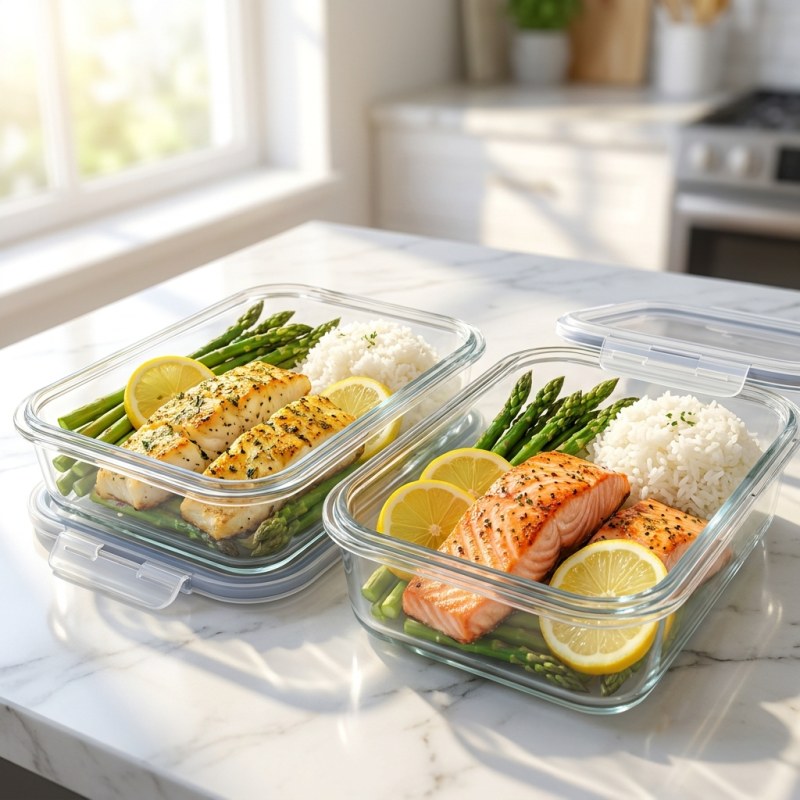
Fish is the meal prep protein most people avoid because of the office microwave problem. That's a valid concern — reheating fish in a sealed office microwave at full power produces a smell that clears the room and earns genuine resentment from colleagues. But the problem is the reheating method, not the fish. This guide covers which fish produces least smell when reheated, the specific technique that keeps smell compounds from volatilising, and a full fish prep system designed around the 3-day storage window that applies to all cooked fish.
I've run fish in my rotation for months. Cod on Mondays through Wednesdays, canned tuna as the Thursday-Friday fallback. The system works once you understand the smell chemistry.
Which Fish Lasts Longest in the Fridge After Cooking?
Per USDA FoodKeeper, the storage window is the same across all cooked fish: 3–4 days refrigerated at 40°F (4°C). None of the commonly meal-prepped fish varieties reach 5 days. This is a harder constraint than chicken (4 days) or beef (4 days) and needs to be planned around explicitly.
| Fish | Price/lb (2026) | Protein/3oz | Omega-3/3oz | Office Smell | Meal Prep Verdict |
|---|---|---|---|---|---|
| Cod | $2.50–$3.50/lb | 20g | 0.2g | ✅ Mildest | Best for office reheating |
| Tilapia | $2.00–$3.00/lb | 21g | 0.1g | ✅ Very mild | Most budget-friendly |
| Halibut | $15–$22/lb | 23g | 0.5g | ✅ Mild | Premium — occasional use |
| Farmed salmon | $4–$6/lb | 22g | 1.8g | ⚠️ Moderate | Best omega-3 per dollar |
| Wild salmon | $7–$12/lb | 22g | 2.2g | ⚠️ Moderate | Highest omega-3, highest cost |
| Tuna steak | $6–$10/lb | 25g | 0.7g | ⚠️ Strong | Not for office — batch at home |
| Mackerel | $3–$5/lb | 20g | 1.6g | ❌ Strongest | Home meals only |
| Sardines | $1.50–$2.50/can | 22g/can | 1.8g/can | ❌ Strongest | Cold only — never reheat |
| Canned light tuna | $0.88–$1.10/can | 25g/can | 0.7g/can | ✅ Mild cold | Best backup protein — no cooking |
The pattern: white fish (cod, tilapia, halibut) reheats with the least smell. Fatty fish (salmon, mackerel, sardines) produces significantly more volatile compounds when heated because the omega-3 fatty acids oxidise more rapidly at elevated temperature. This is the direct chemical reason fatty fish smells stronger when reheated — not a freshness issue, a chemistry one.
The practical Monday-through-Wednesday protein: cod or tilapia. Both are mild enough to reheat in a shared office microwave with the smell-minimisation technique below without incident. Salmon is the better nutritional choice but requires more consideration of your eating context.
How Do You Reheat Fish Without the Smell Taking Over the Room?
The smell comes from trimethylamine (TMA) and specific volatile fatty acid oxidation compounds that are released when fish proteins are heated. Temperature is the primary driver — the compounds volatilise exponentially with heat. A piece of cod at 120°F (49°C) produces 20% of the smell of the same cod at 165°F (74°C).
The smell-minimisation reheating technique:
- Remove fish from container. Add 1 slice of lemon directly on top of the fish — lemon acid converts TMA to a less volatile salt compound, chemically reducing the smell at the source.
- Cover the dish loosely but not sealed — vented, not open. This traps some steam (which helps reheat gently) while allowing the most concentrated smell compounds to escape rather than building pressure.
- Microwave at 50% power for 90 seconds. Low power = lower peak temperature = significantly less smell volatilisation. The fish warms through without reaching the high-temperature zone where smell compounds become aggressive.
- Check internal temperature — fish should be warm but not steaming aggressively. If still cold in the centre, 30 more seconds at 50%.
For home reheating where smell is not a constraint, wrap fish tightly in foil with 1 tbsp of water and reheat at 275°F (135°C) for 10–15 minutes. The low temperature and steam environment from the added water produces the closest result to fresh-cooked fish of any reheating method. The foil also contains any smell within the oven rather than dispersing it through the kitchen.
The cold option: For work lunches specifically, eat the fish cold. Cold cooked cod or salmon over room-temperature rice with a lemon-herb dressing is a legitimate preparation — not a compromise. It eliminates the smell problem entirely and produces a meal that often tastes better than reheated fish because the texture hasn't been disrupted by a second heat cycle.


What Fish Work Best for Meal Prep Batching?
Cod is the optimal meal prep fish. Here's why specifically:
- Uniform thickness when filleted: Most cod portions are 1–1.5 inches thick throughout, which means they cook evenly without thin ends overcooking before the centre is done. Uneven thickness is the main cooking challenge with fish.
- Mild flavour absorbs any seasoning: The same cod preparation takes lemon-herb on Monday, garlic-miso on Tuesday, and smoked paprika on Wednesday as different flavour profiles.
- Price: $2.50–$3.50/lb at most US grocery stores — less than half the price of salmon and significantly cheaper than halibut.
- USDA storage: 3–4 days at 40°F (4°C) — within the standard fish storage window, covering Monday through Wednesday from a Sunday prep.
- Freezes well: Cooked cod freezes for up to 3 months per USDA FoodKeeper, with minimal quality loss compared to salmon which becomes watery after freezing.
Tilapia is the budget alternative at $2.00–$3.00/lb. The trade-off is a flatter flavour profile (milder even than cod, which some people find it too bland) and thinner fillets that are less forgiving to cook. Tilapia at 0.5 inches thick overcooked to rubbery in 14 minutes at 400°F (200°C) in my testing — 10–12 minutes is the correct window.
Salmon is nutritionally superior (2.2g omega-3 per 3oz versus cod's 0.2g) but costs 2–3× more and produces more smell when reheated. The right approach for most people: cod for Tuesday-Wednesday office lunches, salmon on Sunday or Monday evening (home dinner where smell doesn't matter).
Is It Safe to Meal Prep Fish for 5 Days?
No. Per USDA FoodKeeper: cooked fish 3–4 days maximum at 40°F (4°C). Not 5 days.
The relevant bacteria for fish are different from meat: Salmonella is the primary risk from cross-contamination during preparation. Listeria monocytogenes is the specific risk for smoked fish and lox — Listeria grows at refrigerator temperatures (it does not require the warm temperatures that most bacteria need), meaning smoked salmon stored for 5 days in a fridge continues accumulating Listeria regardless of cold temperature. This is the specific reason smoked fish has a shorter window than cooked fish: USDA FoodKeeper specifies smoked salmon 5–8 days refrigerated (sealed) but once opened, consume within 3–4 days.
Smoked salmon, smoked trout, and lox are cured and cold-smoked products — not fully cooked. The Listeria risk is real and specific. USDA FoodKeeper: opened smoked salmon 3–4 days in the refrigerator. Frozen smoked salmon 2 months. Never push smoked fish to day 5 — Listeria monocytogenes is a serious pathogen that causes severe illness and is particularly dangerous for pregnant women, elderly, and immunocompromised individuals. Fully cooked (hot-smoked) fish has the same window as cooked fish: 3–4 days.
The 5-day fish system: Batch cooked fish for Monday through Wednesday. Freeze Thursday and Friday's portions immediately on Sunday rather than refrigerating. Thaw Wednesday night for Thursday, Thursday night for Friday. Frozen cooked fish thawed this way produces better quality than fish refrigerated for 5 days — it was frozen at day-1 quality rather than slowly degrading over the storage window.
What Are the Best Fish Meal Prep Combinations?
| Bowl | Fish | Base | Sauce | Calories | Protein | Cost/serving |
|---|---|---|---|---|---|---|
| Lemon herb cod bowl | Baked cod | Brown rice | Lemon + olive oil + herbs | 420 cal | 26g | $2.80 |
| Miso glazed salmon bowl | Baked salmon | Brown rice | White miso + soy + honey | 490 cal | 28g | $3.50 |
| Mediterranean cod | Baked cod | Quinoa | Olive oil + capers + tomatoes | 440 cal | 24g | $3.20 |
| Teriyaki salmon | Pan-seared salmon | Brown rice + edamame | Teriyaki (soy + honey + sesame) | 520 cal | 30g | $3.80 |
| Fish taco bowl | Baked tilapia | Cauliflower rice | Chipotle yogurt + lime | 360 cal | 24g | $2.40 |
| Omega-3 power bowl | Salmon + sardines cold | Mixed greens | Lemon + olive oil | 480 cal | 32g | $3.20 |
All sauce components store separately in small jars and are added at eating time — applying sauce before storage accelerates fish quality decline. The acid in sauces (lemon, vinegar) begins denaturing the fish protein during refrigerator storage.
For how to build any of these into a complete bowl system, see the meal prep bowls for work lunches guide.
How Do You Batch Multiple Types of Fish in One Session?
Running two types of fish in one Sunday session doubles your variety without significantly increasing effort. The key is cooking sequence and temperature management.
The two-fish Sunday method:
0:00 — Oven to 400°F (200°C). Brown rice on stovetop.
0:10 — Cod into oven first (longer cook time).
Season with olive oil, lemon zest, garlic powder, salt, thyme. Parchment-lined sheet pan. 14–16 minutes. Internal temperature target: 145°F (63°C). Cod flakes cleanly at this temperature — use a fork to check the thickest section. If it flakes but still looks translucent in the centre, add 2 more minutes.
0:20 — Sheet pan salmon into second oven rack.
Season differently (miso glaze or smoked paprika) to produce variety from the same session. Salmon 12–14 minutes for a 1-inch thick portion at 400°F (200°C). Target: 145°F (63°C) — opaque throughout, not translucent pink. Rest 3 minutes before portioning.
0:26 — Cod out at 14–16 minutes. Salmon out at 12–14 minutes.
Both at 145°F (63°C). The key contamination prevention step: use separate cutting boards and utensils for each type of fish, and wash hands between handling different species.
0:35 — Spread all fish on open trays to cool 15 minutes.
Fish should not be sealed hot. Steam condensation in a sealed container produces a strong smell on opening and accelerates quality decline.
0:50 — Portion into containers.
Cod portions for Monday through Wednesday (3 containers). Salmon portions for Thursday through Wednesday of next week (freeze 2 of the 4 salmon portions immediately on Sunday). Label with species and date — critical when you have multiple fish types in the same fridge.
For the sheet pan approach that runs fish alongside vegetables simultaneously, see the sheet pan meal prep ideas guide.
Frequently Asked Questions About Fish Meal Prep
How long does cooked fish last in the fridge?
3–4 days at 40°F (4°C) per USDA FoodKeeper — for all cooked fish including cod, salmon, tilapia, and tuna. None reach 5 days. Batch for Monday through Wednesday from a Sunday cook. Freeze Thursday and Friday portions immediately on Sunday and thaw as needed. This produces better quality on those days than refrigerating for 4–5 days.
Which fish smells least when reheated in an office microwave?
Cod and tilapia are the mildest. The smell from reheated fish comes from TMA (trimethylamine) and volatile fatty acid compounds released at high temperature. White fish (cod, tilapia, halibut) produces less of these compounds than fatty fish (salmon, mackerel, sardines). For office reheating: cod or tilapia at 50% microwave power for 90 seconds with a lemon slice on top, vented lid. Do not reheat mackerel, sardines, or tuna steak in a shared microwave.


What is the safe internal temperature for cooked fish?
145°F (63°C) per USDA guidelines for all fish. The visual check: the flesh turns from translucent to opaque throughout and flakes easily when pressed with a fork at the thickest point. A thermometer is more reliable than visual inspection for thick portions (salmon, halibut steaks) where the centre can still be undercooked while the exterior appears done.
Can I meal prep fish for 5 days?
No — USDA FoodKeeper specifies 3–4 days for cooked fish. To cover 5 days: prep on Sunday, freeze Thursday and Friday portions immediately, thaw Wednesday night and Thursday night respectively. Frozen at cooking-day quality produces better results than day-4 and day-5 refrigerated fish. Never push refrigerated fish to day 5 on the basis that it "smells okay" — the bacteria risks (Salmonella, Listeria) don't reliably announce their presence through smell.
Is salmon worth the extra cost for meal prep?
For omega-3 specifically, yes. Farmed salmon at $4–$6/lb delivers 1.8g omega-3 per 3oz cooked — nine times more than cod at 0.2g. If you're using fish as a vehicle for omega-3 intake, the price difference is justified. If the primary goal is lean protein at low cost, cod or tilapia at $2–$3.50/lb delivers equivalent protein at half the price. Most people do best with a rotation: cod Mon–Wed for cost, salmon once per week for omega-3 density.
How do I keep fish from drying out in meal prep?
Three techniques: cook to exactly 145°F (63°C) and no further (each degree past this loses moisture), add 1 tbsp of olive oil to the container before refrigerating (the oil coats the surface and reduces moisture evaporation), and reheat at 50% microwave power or in a foil packet at 275°F (135°C). Overcooked fish dries out during the initial cooking — there's no technique that restores moisture lost during overcooking.