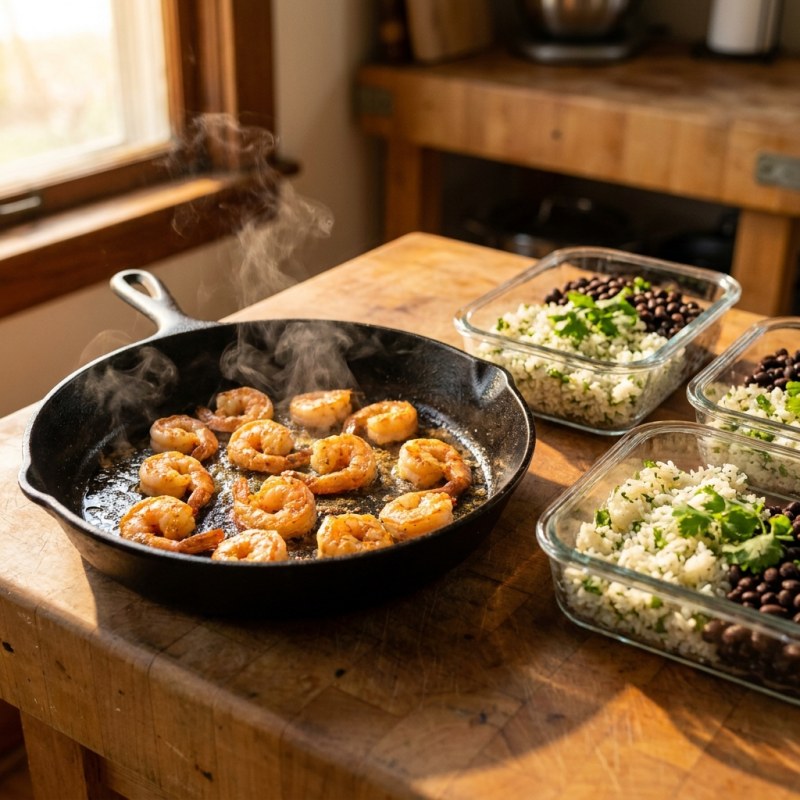
Shrimp goes from frozen to fully cooked in 3–4 minutes. That's the fastest cook time of any protein in a meal prep rotation, which makes it genuinely useful for mid-week emergency prep when you've eaten through everything else by Wednesday. The catch is the storage window: cooked shrimp lasts 3–4 days refrigerated maximum — not 5 days, not "probably fine on Friday if it smells okay." Batch it for Monday through Wednesday, then cook a fresh batch Thursday evening in 10 minutes.
I've kept shrimp in my rotation for months. The two things that make or break it: never buying pre-cooked shrimp, and never microwaving the leftovers.
What Size Shrimp Is Best for Meal Prep?
Shrimp is sold by count per pound — the number indicates how many shrimp fit in one pound. Smaller number = larger shrimp. For meal prep specifically, size determines how well the shrimp holds up through storage and reheating.
| Count/lb | Size Name | Meal Prep Verdict | Why |
|---|---|---|---|
| 16–20 | Extra large | ✅ Best — the meal prep sweet spot | Large enough to not overcook in seconds, 5–6 per serving is satisfying |
| 21–25 | Large | ✅ Good — acceptable substitute | Slightly more prone to overcooking, still holds texture |
| 26–30 | Medium | ⚠️ Marginal | Easy to overcook; texture degrades faster after 2 days |
| 31–40 | Small | ❌ Avoid for meal prep | Cook in seconds; rubbery within 24 hours |
| 71–90 | Salad shrimp | ❌ Never | Rubber pellets when reheated — not viable |
The 16–20 count at $7.49–$9.99/lb frozen at Walmart yields approximately 4 portions at 5–6 shrimp each. Per serving cost: $1.87–$2.50 from shrimp alone — one of the more affordable seafood options per gram of protein.
Frozen vs Fresh vs Pre-Cooked Shrimp — Which Should You Buy?
This is the most consequential decision in shrimp meal prep and most people get it wrong.
Always buy frozen raw. Here's why each of the other options fails:
Fresh shrimp at the seafood counter: Almost certainly previously frozen and thawed at the store. You're paying fresh prices for shrimp that's already been frozen once and may have been sitting in the display case for 1–2 days. The clock on its usable life has already started. Buy from the frozen bags instead — the shrimp was frozen at sea, immediately after catch, at the peak of freshness.
Pre-cooked frozen shrimp: This is the critical mistake. Pre-cooked shrimp has been cooked once during processing. When you "reheat" it for meal prep, you're cooking it a second time. Two cooking events means double the moisture loss and double the protein denaturation. The result is rubbery, dry shrimp that tastes like it came from a bad buffet. There is no technique that fixes shrimp that has been cooked twice.
Frozen raw shrimp (the right choice): Thaw in the refrigerator overnight or in cold running water for 15 minutes. You control the single cooking event. You control the temperature. You control the timing. The difference in texture between properly cooked frozen raw shrimp and pre-cooked shrimp is dramatic.
Frozen shrimp comes shell-on or peeled/deveined. Shell-on is cheaper by $1–$2/lb and some argue the shell protects the shrimp during cooking, keeping it moister. For meal prep — where you want fast portioning into containers — buy peeled and deveined (P&D). The labour savings on Sunday are worth the price difference. Look for "EZ-peel" as a middle option if cost is the priority.


How Long Does Cooked Shrimp Last in the Fridge?
Per USDA FoodKeeper: cooked shrimp 3–4 days refrigerated at 40°F (4°C).
This is shorter than chicken (4 days) and beef (4 days) and needs to be planned around. The practical week structure:
- Prep Sunday → eat Monday, Tuesday, Wednesday — within the 3–4 day window
- Thursday: 10-minute fresh batch — raw shrimp cooks faster than any other protein
- Friday: eat Thursday's batch (day 1–2 from the second cook)
The bacteria risks specific to shrimp: Salmonella (common contamination in imported shrimp) and Vibrio vulnificus (naturally present in warm coastal waters, particularly in Gulf shrimp). Both are fully destroyed at 145°F (63°C). The food safety argument for cooking your own from raw — rather than relying on pre-cooked — is strongest with shrimp because you can verify the temperature yourself.
Shrimp is among the fastest proteins to spoil at room temperature. Vibrio bacteria double in population every 9 minutes at 86°F (30°C) — faster than almost any other foodborne pathogen. The USDA 2-hour rule applies to all proteins, but the margin is tightest with shellfish. Cool shrimp on an open tray for 15 minutes maximum after cooking, then refrigerate immediately. Never leave a shrimp bowl on your desk for 3 hours and then refrigerate it — the bacteria window has already closed.
How Do You Cook Shrimp in Bulk Without Overcooking It?
The overcooking line for shrimp is one of the most precise in cooking. Shrimp is done the instant it turns from translucent grey to uniformly opaque pink and curls into a loose C-shape. At that exact moment, it is at 145°F (63°C) — the USDA minimum — and at its peak texture.
30 seconds past that point: the shrimp continues to tighten and curl into a tight O-shape. Moisture has begun escaping.
60 seconds past that point: the shrimp is overcooked. It will be rubbery within 2 hours.
The batch cooking method that prevents overcooking:
- Heat a large skillet to medium-high (not high — the goal is control, not char).
- Add 1 tbsp oil. Add shrimp in a single layer — do not crowd. Crowding drops temperature and causes uneven cooking.
- Cook 2 minutes without moving — let the first side develop a light sear.
- Flip. 1–2 minutes on the second side until opaque throughout.
- Watch for the C-shape. The moment every shrimp has curled and gone fully opaque: off heat, immediately transfer to a plate.
- Do not leave shrimp in the hot pan — residual heat continues cooking for 1–2 minutes after the flame is off.
For 1 lb of shrimp (16–20 count): cook in two batches of 8–10 shrimp each. Batch cooking takes 8 minutes total for the entire pound. Do not cook all 20 shrimp at once in a standard skillet — the pan drops temperature and you lose the sear.
What Are the Best Shrimp Meal Prep Combinations?
| Bowl Combination | Protein | Carbs | Cost/serving | Notes |
|---|---|---|---|---|
| Garlic butter shrimp + brown rice + broccoli | 22g | 42g | $2.40 | The anchor recipe — works with any sauce |
| Shrimp taco bowl + cauliflower rice + salsa | 22g | 8g net | $2.60 | Low carb version |
| Shrimp fried rice (egg + soy + sesame) | 26g | 55g | $2.20 | Use day-old rice for best texture |
| Mediterranean shrimp + quinoa + cucumber | 24g | 38g | $2.80 | Lemon + olive oil + herbs |
| Shrimp pad thai-style + rice noodles | 22g | 52g | $2.50 | Make sauce separately |
| Shrimp and mango salsa bowl | 22g | 35g | $3.10 | Best Mon–Tue only — mango oxidises |
The garlic butter shrimp + brown rice + broccoli combination is the anchor — it's the most stable, the easiest to assemble, and works as a base for any sauce variation. See the meal prep bowls for work lunches guide for the full bowl formula applied to shrimp.
How Do You Reheat Shrimp Without Making It Rubbery?
Never microwave shrimp. The microwave drives moisture out of the already-lean protein within 60 seconds, producing rubbery, dry shrimp regardless of power level. Unlike chicken or beef where there's enough internal fat and moisture to survive a microwave cycle, shrimp has no reserve.
The correct reheating method:
- Add shrimp to a cold skillet.
- Medium heat.
- 60–90 seconds total, stirring once.
- Off heat the moment it's warmed through.
That's it. The cold-start method prevents the shrimp from hitting scorching heat immediately, which is what causes the rubber texture. The shrimp warms gradually with the pan.
If you must use a microwave: 30% power, 30-second intervals, check after each. This is the least bad microwave approach. It's still inferior to the skillet method by a significant margin.
Eat shrimp cold as an alternative: Cooked shrimp served cold over rice with a sauce is genuinely good — many people prefer it for work lunches because it avoids the reheating problem entirely. Cold garlic shrimp over room-temperature rice with soy-lime dressing is a satisfying bowl that doesn't require any reheating equipment.
For the full container system that keeps shrimp from getting soggy in storage, see the best meal prep containers guide. The key is a container that allows air circulation and doesn't trap the steam from hot shrimp.


Frequently Asked Questions About Shrimp Meal Prep
How long does cooked shrimp last in the fridge?
3–4 days at 40°F (4°C) per USDA FoodKeeper. This is shorter than most proteins — plan shrimp for Monday through Wednesday only from a Sunday batch. Cook a second 10-minute batch Thursday for Thursday and Friday. Never push to day 5 on the reasoning that "it smells fine" — Vibrio bacteria from seafood don't reliably announce their presence through smell.
Why should I never buy pre-cooked shrimp for meal prep?
Pre-cooked shrimp has been cooked once during processing. Reheating it is a second cooking event — double the moisture loss, double the protein tightening. The result is rubbery, dry shrimp with no technique fix available. Always buy frozen raw shrimp and cook it yourself for the first and only time.
What is the best shrimp size for meal prep?
16–20 count per pound (Extra Large). Large enough that 5–6 shrimp per serving is a satisfying portion, and large enough that the difference between properly cooked and overcooked is 30–60 seconds rather than 5 seconds (which is the margin with small shrimp). The 16–20 count at $7.49–$9.99/lb frozen is available at Walmart, Kroger, and Costco.
Can you freeze cooked shrimp for meal prep?
Yes — cooked shrimp freezes well for up to 3 months per USDA FoodKeeper. Freeze in a single layer on a tray first (prevents them freezing together), then transfer to a zip-lock bag. Thaw overnight in the refrigerator. The texture after thawing is slightly softer than fresh-cooked — acceptable for bowls with sauce, less good if you want the firm texture of just-cooked shrimp.
Why is shrimp meal prep limited to 3 days maximum?
The 3–4 day refrigerator window (versus 4 days for chicken and beef) is set by the USDA based on bacterial growth rates specific to seafood. Vibrio bacteria — naturally occurring in coastal waters and a significant contamination risk in shrimp — grow rapidly at refrigerator-adjacent temperatures and cause serious illness. The shorter storage window reflects the specific microbiology of shellfish.
What is the correct internal temperature for cooked shrimp?
145°F (63°C) per USDA guidelines for all seafood. For shrimp, visual indicators are a reliable proxy: opaque throughout with no grey translucent areas and a loose C-curl. A tight O-curl means overcooked. A loose C with some translucency means undercooked. Use a thermometer on a few pieces when establishing your technique — then trust the visual once calibrated.