I've tracked my protein intake as a vegetarian for 14 months straight. The number that surprised me most wasn't how easy it was to hit 100g — it was how cheap. A week of vegetarian meal prep that reliably delivers 105–120g protein daily costs me $38–$42. That's cheaper per gram of protein than a chicken-based week, because tempeh, lentils, and Greek yogurt are underpriced relative to what they deliver nutritionally.
The persistent myth — that vegetarians struggle with protein — survives because most vegetarian meal prep guides skip the actual numbers. This guide doesn't. Every food in this system has a protein-per-oz figure, a cost-per-gram figure, and a specific role in the daily protein stack. You'll know exactly how 105g lands across the day before you spend anything at the grocery store.
Why Vegetarian Protein Math Is Different From What Most People Think
The critical misunderstanding is confusing protein quality with protein quantity. Most plant proteins are "incomplete" — they lack one or more essential amino acids in adequate ratios. This is true. What isn't true is that it makes hitting daily protein targets harder. Amino acid completeness is a within-day concern, not a within-meal concern. If your Greek yogurt at breakfast (complete protein) and your lentil lunch (incomplete) and your tempeh dinner (near-complete) cover the amino acid map across the day, you're fine.
If your plan includes eggs and Greek yogurt — both complete proteins — your amino acid profile for the day is complete regardless of what plant proteins you add. This is the practical reality for lacto-ovo vegetarians: the completeness question is already answered by two ingredients.
Protein-dense vegetarian foods cost significantly less per gram of protein than chicken at current US grocery prices. Dried red lentils: $0.024/g protein. Eggs: $0.027/g. Greek yogurt: $0.044/g. Chicken breast: $0.10–$0.13/g. The vegetarian protein stack is the budget option, not the expensive one.
Top Vegetarian Protein Foods for Meal Prep — Ranked by Density
These are the foods that do the actual work in a 100g+ vegetarian protein day, ranked by protein density (grams per 100g) rather than per serving — because density determines which foods earn their place in a container with limited space.
| Food | Protein / 100g | Cost per 10g protein (2026) | Fridge life (USDA FoodKeeper) | Meal prep role |
|---|---|---|---|---|
| Tempeh | 19g | $0.58 | 4 days cooked | Primary dinner protein — best texture after 4 days |
| Hemp seeds | 31g | $0.60 | Pantry-stable | Topper — add at serving time, not prep time |
| Greek yogurt 0% | 10g | $0.44 | To printed date | Breakfast anchor — 21g per ¾ cup in overnight oats |
| Extra-firm tofu (pressed + baked) | 17g cooked | $0.41 | 4 days cooked | Alternate dinner protein — requires pressing |
| Eggs (hard-boiled) | 13g | $0.27 | 7 days in shell | Snack + addition — cheapest complete protein |
| Edamame (cooked) | 11g | $0.38 | 4–5 days | Bowl addition + snack — also highest plant folate source |
| Cottage cheese 1% | 11g | $0.31 | To printed date | Snack + sauce addition — slow-digesting casein |
| Red lentils (cooked) | 9g | $0.24 | 5 days | Lunch base — cheapest protein in this list |
| Chickpeas (cooked) | 8.9g | $0.35 | 5 days | Bowl addition + roasting for texture |
| Quinoa (cooked) | 4g | $0.75 | 5–6 days | Grain base — the only complete-protein grain |
Unpressed tofu has approximately 8g protein per 100g. Pressed and baked extra-firm tofu has approximately 17g protein per 100g — more than double. Pressing removes moisture, concentrating protein content and creating the firm texture that holds in a meal prep container for 4 days. Skip pressing and you get a softer, blander, protein-diluted result. 20 minutes under a heavy pan before cooking is the non-negotiable step.
The Three-Anchor System: How 105g Protein Actually Lands Daily
Hitting 100g+ protein on a vegetarian diet isn't about finding miracle foods — it's about structuring three protein anchors across the day, then filling gaps with additions. Here's the exact daily structure I use:
Breakfast Anchor — 35–40g protein
High-protein overnight oats. The base is ¾ cup 0% Greek yogurt (21g) + ½ cup rolled oats (5g) + ½ cup milk (4g) + 1 tbsp chia seeds (2g) + 1 tbsp hemp seeds (3g). Total: 35g protein before any additions. Add ¼ cup cottage cheese stirred in to push it to 38–40g.
Cost: $0.58 per jar. Time: 2 minutes per jar, 8 minutes for 5 jars on Sunday. Lasts 5 days refrigerated — covers the entire work week from one Sunday session.
Lunch Anchor — 28–33g protein
Lentil dahl base with tempeh or tofu addition. 1.5 cups cooked red lentil dahl (18g) + 2oz baked sesame tempeh (11g) = 29g protein. Add ½ cup edamame = 34g total. This combination is also where the week's folate comes from: lentils deliver 358mcg folate per cup cooked, edamame delivers 482mcg per cup — together they approach the 600mcg daily target before breakfast is counted.
Dinner Anchor — 26–30g protein
Tofu or tempeh bowl with grain. 4oz baked extra-firm tofu (22g) + ½ cup edamame (6g) + tahini sauce (2g) = 30g protein. Alternatively: 4oz baked tempeh (22g) + roasted chickpeas (7g per ½ cup) = 29g.
Snack — 12–15g protein
2 hard-boiled eggs (12g) or ½ cup cottage cheese (13g) or 1 tbsp hemp seeds added to a meal (3g bonus on top of another snack).
Daily total: 35 + 30 + 28 + 12 = 105g from four eating occasions. Plus approximately 10–15g of background protein from grains, vegetables, and sauce ingredients across the day. Actual daily total: 115–120g protein consistently.
| Eating Occasion | Food | Protein | Cost |
|---|---|---|---|
| Breakfast | Greek yogurt overnight oats + chia + hemp seeds | 35–38g | $0.58 |
| Lunch | Red lentil dahl + 2oz tempeh + ½ cup edamame + rice | 30–34g | $1.85 |
| Dinner | Baked tofu bowl + edamame + tahini + broccoli | 28–32g | $2.20 |
| Snack | 2 hard-boiled eggs | 12g | $0.58 |
| Daily Total | 105–116g | $5.21 |
The 90-Minute Sunday Prep Session
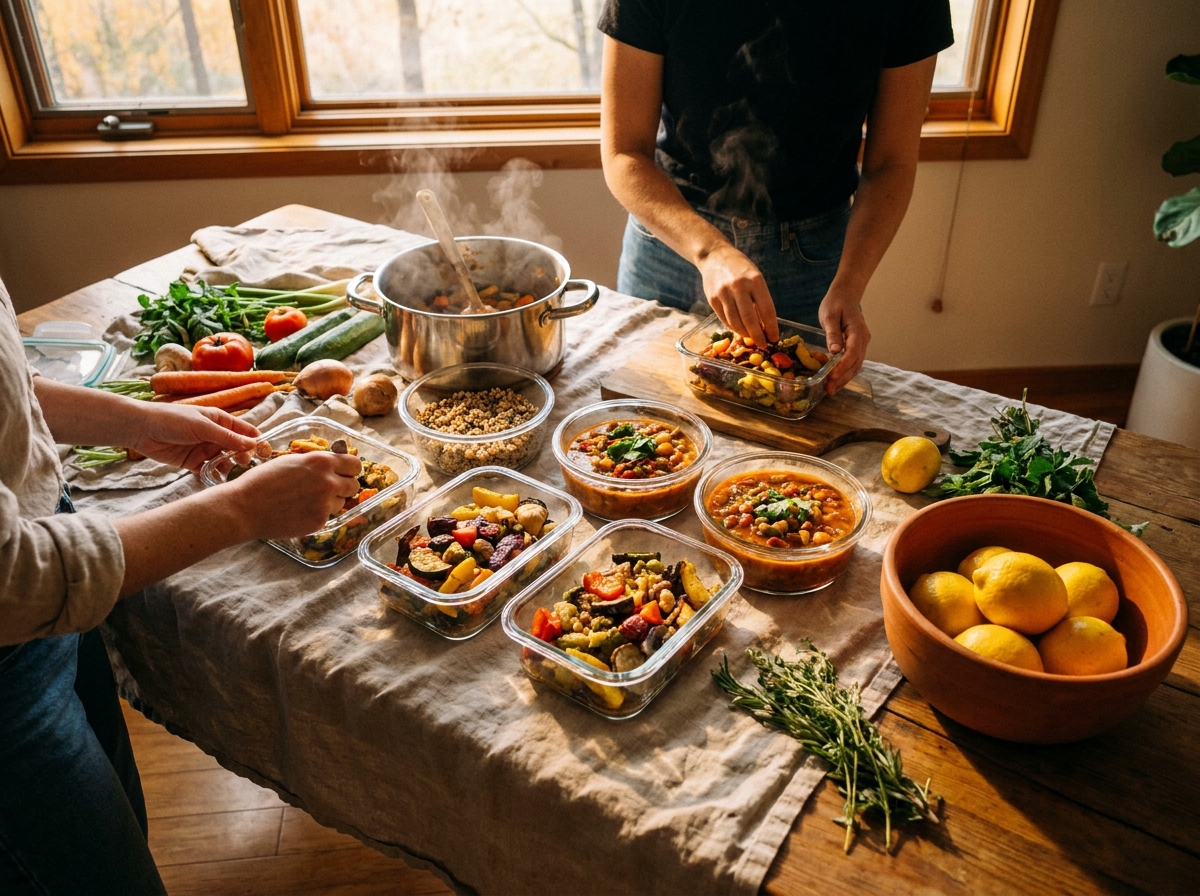
This session runs two oven batches and one stovetop simultaneously. Total active time: approximately 50 minutes. The other 40 minutes is the oven and stovetop running unattended.
0:00 — Oven to 425°F (220°C). Start pressing tofu (20 minutes passive).
Wrap 1 block extra-firm tofu in clean kitchen towels. Place under a heavy cast iron skillet or pot. Timer 20 minutes. The moisture that comes out is what was diluting the protein and preventing crispness.
0:00 — Brown rice on stovetop. Timer 40 minutes unattended.
1.5 cups dry brown rice + 3 cups water. Boil, cover, lowest heat. Do not lift the lid.
0:05 — Start red lentil dahl.
Half a diced onion in 1 tsp olive oil, 3 minutes. Add 3 garlic cloves minced + 1.5 tsp cumin + 1 tsp turmeric + 1 tsp smoked paprika, 1 minute. Add 1 cup dry red lentils + 1 can diced tomatoes + 3.5 cups water. Bring to boil, simmer uncovered 22–25 minutes. The lentils dissolve into a thick sauce. Season with salt, lemon juice, finish with 1 cup spinach stirred in. 5 servings.
0:20 — Cut pressed tofu into 1-inch cubes. Marinate and sheet-pan.
Toss tofu with 2 tbsp soy sauce + 1 tbsp sesame oil + 1 tbsp cornstarch + 1 tsp garlic powder. The cornstarch is the crispiness agent — do not omit. Spread on parchment-lined sheet pan. Separate pieces so they roast, not steam.
0:25 — Slice both tempeh blocks. Second sheet pan.
Slice 2 × 8oz blocks into ½-inch pieces. Toss with 3 tbsp soy sauce + 1 tbsp sesame oil + 1 tbsp rice vinegar + 2 tsp maple syrup + 1 tsp garlic powder. Sheet pan 2.
0:28 — Both sheet pans into oven.
Tofu: 26–28 minutes, flip once at 14 minutes. Tempeh: 20 minutes, flip once at 10 minutes. They finish within minutes of each other.
0:30 — Make 5 overnight oat jars.
Assembly line: 5 jars. Into each: ½ cup rolled oats + ¾ cup Greek yogurt + ½ cup milk + 1 tbsp chia seeds + 1 tbsp hemp seeds + 1 tsp honey. Stir each jar for 20 seconds. Seal. Refrigerate. 8 minutes total. $2.90 for all five.
0:48 — Tempeh out. Tofu 3–5 more minutes.
0:40 — Lentil dahl done. Rice done.
Cooked rice must be cooled quickly before refrigerating. B. cereus spores survive cooking and multiply rapidly when rice sits at room temperature between 40°F and 140°F (4°C and 60°C). Spread hot rice on a wide tray immediately — do not let it sit in the pot on the counter for 2–3 hours. Refrigerate within 2 hours of cooking. USDA FoodKeeper: cooked rice 4–6 days at 40°F (4°C).
1:00 — Hard-boil 8 eggs.
Cold start: eggs in cold water by 1 inch, bring to boil, 12 minutes, ice bath. In shell: 7 days refrigerated per USDA FoodKeeper. Peel only at eating time — peeled eggs lose moisture faster.
1:00 — Microwave edamame.
Frozen shelled edamame + 2 tbsp water, covered, 3 minutes. Salt. Cool. Store in bulk container — add to bowls throughout the week.
1:15 — Make tahini sauce.
3 tbsp tahini + juice of 1 lemon + 3 tbsp warm water + ½ tsp cumin + salt. Whisk until smooth — it will seize first, then loosen. Add water 1 tbsp at a time to reach desired consistency. Jar. Refrigerates 5 days.
1:20 — Spread everything to cool. 20 minutes before portioning.
Never seal hot food. Tofu and tempeh on separate surfaces. Lentil dahl in a wide bowl with lid off. Rice on a tray. Sealing hot food creates condensation, makes tofu soggy, and raises container temperature into the bacterial growth zone.
1:45 — Portion and label.
Tofu in one container. Tempeh in one container. Lentil dahl in 5 portions. Rice in one large container. Edamame bulk. Label everything with the date. Refrigerate at 40°F (4°C).
Three Batch Recipes — Full Instructions
Soy-Ginger Baked Tempeh (11g protein per 2oz serving)
Slice 2 × 8oz tempeh blocks into ½-inch pieces. Marinate in: 3 tbsp soy sauce or tamari + 1 tbsp sesame oil + 1 tbsp rice wine vinegar + 2 tsp maple syrup + 1 tsp garlic powder + 1 tsp fresh ginger grated. Toss to coat — let sit 10 minutes if time allows, longer is better but not required. Spread on parchment-lined sheet pan in a single layer. Bake 400°F (200°C) for 20 minutes, flip once at 10 minutes. Tempeh should be deep golden with caramelised edges.
Reheat method: dry skillet, medium heat, 2 minutes per side. Never microwave — it softens the exterior that makes day-4 tempeh genuinely good.
Storage: 4 days refrigerated per USDA FoodKeeper for cooked soy products. Freeze portions beyond day 4 — tempeh freezes well and thaws without texture loss.
Red Lentil Coconut Dahl (18g protein per 1.5 cups cooked)
In a large pot: heat 1 tbsp olive oil over medium heat. Add ½ diced onion, cook 4 minutes. Add 3 garlic cloves minced + 1.5 tsp cumin + 1 tsp turmeric + 1 tsp smoked paprika + ½ tsp coriander, cook 1 minute. Add 1 cup dry red lentils + 1 can (14.5oz) diced tomatoes + 1 can (13.5oz) full-fat coconut milk + 1.5 cups water. Bring to boil, reduce to simmer, cook 22 minutes uncovered — stir occasionally. Red lentils dissolve completely into a thick, creamy sauce. Add salt + juice of ½ lime. Stir in 2 cups fresh spinach, cook 2 minutes until wilted.
This dahl tastes better on day 3–4 than on day 1 as the spices deepen and the coconut milk integrates. Make it first in the Sunday session. Storage: 5 days refrigerated (USDA FoodKeeper cooked legume dishes).
Crispy Pressed Tofu (22g protein per 4oz serving)
Press 1 block extra-firm tofu (14oz) for 20 minutes minimum under a heavy pan. Cut into 1-inch cubes. In a bowl: toss with 2 tbsp soy sauce + 1 tbsp sesame oil + 1 tbsp cornstarch + 1 tsp garlic powder + 1 tsp smoked paprika. The cornstarch coats each cube and crisps the exterior at high heat — skip it and tofu stays soft. Spread on parchment-lined sheet pan with space between each piece. Bake 400°F (200°C) for 26–28 minutes, flipping once at 14 minutes. Tofu should be deep golden and firm throughout.
Reheat: dry skillet only, 2 minutes per side. Microwave makes tofu rubbery and eliminates the texture that makes this recipe worth making. Storage: 4 days refrigerated (USDA FoodKeeper cooked tofu).
Weekly Grocery List (~$42)
All prices are 2026 Walmart estimates. Mainstream grocery stores run 15–20% higher on most items.
- Tempeh, 2 × 8oz packages — $5.98
- Extra-firm tofu, 1 block (14oz) — $2.49
- Eggs, 12-count — $3.49
- Greek yogurt, plain 0%, 32oz — $4.48
- Cottage cheese, 1%, 16oz — $2.49
- Dried red lentils, 1 lb — $2.19
- Frozen edamame, shelled, 12oz — $2.28
- Canned full-fat coconut milk, 13.5oz — $1.89
- Canned diced tomatoes, 14.5oz — $0.88
- Brown rice, 5 lb bag (amortised) — $0.65/week
- Rolled oats, 42oz (amortised) — $0.95/week
- Fresh spinach, 5oz bag — $2.49
- Frozen broccoli, 32oz — $2.18
- Tahini, 16oz (amortised) — $1.20/week
- Hemp seeds, 12oz (amortised) — $1.85/week
- Chia seeds (amortised) — $0.60/week
- Soy sauce, sesame oil, rice vinegar, maple syrup, cornstarch (amortised) — $1.20/week
- Lemons, 3-pack — $1.99
- Garlic, 3-head bag (amortised) — $0.35/week
- Onion (amortised) — $0.25/week
Total weekly perishables: $30–$34. Total including amortised pantry items: $38–$42.
Tempeh at $5.98 for two blocks is the biggest single weekly cost. It's worth it — 11g protein per 2oz serving from a whole food is hard to match. But if the budget is tight in a given week, replace one block of tempeh with an extra pound of lentils ($2.19) and an additional 6 eggs ($1.50). You maintain the protein target at significantly lower cost, just with less variety.
Are Vegetarian Proteins Complete Proteins?
Most plant proteins are "incomplete" — they're missing one or more essential amino acids in sufficient quantities for the body to use them efficiently. This is technically true for most legumes and grains individually. It is not a practical problem in most vegetarian diets for two reasons.
First, amino acid complementation happens across the day, not within a single meal. Lentils (low in methionine, adequate in lysine) combined with rice or oats across the day (adequate in methionine, low in lysine) produces a complete amino acid profile. You don't need to eat them together — just eat both within the same day.
Second, eggs and Greek yogurt are complete proteins. If your vegetarian day includes these — which this plan does, daily — the amino acid gaps from plant proteins are covered. The completeness question is resolved at the breakfast and snack level before you've eaten a gram of tempeh or lentils.
For strict vegans removing eggs and dairy: quinoa (the only complete-protein grain), hemp seeds (complete amino acid profile), and a combination of lentils + rice covers the essential amino acids when eaten across the same day. The system is slightly more deliberate but equally achievable.
For the broader vegetarian meal prep system — including the budget approach, the full 5-day plan, and how to scale this for two people — see the vegetarian meal prep guide. For comparison with the meat-based high protein approach using the same weekly cost, see the high protein meal prep guide.
FAQ
How do vegetarians actually hit 100g protein daily?
Three anchors: Greek yogurt overnight oats at breakfast (35–38g), a lentil and tempeh lunch (30–34g), and a tofu or tempeh dinner (28–32g), plus 2 hard-boiled eggs as a snack (12g). Total: 105–116g protein daily from four eating occasions. The single highest-impact change for most vegetarian diets is replacing a milk-only oat base with a Greek yogurt base — it adds 21g protein to breakfast at minimal cost.
Is tempeh or tofu better for vegetarian meal prep?
Tempeh for protein density and meal prep longevity. Tempeh has 19g protein per 100g raw vs tofu's 8g per 100g raw. Tempeh also holds texture better after 4 days refrigerated and reheats well in a dry skillet. Tofu requires pressing (non-negotiable for texture and protein concentration) and skillet reheating only — never microwave. Both belong in a rotation; tempeh provides protein density, tofu provides variety and a different flavour profile.
How long does vegetarian meal prep last in the fridge?
Per USDA FoodKeeper: baked tempeh 4 days, baked tofu 4 days, cooked lentil dahl 5 days, cooked brown rice 4–6 days, overnight oats 5 days, hard-boiled eggs in shell 7 days. Eat tempeh and tofu Monday through Wednesday for best texture, rely on lentil dahl and eggs Thursday and Friday when the dahl flavour has deepened and the plant proteins are at their best.
What is the best complete plant protein for meal prep?
Quinoa is the only grain that is a complete protein (8g per cup cooked). Hemp seeds are complete at 31g per 100g — the highest-density plant protein available. Among fermented soy products, tempeh is near-complete and the most practical meal prep protein due to its density and texture. For fully plant-based vegetarians: quinoa as the grain base and hemp seeds as a daily topper covers the complete amino acid profile alongside lentils and tempeh.
How much does vegetarian high protein meal prep cost per week?
$38–$42 for a full week covering all meals for one person, hitting 105–120g protein daily. That breaks down to approximately $0.23–$0.28 per gram of protein — significantly cheaper than the equivalent meat-based plan ($0.10–$0.13/g for chicken, but the total weekly cost is comparable or higher when you account for the volume of chicken needed). The vegetarian version costs less at equal protein targets because lentils, eggs, and Greek yogurt are among the cheapest protein-per-dollar foods available.